6 Reasons Rexburg Drivers Should Check Their Engine Air Filter Before They Trust It – Used-Car Clues, Winter Hisses, and the Dashboard Reminder That Cannot See Dust
Location: Rexburg, ID Topic: Grease Monkey Center #658 By: Phil Gilliam
An Authoritative Guide for Engine Air Filter Care in a College Town Ringed by Potato Fields
Grease Monkey, 582 North 2nd East, Rexburg, ID 83440. Has Over 2,550 Google Reviews With A 4.7 Star Rating.
A Note on Authority and Expertise: This article was researched and written by Phillip Paul Gilliam, a veteran journalist and former Editor-in-Chief with more than 50 years of publishing experience in automotive, trucking, and safety communications.
A long career in automotive publishing has taught one lesson that applies to every engine air filter question: the part looks simple, so the myths multiply. This guide sorts the useful from the merely repeated. Its answers draw on Consumer Reports' used-car guidance, a peer-reviewed review of how intake dust wears engines, filtration research from engineers at Cummins Filtration, efficiency data published by Donaldson, factory maintenance guidance from Honda and Toyota, and the U.S. Department of Energy's guidance on hybrid and electric vehicle upkeep. Where a common belief does not hold up, this guide says so directly.
The shop at 582 North 2nd East is Grease Monkey Center #658, managed by Alonzo Padilla and operated by Threshold Automotive as part of the FullSpeed Automotive family [1]. Grease Monkey has been in the business since 1978 and is headquartered in Denver [2]. FullSpeed reported more than 900 franchised and company-owned locations nationwide in July 2026 [3]; when the company changed hands in 2020 it was already described as the fourth largest quick lube operator in the country, with company-owned centers servicing nearly two million vehicles a year [4]. CARFAX named 435 FullSpeed service centers 2025 Top Shop winners [5].
Rexburg makes the engine air filter a more interesting part than most places do. The city sits at 4,865 feet and is surrounded by grain, hay, and potato ground, with three potato processing plants running most of the year [6]. Brigham Young University-Idaho estimated that about 22,000 students were living in Rexburg in fall 2025 [7], which means a constant churn of used cars, first-time car owners, and cross-country drives home. Winters are long, with about 55 inches of snow a year and January lows averaging around 13 degrees Fahrenheit [8]. Each of those facts changes how an engine air filter should be judged here.
An Introduction to Engine Air Filters on North 2nd East and Across Madison County
On any weekday afternoon on North 2nd East, the traffic tells the story of Rexburg. A student's hand-me-down sedan with Utah plates. A farm pickup with field dust caked on the fenders. A hybrid that somebody's parents bought for the drive to campus. A minivan headed toward Highway 20 and the Tetons. Every one of them breathes through an engine air filter, and the owners of most of them have never actually looked at it.
That is understandable. The engine air filter is cheap, out of sight, and surrounded by folk wisdom: hold it up to the light, trust the dashboard reminder, buy the fancy one, or ignore it because the car is a hybrid. Some of that advice is fine. Some of it is wrong in ways that cost real money, especially in a town where a lot of drivers are buying their first used car or learning maintenance for the first time.
This guide answers six questions Rexburg drivers actually ask about the engine air filter, ordered from the one with the most money on the line to the one that is simply good to know. Each answer opens with a short, plain reply, then explains the engineering, the research behind it, and what it means on campus streets, farm roads, and winter mornings in Madison County.
Most of these questions can be settled in the time it takes to open an air box. The crew at Grease Monkey on North 2nd East checks the engine air filter as part of the 16-point inspection that comes with every oil change, and the shop also performs pre-purchase inspections on used vehicles [1]. Here is what to look for, and what it means.
Buying a used car from a graduating student? Check the engine air filter… it can tell you a whole lot about how the car has been serviced.
1. Buying a Used Car From a Graduating Student? Open the Air Box and Let the Engine Air Filter Talk
What can the engine air filter tell me about a used car before I buy it in Rexburg?
Quick Answer: More than most buyers expect. An engine air filter that is black, packed with debris, the wrong size, or missing suggests long-skipped maintenance, and dust or sand on the clean side of the housing is a warning that dirt may have reached the engine. It is one quick clue to pair with a full pre-purchase inspection.
Rexburg has one of the busiest used-car rhythms in Idaho. With roughly 22,000 students living in town during the school year [7], cars change hands every semester, often between people who are new to owning one. A seller who is graduating and moving away may be honest and still have no idea when the car was last serviced. That is where the engine air filter becomes useful. It is one of the few maintenance items a buyer can inspect in two minutes without tools, and it keeps a surprisingly honest record.
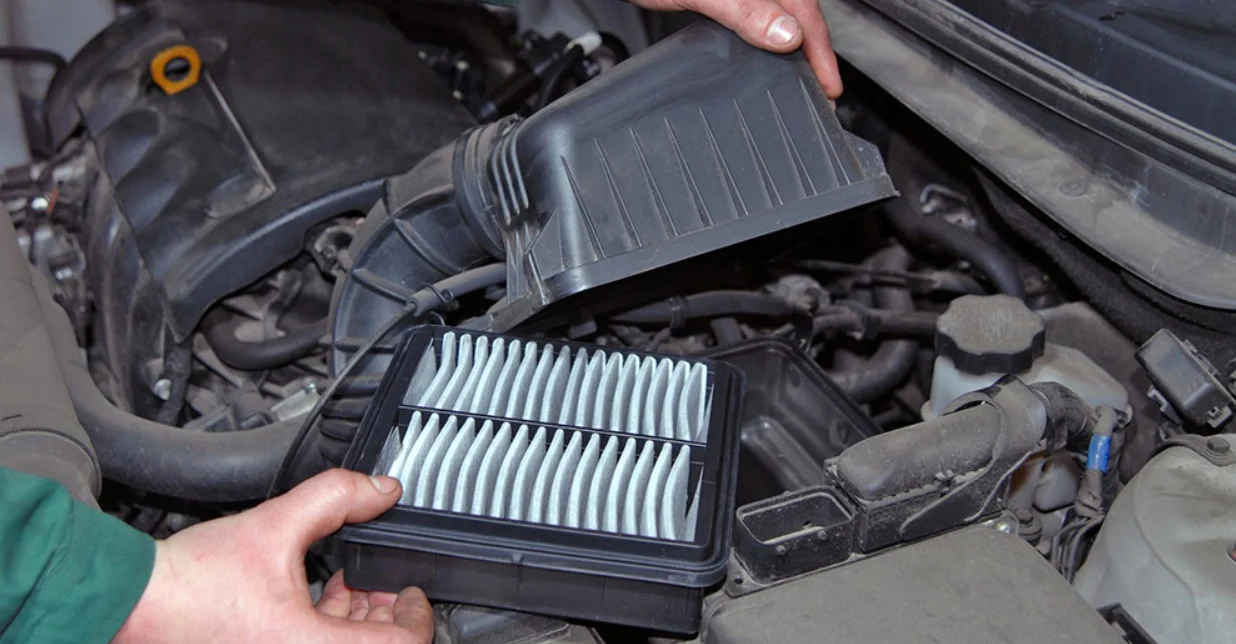
Start by unlatching the air box and lifting out the engine air filter. A filter that is gray or tan with pleats still visible has been changed in a reasonable time. One that is solid black, matted, full of leaves, seeds, or insects, or crumbling at the edges has probably been ignored for a long time, and the oil, coolant, and transmission fluid may have been ignored with it. A missing engine air filter, a filter that clearly does not fit the housing, or a lid that will not latch is worse, because it means the engine may have been breathing unfiltered air.
Then look at the clean side – the inside of the housing and the duct that leads toward the engine. That area should be clean. Fine dust or sand there means dirt got past the engine air filter at some point. Laboratories that analyze used engine oil treat silicon, the main marker of dust, as a red flag when it rises along with wear metals, because it points to dirt entering through a defective air cleaner or a damaged intake path [9]. For a buyer, dust on the clean side is a reason to ask more questions or to have an oil analysis done before paying.
The engine air filter is only one clue, and it should not be the only test. Consumer Reports recommends having any used car inspected before purchase by a qualified mechanic who routinely performs diagnostics, noting that a thorough diagnosis typically costs around $120 [10]. Its guidance also flags black smoke from the tailpipe as a symptom worth investigating, with a dirty engine air filter among the possible causes alongside sensor problems [10]. A mechanic can put the engine air filter clue in context with compression, fluid condition, codes, and leaks.
If you are the seller, the same logic works in reverse. A fresh engine air filter, a clean air box, and a receipt in the glove box tell the next owner that the car was cared for, and that can be worth more at sale time than the filter costs.
Before you hand over cash for that semester-end bargain, let the engine air filter testify. Bring the car to Grease Monkey, 582 North 2nd East, Rexburg, ID, for a pre-purchase inspection and find out what it has really been breathing: https://www.greasemonkey.com/locations/id/rexburg/582-north-2nd-east/.
2. A Hiss Near the Air Box on a 13-Degree Rexburg Morning Can Mean Air Is Sneaking Around Your Engine Air Filter
Why do I hear a whistling or hissing sound near my engine air filter housing, and is it serious?
Quick Answer: It can be. A hiss or whistle near the engine air filter housing or intake tube often means air is leaking in through a cracked intake boot, a loose clamp, or a lid that is not sealed. That air skips the engine air filter and the airflow sensor, which can cause rough running, warning lights, and engine wear.
Between the engine air filter and the engine, most modern cars have a sealed path: the filter housing, a mass airflow sensor that measures every bit of incoming air, and a flexible rubber or plastic intake boot that carries that air to the throttle body. The whole system depends on one rule. Every molecule of air that reaches the engine is supposed to pass through the engine air filter first and the airflow sensor second.
When a boot cracks or a clamp loosens, the engine starts pulling air through the gap. Mechanic Vlad Samarin’s diagnostic guidance describes what follows: air entering through a cracked or ripped intake boot is unmetered, so the airflow sensor reports less air than the engine is actually getting, and a leak of this kind can show up as a hissing sound under the hood at idle [11]. The engine computer then fuels for the wrong amount of air, which can bring rough idle, hesitation, and a check engine light. The same guidance adds that when such a problem begins right after an engine air filter change, the filter installation and the airflow sensor should be the first things checked [11].
There is a second cost that does not set a warning light. Air that slips in through a crack between the engine air filter and the engine is not filtered at all. A 2022 review of engine wear research found that the hard mineral dust most responsible for abrasive wear is in the 5 to 20 micrometer range, far smaller than a crack in a rubber boot [12]. An engine air filter can be brand new and still be protecting nothing if the path after it is leaking.
Rexburg winters make these leaks more likely. January lows here average around 13 degrees Fahrenheit [8], and rubber intake boots that have been through a few dozen of those mornings get stiff, and older ones crack along their folds. Student mechanics changing an engine air filter in a cold parking lot are also more likely to pinch a boot, miss a clip, or leave a hose clamp half-tightened. None of those mistakes is unusual. All of them are easy to find if someone listens and looks.
If you hear a new whistle or hiss from the front of the engine, especially at idle or right after someone worked on the engine air filter, do not wait for the check engine light. Have the housing, boot, and clamps inspected. The fix is often a few minutes and an inexpensive part.
If your engine is whistling, it is trying to tell you something. Let the crew at Grease Monkey, 582 North 2nd East, Rexburg, ID, track down the leak and make sure every breath goes through your engine air filter the way it should: https://www.greasemonkey.com/locations/id/rexburg/582-north-2nd-east/.
3. Why Holding Your Engine Air Filter Up to a Dorm-Room Lamp Can Fool You
Can I tell if my engine air filter needs replacing by holding it up to the light or by how dirty it looks?
Quick Answer: Not reliably. Engine air filter media is dense enough that the light test proves little, and a dark, dusty-looking engine air filter often still has useful life because the dust layer actually helps it filter. Airflow restriction and a side-by-side comparison with a new engine air filter are better guides.
The light test is one of the most repeated pieces of car advice on the internet: hold the engine air filter up to a bright light, and if light shines through, it is fine. The trouble is that the test measures the wrong thing. A pleated engine air filter is a mat of fibers, and a standard cellulose fiber is about 20 micrometers across [13]. The dust that matters most is close to that size or smaller. How much light passes through tells you very little about how much air can pass through, and nothing about how well the remaining media is trapping fine dust.
Appearance misleads in the other direction too. Filter makers test engine air filters under a standard called ISO 5011, feeding a known amount of test dust into the filter until its airflow restriction reaches end of life, then weighing what got through. By that measure, Donaldson reports that its cellulose filters exceed 99.9 percent overall efficiency [14]. Just as important, Donaldson notes that efficiency improves as dust builds up on the filter surface, so an engine air filter actually gets better at filtering with use, up to the point where restriction becomes too high [14]. Engineers at Cummins Filtration describe the same effect: cellulose media reaches high efficiency once a dust cake forms on its surface [13].
That is why Donaldson’s guidance is to let restriction, not appearance, decide when an engine air filter is replaced [14]. A filter that looks dirty may have plenty of life left, and replacing it early throws away its best-performing stage. A filter that looks fairly clean on its face can still be loaded deep in the pleats with fine dust, and a light test will not reveal that either.
Rexburg makes looks especially deceptive. Harvest season around the city’s potato, grain, and hay ground puts fine soil in the air [6], and an engine air filter can turn brown quickly while still flowing well. A car that sat through a winter of short campus trips can have an engine air filter that looks clean but is old, brittle, or water-stained.
A technician’s check is more useful than either test. It compares the filter against a new one of the same part number, looks at how deep the dust sits in the pleats, checks for clumps, debris, or damp spots, checks the rubber seal, and, on vehicles that have one, reads the restriction indicator. That combination tells you whether the engine air filter is done or just hard-working.
Skip the lamp test and get a real answer. Grease Monkey, 582 North 2nd East, Rexburg, ID, will set your engine air filter next to a new one and show you honestly whether it is worn out or just doing its job: https://www.greasemonkey.com/locations/id/rexburg/582-north-2nd-east/.
If your car could talk, it would say, “Oh boy… where are you taking me now!!!”
4. Your Dashboard Says the Engine Air Filter Is Fine – But It Has Never Seen a Madison County Gravel Road
My car’s maintenance reminder says the engine air filter is due (or not due yet). Should I trust it?
Quick Answer: Treat it as a starting point. Most maintenance reminders estimate engine air filter life from mileage, time, and engine operating data, but they cannot see dust. Honda, for example, tells owners who drive in dusty conditions to replace the engine air filter every 15,000 miles no matter what the reminder says.
Many newer vehicles, especially the Hondas, Toyotas, and other commuter cars that fill campus parking lots, display maintenance reminders that tell drivers when service is due. Honda’s Maintenance Minder is a good example. It shows a main code for oil service and numbered sub-items for other work, and sub-item 2 includes replacing the engine air filter, which Honda calls the air cleaner element [15].
These systems are useful, but it helps to know what they measure. Honda describes its system as monitoring engine operating conditions to decide when maintenance is due [15]. That means it is calculating, not inspecting. Most passenger cars do not have a sensor inside the air box that measures how loaded the engine air filter actually is, so the reminder has no way to know whether the last 3,000 miles were on clean pavement or on dusty farm roads.
The manufacturers know it. Alongside the Maintenance Minder, Honda tells owners that if they mainly drive in dusty conditions, they should replace the air cleaner element every 15,000 miles [15]. In other words, the reminder is the schedule for average driving, and the owner is expected to adjust for conditions the computer cannot see. Most other automakers handle it the same way, with a separate severe or dusty-condition schedule in the owner’s manual.
A lot of Rexburg driving belongs on that dusty schedule for part of the year. Students who work on farms, families who live on gravel county roads, drivers who head out on unpaved roads toward the sand dunes or the mountains, and anyone following farm equipment during harvest are all loading their engine air filter faster than a mileage-based estimate assumes. On the other hand, a student who drives only paved campus streets may find the reminder is right on time.
Two habits make the reminder far more useful. First, have the engine air filter looked at whenever the hood is up for an oil change, and let what it actually looks like override the dashboard when the two disagree. Second, make sure the reminder is reset correctly after the engine air filter is replaced, so the next countdown starts from the right place.
Your car’s computer can count miles, but it cannot see dust. Let Grease Monkey, 582 North 2nd East, Rexburg, ID, check the engine air filter the reminder is guessing about and reset the countdown when it is time: https://www.greasemonkey.com/locations/id/rexburg/582-north-2nd-east/.
5. Paper or Nanofiber? Picking an Engine Air Filter That Can Keep Up With Rexburg’s Field Dust
Are synthetic or nanofiber engine air filters better than standard paper engine air filters?
Quick Answer: They can be better at specific jobs. Nanofiber layers on an engine air filter catch fine dust at the surface, which can raise efficiency and dust-holding capacity, but a quality cellulose engine air filter already stops more than 99 percent of dust. For most cars, correct fit and a good seal matter more than media type.
Most engine air filters in passenger cars use cellulose media, a paper-like mat of wood fibers, sometimes blended with synthetic fibers. Premium and heavy-duty filters increasingly add a very thin layer of nanofibers on the surface. The difference in scale is striking. Engineers at Cummins Filtration reported nanofibers in the range of 40 to 800 nanometers, roughly 130 times finer than typical cellulose fibers, and a nanofiber with about 100 times more surface area per gram than a 20-micrometer cellulose fiber [13].
Finer fibers catch fine dust more easily. The same paper cites research showing that filtering with 1-micrometer fibers instead of 50-micrometer fibers can improve efficiency by a factor of about 2,000 [13]. In practice, a nanofiber layer catches more of the fine dust right at the surface instead of letting it work deep into the media, which helps the engine air filter hold more dust before its restriction climbs too high, and the researchers found that a uniform nanofiber layer produced a uniform dust cake and high efficiency [13].
The numbers on the box can be confusing, so it helps to see them side by side. Donaldson, which makes both types, lists its standard heavy-duty media at up to 99.9 percent efficiency, its nanofiber Ultra-Web media at up to 99.99 percent, and its Ultra-Web HD at up to 99.999 percent, while noting that typical will-fit standard media can be closer to 99.0 percent [14]. Those differences sound small, but each step represents roughly ten times less dirt passing through. The gap matters most on engines that swallow huge volumes of dusty air for long hours, such as farm trucks and heavy equipment.
For a typical car or small SUV in Rexburg, the right engine air filter is one that matches the factory specification, fits the housing exactly, and seals all the way around. A premium nanofiber engine air filter can be a sensible upgrade for vehicles that live on gravel roads, run farm errands through harvest, or simply rack up high mileage in dust. It is not a fix for a cracked housing, a missing clip, or an engine air filter left in far past its life.
One caution: synthetic and nanofiber media should not be confused with oiled cotton performance filters, which use a different approach and different maintenance. Ask which type is being installed and why.
6. Driving a Hybrid to Campus? Its Engine Air Filter Still Needs Attention, Even When the Engine Is Asleep
Do hybrids and plug-in hybrids have an engine air filter, and how often does it need to be changed?
Quick Answer: Yes. Every hybrid and plug-in hybrid has a gasoline engine, so it has an engine air filter that needs service much like a conventional car’s. Only fully electric vehicles have no engine air filter. Follow the maker’s schedule, and have the engine air filter checked for age and debris even if the engine runs less.
Hybrids have become a common sight around BYU-Idaho, and plenty of their owners assume that a car that runs partly on electricity needs less engine maintenance. The U.S. Department of Energy says otherwise: because hybrids and plug-in hybrids have internal combustion engines, their maintenance requirements are similar to those of conventional vehicles [16]. Only all-electric vehicles drop the engine-related items, with fewer fluids such as engine oil to maintain [16]. That means a hybrid’s engine air filter still matters, and an all-electric car has a cabin air filter but no engine air filter at all.
Automakers schedule it accordingly. Toyota’s maintenance schedule for the Prius, the best-known hybrid on the road, calls for replacing the engine air filter at 30,000-mile intervals, while the cabin air filter is replaced every 10,000 miles [17]. Those intervals assume average conditions. A Prius that spends its weekends on dusty roads needs its engine air filter checked sooner.
Hybrids add a wrinkle. Because the gasoline engine shuts off in town and at low speeds, a hybrid’s engine air filter may see less air per mile than a conventional car’s. That is good news for dust loading, but it does not stop time. The filter still ages, the rubber seal still hardens, and moisture and debris can still collect in the air box. A plug-in hybrid driven mostly on battery power may go months with its engine barely running, which makes an inspection by age and condition more useful than an inspection by mileage alone.
Rexburg’s winter changes the picture again. With January lows around 13 degrees Fahrenheit [8], many hybrids run their gasoline engines more often in cold weather to warm the engine and help heat the cabin. A hybrid that seems to run mostly on electricity in September can be leaning on its engine, and its engine air filter, much harder by January.
The practical rule is simple. If the car has a gasoline engine, it has an engine air filter, and it deserves the same look at every oil change that any other car gets. If the car is fully electric, the filter to ask about is the cabin air filter, not the engine air filter.
Hybrid or not, if it burns gas, it breathes through a filter. Bring yours to Grease Monkey, 582 North 2nd East, Rexburg, ID, and let the team make sure the engine air filter is ready for the next cold start: https://www.greasemonkey.com/locations/id/rexburg/582-north-2nd-east/.
About Grease Monkey, 582 North 2nd East, Rexburg, ID 83440
Grease Monkey Center #658 keeps longer weekday hours than most quick lubes in the area: Monday through Friday from 7:00 AM to 7:00 PM and Saturday from 8:00 AM to 5:00 PM, closed Sunday. Appointments can be scheduled online, walk-ins are welcome, and the shop can be reached at (208) 369-9318. Manager Alonzo Padilla leads the team [1].
The service menu covers conventional, synthetic, European-formula, and Royal Purple premium oil changes, each with a 16-point inspection and a mid-service fluid check and vacuum, along with engine, cabin, and fuel filter replacement, tune-ups, tire services, wheel balancing, serpentine belts, radiator and transfer case service, wipers, pre-purchase inspections, and fleet services for 3 vehicles to 3,000. Services are backed by a limited warranty of three months or 3,000 miles [1].
The shop caters to the student schedule with quick service between classes and offers discounts for students, seniors, military, first responders, and law enforcement. The lobby has free Wi-Fi, cable TV, a coffee station, refreshments, and a view into the service bay. Drivers have given this North 2nd East location a 4.7-star rating across more than 2,550 Google reviews [1].
Author Information
Author Bio – Phillip Paul Gilliam
Phillip Gilliam is a veteran journalist and former Editor-in-Chief with 50+ years of publishing experience and thousands of published articles. Specializing in automotive, trucking, and digital publishing, he creates authoritative, search-optimized content built on real-world expertise and editorial excellence. To learn more about Phil, visit http://www.phillipgilliam.com/about.html or contact Phil at [email protected]. He would love to hear from you!
Full Citation List
[1] Grease Monkey. Oil Change & Auto Repair, 582 North 2nd East, Rexburg, ID. Grease Monkey. Available at: https://www.greasemonkey.com/locations/id/rexburg/582-north-2nd-east/. (Center #658; manager Alonzo Padilla; operated by Threshold Automotive dba Grease Monkey, part of the FullSpeed Automotive family; address, phone, hours, services including engine filter replacement and pre-purchase inspections, 16-point inspection, BYU-Idaho student service and discounts, fleet program, 3-month/3,000-mile limited warranty; current Google rating of 4.7 stars from 2,558 reviews, checked October 10, 2026.)
[6] Rexburg Area Chamber of Commerce. Rexburg City Information. Available at: https://rexburgchamber.org/rexburg-city-information/. (Elevation of 4,865 feet; agriculture is the major industry, with grain, hay, and potatoes the chief crops; three potato processing plants operate nine to ten months a year.)
[8] U.S. Climate Data. Climate Rexburg – Idaho. usclimatedata.com. Available at: https://usclimatedata.com/climate/rexburg/idaho/united-states/usid0215. (1991-2020 normals: about 55 inches of annual snowfall, 13.36 inches of precipitation, and January highs near 29 and lows near 13 degrees Fahrenheit.)
[9] Machinery Lubrication. High Silicon in Engine Oil Analysis. Noria Corporation. Available at: https://www.machinerylubrication.com/Read/89/silicon-engine-oil. (Silicon is the main dust indicator in oil analysis; rising silicon with wear metals points to airborne dust entering through a defective air cleaner or damaged induction system.)
[10] Linkov, J. How to Avoid Buying a Lemon When Shopping for a Used Car, SUV, or Truck. Consumer Reports, updated July 12, 2026. Available at: https://www.consumerreports.org/used-cars/how-to-avoid-buying-a-lemon-car/. (Have a used vehicle inspected before purchase by a qualified mechanic who routinely performs diagnostics, at around $120 for a thorough diagnosis; black tailpipe smoke can point to a dirty air filter, a faulty oxygen sensor, or a defective mass airflow meter.)
[11] Samarin, V. P0101 – Mass Air Flow Sensor Circuit Range/Performance. Samarins.com. Available at: https://www.samarins.com/diagnose/p0101.html. (A cracked, ripped, or disconnected intake boot lets unmetered air bypass the airflow sensor; a vacuum leak can cause hissing at idle; if the problem began soon after an air filter replacement, check the filter installation and airflow sensor.)
[12] Dziubak, T., and Dziubak, S.D. A Study on the Effect of Inlet Air Pollution on the Engine Component Wear and Operation. Energies 15(3), 1182, 2022. Available at: https://www.mdpi.com/1996-1073/15/3/1182. (Hard mineral dust grains of about 5-20 micrometers most often cause abrasive engine wear.)
[13] Jaroszczyk, T., Fallon, S.L., and Schwartz, S.W., Cummins Filtration. Development of High Dust Capacity, High Efficiency Engine Air Filter with Nanofibers. Journal of KONES Powertrain and Transport 15(3), 2008. Available at: https://yadda.icm.edu.pl/baztech/element/bwmeta1.element.baztech-article-BUJ5-0034-0026/c/httpwww_bg_utp_edu_plartjok32008jo20kones20200820no20320vol201520jaroszczyk.pdf. (Nanofibers of 40-800 nm versus about 20-micrometer cellulose fibers, a diameter ratio of about 1:130; a 200 nm nanofiber has about 20 m2/g of surface area versus 0.2 m2/g for 20-micrometer cellulose; 1-micrometer fibers versus 50-micrometer fibers raise efficiency by a factor of about 2,000; cellulose reaches high efficiency once a dust cake forms; uniform nanofiber layers produce a uniform dust cake.)
[14] Donaldson Company. How Well Does an Engine Air Filter Clean Incoming Dirty Air? Air Filter Efficiency Explained. Donaldson technical article. Available at: https://www.donaldson.com/en/resources/technical-articles/air-filter-efficiency-explained/. (ISO 5011 testing feeds test dust until end-of-life restriction and measures what passes; Donaldson cellulose filters exceed 99.90 percent overall efficiency; standard media up to 99.9 percent, Ultra-Web up to 99.99 percent, Ultra-Web HD up to 99.999 percent, will-fit standard media up to 99.0 percent; efficiency improves as dust builds on the filter; restriction, not appearance, should determine replacement.)
[15] Buerkle Honda. A Guide to Honda's Maintenance Minder Codes. Buerkle Honda, September 23, 2020. Available at: https://www.buerklehonda.com/a-guide-to-hondas-maintenance-minder-codes/. (Maintenance Minder sub-item 2 covers the air cleaner element; the system monitors engine operating conditions to determine when maintenance is due; if you mainly drive in dusty conditions, replace the air cleaner element every 15,000 miles.)
[16] U.S. Department of Energy, Alternative Fuels Data Center. Maintenance and Safety of Electric Vehicles. Available at: https://afdc.energy.gov/vehicles/electric-maintenance. (Because hybrids and plug-in hybrids have internal combustion engines, their maintenance requirements are similar to conventional vehicles; all-electric vehicles have fewer moving parts and fewer fluids, such as engine oil, that require regular maintenance.)
[17] AutoNation Parts. Toyota Prius Maintenance Schedule. AutoNation. Available at: https://www.autonationparts.com/toyota-prius-maintenance-schedule. (Engine air filter replacement at 30,000, 60,000, 90,000, and 120,000 miles; cabin air filter replacement every 10,000 miles.)
We use cookies to improve your browsing experience on our website. By closing this banner or interacting with our site, you acknowledge and agree to our privacy policy.