6 Reasons to Give Your Engine Air Filter a Hard Look in Pocatello's Truck Country – Turbos, Snow-Packed Intakes, and the Rubber Valve Nobody Checks on West Quinn Road
Location: Pocatello, ID Topic: Grease Monkey Center #544 By: Phil Gilliam
An Authoritative Guide for Engine Air Filter Care Where Pocatello Meets Chubbuck and the Interstates Cross
Grease Monkey, 710 West Quinn Rd, Pocatello, ID 83201. Has Over 2,230 Google Reviews With A 4.6 Star Rating.
A Note on Authority and Expertise: This article was researched and written by Phillip Paul Gilliam, a veteran journalist and former Editor-in-Chief with more than 50 years of publishing experience in automotive, trucking, and safety communications.
Half a century of covering trucks and the people who run them teaches a writer to respect two kinds of evidence: the engineering test and the fleet invoice. This guide leans on both. Its answers are built on turbocharger failure guidance published by Cummins Turbo Technologies, technical bulletins from filtration manufacturer Donaldson, an automaker service bulletin, and a national laboratory study that measured what clogged engine air filters actually do to three modern turbo-diesel vehicles. Where the evidence says a popular worry is overblown, the article says so.
The shop on West Quinn Road is Grease Monkey Center #544, operated locally by Threshold Automotive as part of the FullSpeed Automotive family [1]. FullSpeed reported more than 900 franchised and company-owned locations in January 2026, and its Grease Monkey brand alone counts more than 460 centers across the United States, China, Colombia, Mexico, and Saudi Arabia [2]. Grease Monkey was named to Entrepreneur's Franchise 500 in 2025 for the ninth year in a row and holds a VetFran 5-Star rating [2], and CARFAX recognized 435 FullSpeed Automotive service centers as 2025 Top Shop winners [3]. The brand has been changing oil since 1978 [4].
The store's own page puts it plainly: Pocatello is truck country [1]. This end of town sits where Pocatello runs into Chubbuck, a short drive from the junction of Interstates 15 and 86, and the vehicles that roll into these bays skew toward diesel pickups, turbocharged half-tons, work trucks, and fleet units. The city sits at 4,462 feet [1], picks up about 44 inches of snow in an average winter [5], and spends much of the rest of the year dry and dusty. Those conditions put the engine air filter, and the parts around it, under a kind of stress that a generic maintenance schedule was never written for.
An Introduction to Engine Air Filters on West Quinn Road and the North End of the Portneuf Valley
Drive West Quinn Road on a weekday morning and count the pickups. Some are hauling tools to a jobsite, some are pulling stock trailers, some carry a company logo on the door, and more than a few have a turbocharger whistling under the hood. Every one of them breathes through an engine air filter, and on a lot of them the filter is only the most visible part of an air intake system that also includes a dust-dumping valve, a restriction gauge, sometimes a second safety element, and the turbo itself.
That is what makes this end of Pocatello different. On a commuter sedan, an engine air filter question is usually simple: is it dirty, and should it be replaced? On a diesel pickup or a medium-duty work truck, the questions multiply. What happens to a turbo spinning at hundreds of thousands of revolutions per minute when dust gets past the filter? What is that second filter inside the big canister, and why does the manual say never to clean it? Why did the truck lose power on I-86 in a snowstorm with a nearly new engine air filter? What does the restriction gauge really measure? And for a business running a fleet, what does skipping a two-minute engine air filter check actually cost?
This guide answers six of those questions, starting with the one where the most money is at stake and working toward the ones that quietly save it. Each begins with a short, direct answer, then walks through the engineering, the research, and what it looks like on Highway 91, on the interstates, and in the gravel yards and farm lanes around the north end of the valley.
The good news is that every one of these problems can be caught with the hood up and the air box open. The technicians at Grease Monkey on West Quinn Road check the engine air filter during the 16-point inspection that comes with every oil change, and the shop offers a dedicated diesel oil change with the heavy-duty filters and higher oil capacities that trucks require [1]. Here is what to know before you pull in.
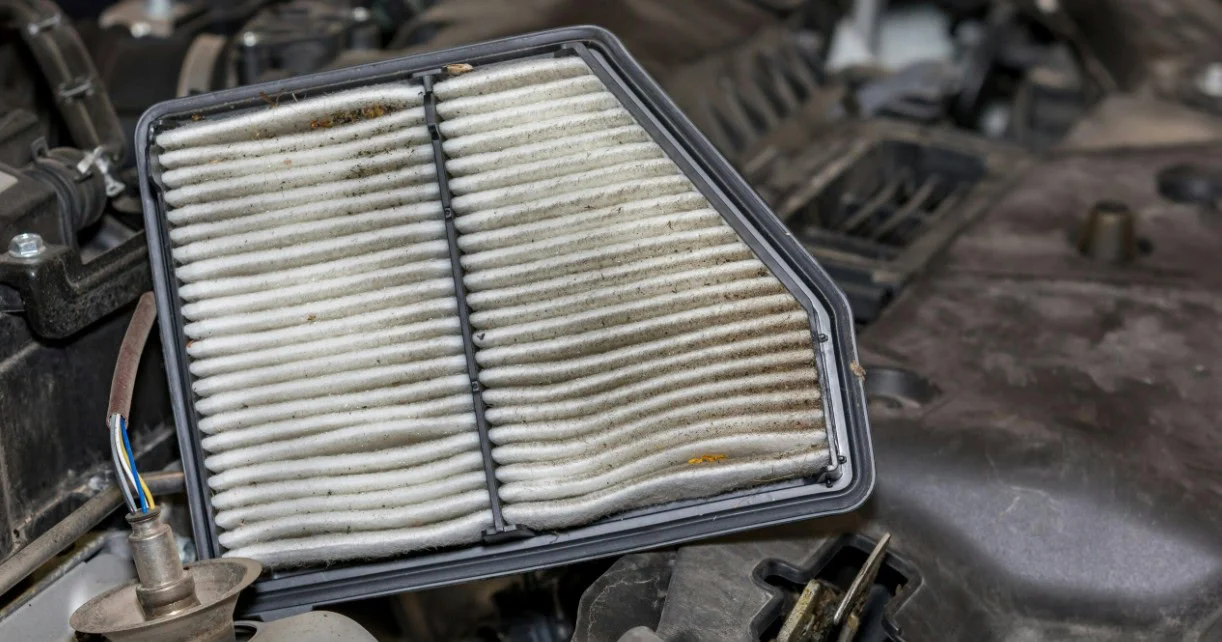
You spend a lot of money to keep your engine running properly. Don’t let a dust-clogged air filter mess you up!
1. Your Turbo Can Spin 250,000 Times a Minute – What Happens When Dust Slips Past the Engine Air Filter?
Can a torn or poorly sealed engine air filter damage the turbocharger on my diesel or turbo gas truck?
Quick Answer: Yes. The turbocharger’s compressor wheel sits directly downstream of the engine air filter and spins at extremely high speed, so any dust or debris that gets past a torn, missing, or badly sealed engine air filter strikes its blades first, chipping and eroding them until the turbo loses boost or fails.
A turbocharger is two fans on one shaft. Exhaust gas spins the turbine on one side, and the compressor wheel on the other side packs fresh air into the engine. That compressor wheel draws its air straight from the engine air filter, and it turns at speeds that are hard to picture: industry guidance from turbocharger specialist Nissens puts turbo speeds at up to 250,000 revolutions per minute [6]. At that speed, the tips of the compressor blades are moving at hundreds of miles per hour, and a grain of sand hitting a blade edge behaves less like dust and more like shrapnel.
The damage is well documented. Cummins Turbo Technologies, which builds Holset turbochargers for diesel engines, warns in its failure diagnosis guidance that foreign material entering the compressor causes impact damage that is clearly visible on the impeller, and that a turbo with damaged blades should never be kept in service, because blade damage throws the rotor out of balance [7]. The same guidance lists a dirty air cleaner and intake restriction among the causes of excess smoke and lack of power [7]. Turbo rebuilders describe what dust and debris leave behind: nicks along the leading edges of the blades, rough or bent tips, and missing metal. Those nicks unbalance the rotating assembly, load the bearings, and can eventually let the wheel touch its housing, which turns a slow decline into a sudden failure [8].
Here is the part that surprises many truck owners. The engine air filter does not have to be clogged to cause this. A loaded engine air filter mostly costs power. It is a torn engine air filter, one that is missing its gasket, one that sits crooked in the housing, or a cracked intake boot or loose clamp between the engine air filter and the turbo that lets unfiltered air in. Rebuilders point to exactly those places – the air filter, the intake boots, the clamps, and the upstream piping – as the first things to check when a compressor wheel shows debris damage [8].
Pocatello’s truck country gives that unfiltered air plenty to carry. Gravel yards, farm lanes, construction sites, and unpaved pull-outs along the interstates all put coarse grit in the air, and work trucks spend their days in it. A diesel pickup that idles in a dusty yard with a mis-seated engine air filter is sandblasting one of the most expensive parts under the hood.
The defense costs almost nothing. Every time the engine air filter is serviced, the technician should confirm the gasket is intact, the element is the correct part number and fills the housing, the lid is latched evenly, and the ducts and clamps between the engine air filter and the turbo are tight and crack-free. If a turbo has started to whistle, smoke, or lose boost, the condition of the engine air filter and intake path is part of the diagnosis, not an afterthought.
A two-minute seal check beats a new turbo. Roll your truck into Grease Monkey, 710 West Quinn Rd, Pocatello, ID, and have the crew make sure every bit of air reaching that compressor wheel has been through a properly sealed engine air filter first: https://www.greasemonkey.com/locations/id/pocatello/710-west-quinn-rd/.
2. The Second Filter Hiding Inside Your Work Truck’s Air Cleaner, and Why It Should Almost Never Come Out
What is the small inner filter inside my truck’s engine air filter housing, and do I need to change it every time?
Quick Answer: It is a safety element, a backup inside the primary engine air filter on many heavy-duty air cleaners. It protects the engine during primary service or if the primary engine air filter fails. Never clean it; Donaldson recommends replacing it once for every two to four primary changes.
Open the air cleaner on a medium-duty truck, a farm truck, or a piece of construction equipment and pull out the big primary engine air filter, and you will often find a second, slimmer element still seated inside. That is the safety filter. Filtration manufacturer Donaldson, whose air cleaners are common on heavy-duty equipment, explains that it is not a second stage of filtering that cleans the air further, and it does not improve overall filtration efficiency. It is an insurance policy [9].
It has two jobs. First, it stays in place while the primary engine air filter is being serviced, so the dust knocked loose inside a partly loaded housing cannot fall straight into the clean air outlet that leads to the engine. Second, it is the last line of defense if the primary engine air filter was damaged in shipping, handling, or installation [9]. Because it is meant to catch only what slips past a failure, its media is more open than the primary element’s and its surface area is small, so it plugs quickly once engine-damaging dust reaches it [9].
That design leads to three rules that are easy to get wrong. Never clean or reuse a safety element. Never run the engine with only the safety element in place. And do not replace it every time the primary engine air filter is replaced; Donaldson puts the best ratio at one safety element for every two to four primary elements [9]. Changing it too often is not just a waste of money. Every time the safety element comes out, the clean side of the housing is exposed to whatever dust is in the air at that moment, which is exactly what the safety element exists to prevent.
The most useful thing a safety element does is tell the truth. If a technician pulls the primary engine air filter and finds dust on the safety element, Donaldson’s guidance is to replace the safety element and find out how the dust got past the primary filter [9]. That clue usually points to a torn primary element, a damaged gasket, a cracked housing, or a primary engine air filter that was not seated properly – problems that would otherwise go unnoticed until the oil analysis or the turbo said so.
Around Pocatello, the trucks most likely to carry a safety element are the ones that work hardest in the dust: dump trucks and service bodies running between gravel yards and jobsites, farm trucks hauling to and from the fields west of town, and fleet units that log long days on gravel roads. For those owners, knowing whether the safety element is there, when it was last changed, and what it looked like at the last service is part of protecting a very expensive engine.
Your safety element keeps a secret about every dusty mile. Let Grease Monkey, 710 West Quinn Rd, Pocatello, ID, pull the primary engine air filter, read what the safety element is saying, and put the right one back only when it is actually due: https://www.greasemonkey.com/locations/id/pocatello/710-west-quinn-rd/.
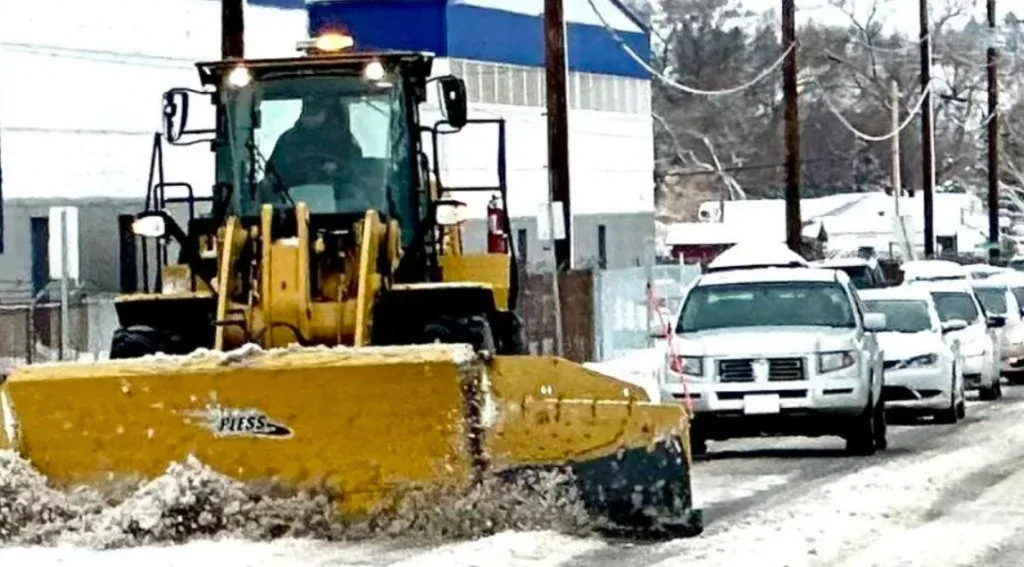
Pocatello can experience snowstorms that can affect your vehicle’s engine air filter.
3. Lost Power in your vehicle in a Snowstorm With a Nearly New Engine Air Filter? Blame the Snow, Not the Filter
Can blowing snow clog my engine air filter and make my truck lose power or set a check engine light?
Quick Answer: Yes. Fine, wind-driven snow can be pulled into the air intake and pack against the engine air filter, choking airflow and costing power. When it melts after shutdown, the water can soak the engine air filter or reach the airflow sensor on restart, which can set a check engine light.
Most people picture the engine air filter fighting dust, but in a Pocatello winter it also fights snow. Dry, powdery snow behaves a lot like dust when the wind is moving it. Many vehicles draw intake air from behind the grille or from an opening near the front fender, and in a ground blizzard or behind a semi on the interstate, that opening can inhale a steady stream of fine snow. The snow piles up on the face of the engine air filter, where it packs and can freeze, and the airflow through the filter drops the same way it would if the engine air filter were clogged with dirt.
Automakers have written service bulletins about exactly this. In one technical service bulletin, Mitsubishi described vehicles that set a Service Engine Soon light with stored trouble codes and reduced engine performance after being driven in heavy snow. The cause was snow entering the air intake and collecting on the engine air filter element. After the engine was shut off, the snow melted and pooled in the bottom of the air cleaner, and on the next start that water was drawn through the airflow sensor, pushing the engine into a failsafe mode. The fix was to cut a small drain into the air cleaner body so the meltwater could escape, and the bulletin noted the condition cleared once the element dried [10].
That sequence explains a lot of winter mysteries. A truck that runs fine in town, loses power on the interstate in blowing snow, and then starts rough the next morning may not have a failing engine at all. It may have an engine air filter that spent the trip packed with snow and the night sitting in meltwater. A paper engine air filter that has been soaked and refrozen can also swell, warp, or pull away from its seal, and once that happens it is no longer protecting the engine from dust in the spring.
Pocatello sees plenty of the conditions that cause it. The city averages about 44 inches of snow a winter [5], and when a storm comes through with wind behind it, the interstates around town turn difficult fast. During a March 2024 storm, Idaho State Police asked truck drivers to chain up on I-86 and I-15 near Pocatello as crews responded to multiple slide-offs and crashes [11]. Those are the same stretches where a pickup running behind a tractor-trailer can swallow a surprising amount of snow.
Some air cleaners are built with an answer, such as a drain like the one Mitsubishi added [10] or the dust-and-water valve described in reason five below. For everyone else, the practical habits are simple. After a long drive in blowing snow, pop the hood and look at the air box. If the engine air filter is wet, packed, or crumpled, let it dry out and have it inspected before assuming it is fine. And if a check engine light shows up the morning after a snowy trip, mention the drive when you have the codes read.
Winter on the interstates is hard enough without an intake full of slush. Swing by Grease Monkey, 710 West Quinn Rd, Pocatello, ID, after the next big storm and let the crew make sure your engine air filter came through it dry, flat, and sealed: https://www.greasemonkey.com/locations/id/pocatello/710-west-quinn-rd/.
4. The Little Gauge on Your Diesel’s Air Box Knows More Than Your Fuel Mileage Does
How do I know when the engine air filter on my diesel pickup really needs changing, and can I just watch my fuel mileage?
Quick Answer: Use the engine air filter restriction indicator, not fuel mileage. Testing on modern turbo-diesels found that even a badly clogged engine air filter caused no measurable fuel economy loss, while the indicator measures the actual airflow restriction across the filter and signals when it reaches the replacement limit.
A lot of drivers believe a dirty engine air filter will show up at the fuel pump. On a modern diesel, it usually will not. Researchers at Oak Ridge National Laboratory tested three late-model turbocharged diesel vehicles – a 2007 Dodge Ram 2500 with the 6.7-liter engine, a 2009 Volkswagen Jetta TDI, and a 2009 BMW 335d – with clean, clogged, and severely clogged engine air filters. Fuel economy showed no measurable decline on any of them, even with the engine air filter restricted well beyond the normal replacement point [12]. The reason is that a diesel runs with little or no throttling. It always pulls in as much air as it can and controls power with fuel, so a partly restricted engine air filter barely changes the work the engine does at normal loads [12].
That does not mean restriction is harmless. The same study found the two sedans accelerated measurably slower at wide-open throttle with a clogged engine air filter [12], which is exactly the condition a loaded pickup climbing out of the valley lives in. It also means fuel mileage cannot be trusted as a warning light. A diesel can be breathing through a nearly plugged engine air filter while the trip computer reports business as usual.
That is the job of the restriction indicator. Many diesel pickups and most medium- and heavy-duty trucks carry a small gauge or pop-up indicator on the air box or intake tube, sometimes called a filter minder. It measures the vacuum the engine creates pulling air through the engine air filter. As dust loads the media, that vacuum rises. The Oak Ridge researchers noted that the Ram’s factory indicator was set at about 3.6 kilopascals of restriction, roughly 14 inches of water, and that typical industry indicators trip somewhere between 5 and 7 kilopascals, roughly 20 to 28 inches of water [12].
Reading one correctly takes a little care. Most indicators latch at the highest restriction they have seen, so the reading reflects the last hard pull, not idle. A reading in the green means the engine air filter still has capacity, even if it looks dark. A reading in the red means replace it, even if it looks fairly clean, because fine dust can load the media deep in the pleats where you cannot see it. After the new engine air filter is installed, the indicator has to be reset, usually by pressing a button on its end, or it will keep reporting the old filter’s restriction. The study’s authors also noted that changing an engine air filter more often than the manufacturer recommends is of little or no value for most drivers [12], which is one more reason to trust the gauge over the calendar.
For Pocatello diesel owners, the habit is easy: glance at the restriction indicator every time the hood is up, and ask the technician to read and reset it at every oil change. Trucks without an indicator rely on visual inspection and the severe-service schedule in the owner’s manual.
Let the gauge do the guessing. Bring your diesel to Grease Monkey, 710 West Quinn Rd, Pocatello, ID, where the crew will read your engine air filter restriction indicator, explain what it says, and reset it the right way when a new filter goes in: https://www.greasemonkey.com/locations/id/pocatello/710-west-quinn-rd/.
5. The Rubber Duckbill Under the Air Cleaner That Can Make an Engine Air Filter Last Up to Six Times Longer
What is the rubber valve on the bottom of my truck’s engine air filter housing, and what happens if it is cracked or missing?
Quick Answer: It is a dust-and-water ejection valve, often called a Vacuator valve, on two-stage air cleaners. It dumps the heavy dust the housing spins out before it reaches the engine air filter. If it is cracked or missing, Donaldson says the engine air filter may need changing six to eight times as often.
Look underneath the round air cleaner housing on many medium-duty trucks, farm trucks, and diesel equipment and you will find a small, wedge-shaped rubber flap pointing down, a little like a duck’s bill. It is easy to ignore, easy to tear off with a pressure washer, and easy to forget during maintenance. It also does a surprising amount of the work of keeping the engine air filter clean.
Those housings are two-stage air cleaners. Before the air ever reaches the engine air filter, vanes inside the housing spin it, and the heavier particles are thrown outward by centrifugal force into a dust cup or collection area. The rubber valve, which Donaldson calls a Vacuator valve, is how that dust gets out. At idle, the pulsing of the intake makes the valve flutter open and closed and spit out dust or water. When the engine shuts off, the lack of vacuum lets it ease open and drain. Under higher speed and load, the stronger vacuum holds it closed [13].
When the valve is cracked, hardened, or missing, the system works backward. Air can be drawn in through the open tube from the wrong direction, which disrupts the spinning pre-cleaning action, and the dust that should have been ejected builds up inside the housing. The engine air filter then has to catch everything by itself. The engine is still protected, because the engine air filter is still doing its job, but the filter’s life collapses. Donaldson notes that in medium-duty two-stage housings, a missing valve can mean engine air filter changes six to eight times more often [13].
That makes a few dollars of rubber one of the best returns on investment under the hood. Donaldson’s guidance is to inspect the valve regularly for cracks, hardening, and wear, confirm it is present, and replace it at any sign of damage [13]. A technician should also squeeze it open to make sure it is not plugged with packed mud or dust, and check that it points downward as designed.
Around the north end of Pocatello, the trucks that carry these housings tend to be the ones working in the worst air: contractors in and out of gravel pits, ag trucks in the fields during harvest, and fleet units that live on dirt roads. Those are also the operators who feel it most when an engine air filter that should last a season starts plugging in a few weeks. Before blaming the filter brand, look at the rubber valve under the housing.
Small rubber, big savings. Ask the team at Grease Monkey, 710 West Quinn Rd, Pocatello, ID, to check the dust valve along with your engine air filter, so your truck’s air cleaner can throw out the dirt before your filter has to catch it: https://www.greasemonkey.com/locations/id/pocatello/710-west-quinn-rd/.
A quick, two-minute check of your truck’s engine air filter can make a huge difference in your wallet!
6. Running a Fleet Out of Pocatello? Do the Math on a Two-Minute Engine Air Filter Check
For a business fleet, is it worth having the engine air filter checked at every service, or is that just extra cost?
Quick Answer: It is worth it. An engine air filter check takes minutes during a routine service and a replacement costs little, while one unplanned breakdown can cost a fleet hundreds of dollars a day in lost revenue, plus towing and repair. Dust-related engine and turbo damage is preventable downtime.
Fleet managers live with a simple truth: a vehicle that is not running is not earning. Penske Truck Leasing, working from American Transportation Research Institute figures, estimated that a truckload unit loses about $637 in revenue for every day it sits, and that three days of unplanned downtime cost close to $2,000 in lost revenue alone [14]. That is before towing, roadside service, emergency repairs, rental or backup equipment, rerouted loads, and the driver frustration that leads to turnover, costs that Penske says can exceed the revenue loss itself [14].
Now set that against the engine air filter. For most fleet vehicles, checking it means opening the air box during a service that is already happening. Replacing it is one of the least expensive items on the maintenance list. The failures it prevents are among the most expensive: dust-damaged turbo compressor wheels, as described in reason one above; dust-worn engines; a plugged safety element that starves a heavy truck of air; and the slow loss of pulling power that turns a loaded climb into a crawl. A fleet does not need many avoided breakdowns to pay for years of engine air filter checks.
The real risk for fleets is not cost but consistency. A company with a dozen vehicles running different routes – one on paved city streets, one on gravel to a jobsite, one towing every day – cannot service all of them on one engine air filter schedule. The dusty units need more frequent attention, and the highway units may not. That requires two things: someone looking at each engine air filter at every service, and records that show what they found.
That is where the location’s fleet program fits. Grease Monkey on West Quinn Road serves fleets of anywhere from 3 to 3,000 vehicles, with no appointment needed, centralized billing, monthly invoices, and maintenance record keeping, and its fleet customers can use the same program across the FullSpeed Automotive network [1]. For a Pocatello contractor whose trucks also run to Idaho Falls or Twin Falls, that means an engine air filter history that follows the vehicle instead of living on scattered receipts.
The best fleet habit is to build the engine air filter into the routine instead of treating it as an upsell. Ask for the restriction reading on trucks that have an indicator, ask to see the filter on the ones that work in dust, and keep the results with the vehicle file. Over a season, those records show which routes eat engine air filters, which drivers need a reminder about intake seals and lid clips, and which vehicles are overdue before they leave someone stranded on I-15.
Downtime is the most expensive part you will never order. Put your fleet on a smarter engine air filter routine with Grease Monkey, 710 West Quinn Rd, Pocatello, ID, and keep every truck earning instead of waiting on a tow: https://www.greasemonkey.com/locations/id/pocatello/710-west-quinn-rd/.
About Grease Monkey, 710 West Quinn Rd, Pocatello, ID 83201
Grease Monkey Center #544 is open Monday through Friday from 7:00 AM to 6:00 PM and Saturday from 8:00 AM to 5:00 PM, and is closed Sunday. Walk-ins are welcome, online appointments are available, and the shop can be reached at (208) 789-2468 [1].
The menu is built for the trucks this part of town drives. Alongside conventional and synthetic oil changes, the shop offers a dedicated diesel oil change with heavy-duty filters and the higher oil capacities diesel engines require, transfer case service, and engine, cabin, and fuel filter replacement. It also handles brakes, tires and wheel balancing, batteries, A/C, radiator and fluid exchanges, serpentine belts, headlights, wipers, tune-ups, pre-purchase inspections, windshield replacement and rock chip repair, and a complimentary car wash [1].
Every oil change includes a 16-point inspection and a mid-service fluid check and vacuum. The lobby offers cable TV, free Wi-Fi, a coffee station, refreshments, outdoor seating, and a window into the service bay, and the shop offers discounts for first responders, law enforcement, military, seniors, and students. Drivers have given this West Quinn Road location a 4.6-star rating across more than 2,230 Google reviews [1].
Author Information
Author Bio – Phillip Paul Gilliam
Phillip Gilliam is a veteran journalist and former Editor-in-Chief with 50+ years of publishing experience and thousands of published articles. Specializing in automotive, trucking, and digital publishing, he creates authoritative, search-optimized content built on real-world expertise and editorial excellence. To learn more about Phil, visit http://www.phillipgilliam.com/about.html or contact Phil at [email protected]. He would love to hear from you!
Full Citation List
[1] Grease Monkey. Oil Change & Auto Repair, 710 West Quinn Rd, Pocatello, ID. Grease Monkey. Available at: https://www.greasemonkey.com/locations/id/pocatello/710-west-quinn-rd/. (Center #544 operated by Threshold Automotive dba Grease Monkey, part of the FullSpeed Automotive family; address, phone, hours, walk-ins welcome; 'Pocatello is truck country'; dedicated diesel oil change with heavy-duty filters; engine, cabin, and fuel filter replacement; 16-point inspection; elevation of 4,462 feet; fleet program for 3 to 3,000 vehicles with centralized billing and record keeping across 700+ FullSpeed locations; current Google rating of 4.6 stars from 2,238 reviews, checked October 10, 2026.)
[2] International Franchise Association. FullSpeed Automotive Accelerates Growth in Record Franchise Development Year, Sets Bold Vision for 2026. franchise.org, January 26, 2026. Available at: https://www.franchise.org/2026/01/fullspeed-automotive-accelerates-growth-in-record-franchise-development-year-sets-bold-vision-for-2026/. (More than 900 franchised and company-owned FullSpeed locations; Grease Monkey has more than 460 centers in the U.S., China, Colombia, Mexico, and Saudi Arabia; Grease Monkey on the 2025 Franchise 500 for the ninth consecutive year; VetFran 5-Star rating.)
[6] Newstead, K. Foreign Object Damage to the Turbocharger. Professional Motor Mechanic, with guidance from Nissens, March 13, 2020. Available at: https://pmmonline.co.uk/technical/foreign-object-damage-to-the-turbocharger/. (Turbochargers run at up to 250,000 rpm; worn or defective air filters and damaged intake piping let particles reach the compressor, causing chipped blades, lost efficiency and performance, and in severe cases total turbo failure.)
[7] Cummins Turbo Technologies. Turbocharger Failure Diagnosis Guidelines (Bulletin 5544148). Cummins Inc. Available at: https://www.cummins.com/sites/default/files/2019-04/5544148_0718.pdf. (Foreign material entering the compressor causes impact damage clearly visible on the impeller; never operate a turbocharger with damaged blades because rotor balance is affected; a dirty air cleaner and intake restriction are listed causes of excess smoke and lack of power.)
[8] The Diesel Store. Compressor Wheel Damage Explained. thedieselstore.com. Available at: https://www.thedieselstore.com/blog/compressor-wheel-damage-explained. (Debris leaves nicks along compressor blade leading edges, bent tips, and missing metal; a poorly sealed air filter, cracked intake boots, and loose clamps let debris reach the wheel; nicks unbalance the rotor, stress bearings, and can lead to housing contact and turbo failure.)
[9] Donaldson Company. Why Safety Filters Matter for Engine Protection. Donaldson technical article. Available at: https://www.donaldson.com/en/resources/technical-articles/importance-of-safety-filters/. (Safety elements protect the clean air outlet during primary service and act as a last line of defense if the primary is damaged; they do not improve overall efficiency; small media area and more open media; never clean or reuse; never run on the safety element alone; best change ratio is 1:2 to 1:4; dust on the safety element calls for replacement and root cause analysis.)
[10] Mitsubishi Motors North America. Technical Service Bulletin TSB-13-13-008: MIL Illumination With DTCs P061A/P1235 or P0068/P1241. November 2013. NHTSA. Available at: https://static.nhtsa.gov/odi/tsbs/2013/SB-10054444-8096.pdf. (After driving in heavy snow, snow entering the air intake collected on the air filter element, melted after shutdown, pooled in the air cleaner body, and was drawn through the air flow sensor on restart, setting the warning light and reducing performance; correction adds a drain to the air cleaner body.)
[11] Eaton, N. Truck Drivers Asked to Use Chains in Pocatello Area, Multiple Crashes Reported on Local Roads. East Idaho News, March 2, 2024. Available at: https://www.eastidahonews.com/?p=654455. (Idaho State Police asked truck drivers to use chains on I-86 and I-15 near Pocatello during heavy snowfall, with multiple slide-offs and crashes reported.)
[12] Thomas, J.F., West, B.H., and Huff, S.P., Oak Ridge National Laboratory. Effect of Air Filter Condition on Diesel Vehicle Fuel Economy. SAE Technical Paper 2013-01-0311, 2013. Available at: https://www.fueleconomy.gov/feg/pdfs/2013-01-0311_Diesel_AirFilter.pdf. (Tested a 2007 Dodge Ram 2500 6.7L, 2009 VW Jetta TDI, and 2009 BMW 335d; no measurable fuel economy decline from clogged filters; diesels operate with little or no throttling; the Jetta and BMW lost some wide-open-throttle acceleration; the Ram's factory restriction indicator was set at about 3.6 kPa and typical industry indicators at 5.0 to 7.0 kPa; changing filters more often than recommended is of little or no value to most drivers.)
[13] Donaldson Company. Vacuator Valves Automatically Expel Dust and Water. Donaldson technical article. Available at: https://www.donaldson.com/en/resources/technical-articles/vacuator-valves-automatically-expel-dust-water/. (The valve on two-stage air cleaners flutters open at idle and opens at shutdown to expel dust and water, and is held closed by vacuum at higher speed and load; a damaged or missing valve disrupts pre-cleaning and can mean 6-8 times more frequent filter changes in medium-duty housings; inspect for cracks, hardening, and wear and replace if damaged.)
[14] Penske Truck Leasing. Understanding the True Cost of Downtime for Fleets. Penske, April 23, 2026. Available at: https://www.pensketruckleasing.com/resources/resource-library/cost-of-downtime/. (About $637 per truck per day in lost truckload revenue, based on ATRI's 2024 average of $4,457 weekly revenue per truck; three days of unplanned downtime cost close to $2,000 in revenue; added costs include towing, roadside service, emergency repairs, replacement equipment, and driver turnover.)
We use cookies to improve your browsing experience on our website. By closing this banner or interacting with our site, you acknowledge and agree to our privacy policy.