6 Reasons Your Engine Air Filter Works Harder on Yellowstone Avenue in Pocatello, Idaho – Dry Benches, Desert Cloudbursts, and the Long Pull Out of the Valley
Location: Pocatello, ID Topic: Grease Monkey Center #28 By: Phil Gilliam
An Authoritative Guide for Engine Air Filter Care in the Portneuf Valley’s Gate City
Grease Monkey, 1055 Yellowstone Ave, Pocatello, ID 83201. Has Over 1,380 Google Reviews With A 4.7 Star Rating.
A Note on Authority and Expertise: This article was researched and written by Phillip Paul Gilliam, a veteran journalist and former Editor-in-Chief with more than 50 years of publishing experience in automotive, trucking, and safety communications.
Fifty years of editing automotive and safety copy leaves one rule standing above the rest: a claim about your engine has to survive a check against the source. Every number in this guide was traced to a named study, agency, or manufacturer document, including Oak Ridge National Laboratory’s controlled tests of clogged engine air filters, a 2022 peer-reviewed review of how intake dust wears engine parts, and current federal and local records for Pocatello itself. Where the research is limited or a popular belief does not hold up, this guide says so plainly instead of rounding it up into advice.
This store operates as Grease Monkey Center #28 on Yellowstone Avenue [1]. Grease Monkey was founded in 1978 and is headquartered in Denver [2], and today it is one of the flagship brands of FullSpeed Automotive, which reported more than 900 franchised and company-owned locations nationwide in July 2026 [3]. CARFAX named 435 FullSpeed Automotive service centers 2025 Top Shop winners [4], and when the company changed hands in 2020 it was already described as the fourth largest quick lube operator in the United States, with its company-owned locations servicing nearly two million vehicles a year [5]. That network puts a neighborhood shop on Yellowstone Avenue behind one of the largest quick lube operators in the country.
Pocatello sits at 4,462 feet [6] and averages only about 12 inches of precipitation a year [7], so the soil around it stays dry, loose, and ready to ride the wind for most of the driving season. Yellowstone Avenue itself is US-91, a main thoroughfare with high daily traffic [8], and it feeds directly into the I-15 and I-86 corridors that carry local drivers toward farm country, reservoirs, and mountain recreation. Dust on the benches, sudden summer cloudbursts, and long loaded climbs out of the valley all land on one part that most drivers never see: the engine air filter.
An Introduction to Engine Air Filters on Yellowstone Avenue and Across the Portneuf Valley
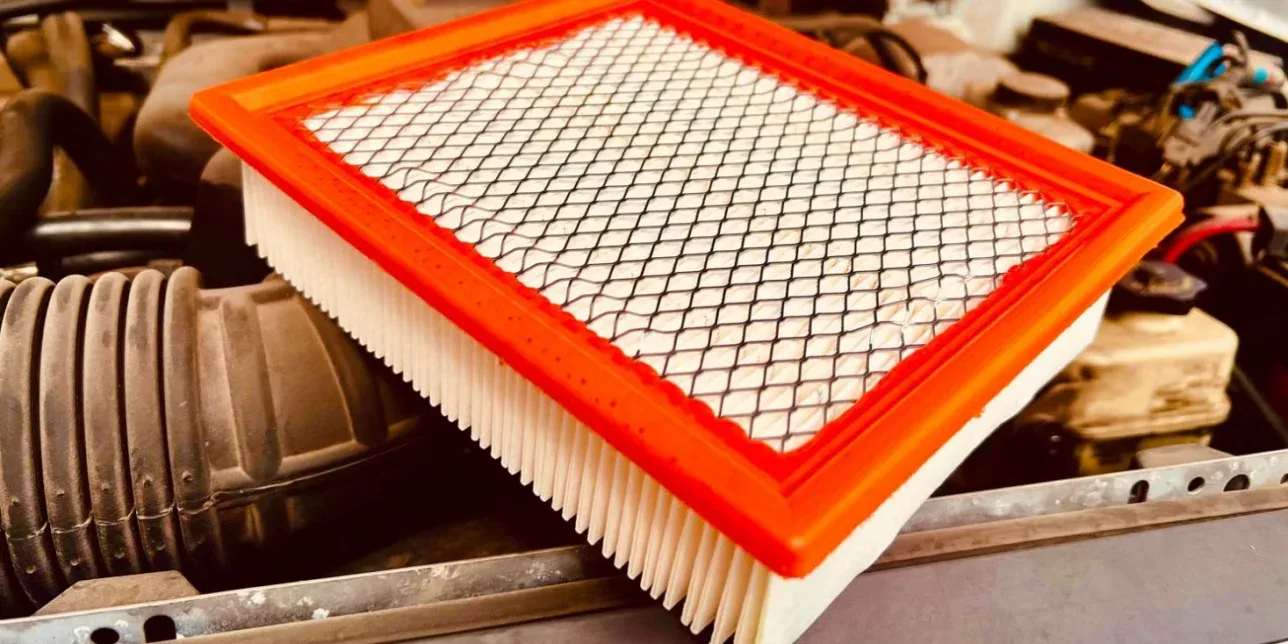
Every gallon of gasoline your engine burns needs roughly 9,000 gallons of air at sea level to go with it, and even more at Pocatello’s altitude, where the air is thinner. Every bit of that air passes through one folded panel of filter media under the hood. In most of the country that is an easy job. In Pocatello it is a working job. The benches above town are dry sagebrush ground, the valley floor sees only about 12 inches of rain and snowmelt a year [7], and the wind that funnels through the Portneuf Gap picks up whatever the last dry week left behind.
That is why the engine air filter deserves more attention here than a sticker interval gives it. A good engine air filter catches nearly all of the dust that reaches it [9], but the small share that escapes, or the dust that slips around a bad seal, is exactly the fine, hard mineral grit that wears an engine from the inside [10]. And the engine air filter has other jobs local drivers rarely think about: it is the first thing water reaches when a car pushes through a flooded underpass, it is where oil shows up when the crankcase ventilation system is in trouble, it is the bottleneck that decides how much pulling power is left when you tow a camper out of the valley, and it is the part people are most tempted to clean with an air hose instead of replace.
This guide takes on six real questions Pocatello drivers ask about the engine air filter, ordered from the one with the most at stake for your engine to the one that matters most on a specific kind of trip. Each answer starts with a short, direct reply and then explains the mechanism, the research behind it, and what it looks like on Yellowstone Avenue, on the benches, and on the highways that leave town.
None of it requires guesswork. An engine air filter can be pulled, inspected, and judged in a couple of minutes, and the team at Grease Monkey on Yellowstone Avenue looks at it as part of the 16-point inspection that comes with every oil change [1]. What follows will help you understand what they are looking for, and what it means for your engine.
Your car is your pride and joy. Don’t let the dusty roads in the Pocatello region clog up your engine air filter.!
1. Can Dust That Slips Past Your Engine Air Filter on Yellowstone Avenue Teach Your Engine to Burn Oil?
If dust gets past my engine air filter, can it really make my engine start burning oil?
Quick Answer: Yes. A clogged engine air filter will not cause it, but a torn, missing, or badly sealed engine air filter lets fine dust into the cylinders, where it wears piston rings and cylinder walls. Worn rings let oil slip into the combustion chamber, and oil consumption climbs over time.
The engine air filter is the only barrier between the outside air and the inside of your cylinders, and a quality engine air filter in good condition removes about 99 percent of the dust that reaches it [9]. That sounds like a solved problem until you look at what the dust is made of. Road and soil dust is mostly hard minerals, chiefly silica and alumina, and a 2022 review of engine wear research found that grains of roughly 5 to 20 micrometers, far finer than a human hair, are the size most often responsible for abrasive wear [10]. Particles that size are close to the thickness of the oil film between the piston rings and the cylinder wall, so instead of being cushioned they get trapped in it and act like a polishing compound.
That polishing is how an engine air filter problem turns into an oil problem. As rings and cylinder walls wear, the rings seal less tightly. Compression drops, more combustion gas blows past the rings into the crankcase, and more oil gets past the rings into the combustion chamber, where it burns. The same review lists exactly that chain – lower compression, more blow-by, and higher oil consumption – as the result of dust-driven ring and liner wear [10]. Laboratories that analyze used engine oil watch for it: rising silicon, the main marker for dust, together with rising iron, chromium, and aluminum points to airborne dust coming in through a defective air cleaner or a damaged intake path [9].
Here is the part most drivers miss. A dirty engine air filter is usually not the danger, because a loaded engine air filter actually traps fine dust well. The danger is a gap: an engine air filter that is torn, crushed at one corner, the wrong size for the housing, or sitting on a lid that was not clipped down evenly after the last change. Air takes the easiest path, and a gap no wider than a pencil lead lets unfiltered air flow straight around the filter media.
Pocatello gives that air plenty to carry. Yellowstone Avenue is in the middle of a 2026 Idaho Transportation Department project that saws out and replaces deteriorated concrete slabs between Hurley Drive and Flandro Drive [8], and cutting concrete is a textbook source of crystalline silica dust [11]. Add the dry ground on the benches and the gravel shoulders and trailhead lots around the valley, and the dust that reaches your engine air filter here is heavy on exactly the hard mineral grit that does the damage.
The practical defense is simple. Make sure the engine air filter seats flat and fills the housing edge to edge, that every lid clip is latched, and that the rubber sealing edge is not torn or folded. If your engine has started using a quart of oil between changes and it never did before, it is worth asking about the history of its engine air filter before assuming the worst, and an oil analysis can show whether dust has been getting in.
2. Why Pocatello’s 12-Inch Rainfall Year Fills an Engine Air Filter Faster Than the Sticker Expects
How often should I check my engine air filter in a dry place like Pocatello, where the dust never seems to settle?
Quick Answer: More often than the standard schedule suggests. Mileage intervals assume average conditions, and dry, dusty driving loads an engine air filter faster. In Pocatello, the practical rule is to inspect the engine air filter at every oil change and replace it when the media is visibly loaded, not when a calendar says so.
Pocatello’s 1991-2020 climate normals show about 12.13 inches of precipitation a year, with only about two-thirds of an inch falling in a typical July [7]. Dry soil does not hold together. Every gust, every passing truck on a gravel shoulder, and every car pulling out of a dirt lot puts fine dust back into the air. Your engine air filter breathes that air at every intersection on Yellowstone Avenue.
Automakers know this, which is why owner’s manuals carry two schedules. AAA notes that in clean city or suburban driving an engine air filter may last 20,000 miles or more, but that driving in dusty rural conditions can require new engine air filters at more frequent intervals [12]. Nissan’s service guide is typical of the industry: it lists driving in dusty conditions or on rough, muddy, or salt-spread roads as a severe operating condition, and tells owners who drive for long periods in dusty conditions to check or replace the engine air filter more often [13]. A lot of Pocatello driving fits that description for at least part of the year.
The tricky part is that a loading engine air filter rarely announces itself. As dust builds up on the media, it forms a cake that actually filters fine particles well, and modern fuel-injected engines adjust their fuel delivery to the air they receive. In Oak Ridge National Laboratory’s tests, clogging the engine air filter on three modern fuel-injected cars produced no significant change in fuel economy [14]. So the usual warning sign drivers expect – worse gas mileage – does not show up on most vehicles built in the last few decades. What does change is how much air the engine can pull at full throttle, and that is covered in reason five below.
That is why inspection beats guessing. A technician looks at how deep the dust sits in the pleats, whether the color has gone from clean to uniformly gray-brown across the whole face, whether sand has collected in the bottom of the air box, and how the filter compares to a new one of the same part number. For a commuter who stays on pavement between the university and the I-15 interchanges, the engine air filter may still have plenty of life at the factory interval. For someone who parks at the City Creek or Mink Creek trailheads every weekend, works on a jobsite, or drives a gravel county road home, it may be loaded in half that distance.
Tying the check to your oil change is the simplest habit. It costs nothing extra to look, it catches a loaded engine air filter before it costs you power, and it keeps you from replacing a perfectly good one just because a sticker says so.
3. When a Summer Cloudburst Floods the Center Street Underpass, How Close Is the Water to Your Engine Air Filter?
Can driving through deep water get past my engine air filter and wreck my engine?
Quick Answer: Yes. The engine air filter stops dust, not water. If the air intake draws in water from a flooded road, the water soaks through the engine air filter into the cylinders, and because water cannot be compressed, it can bend connecting rods or crack the engine. This is called hydrolock.
An engine is an air pump. On every intake stroke it pulls air through the engine air filter and into a cylinder, and on the next stroke it squeezes that air into a tiny space before ignition. Air compresses easily. Water does not. When water rides in through the air intake and fills more of a cylinder than the space left at the top of the piston’s travel, the piston simply cannot finish its stroke, and the force of the still-turning crankshaft goes into the parts instead: connecting rods bend or break, and the crank, head, or block can crack [15]. It does not take much water to do it, and diesel engines, with their high compression ratios and small combustion chambers, are especially vulnerable [15].
The engine air filter offers no protection here. Paper filter media is designed to trap particles in moving air, and once it is soaked it passes water straight through. Where the intake opening sits matters far more. Many vehicles draw air from behind the grille or inside a fender, a foot or two off the ground, and aftermarket cold air intakes that move the engine air filter down low are especially exposed. A vehicle driving fast through standing water also pushes a bow wave ahead of it that can climb well above the actual water depth and reach the intake [15].
Pocatello’s dry climate makes this easy to forget, but desert storms do not drip, they dump. In one evening of thunderstorms, up to 2 inches of rain and large hail fell on the Pocatello and Fort Hall areas, and floodwater shut down the Center Street underpass [16]. The National Weather Service office in Pocatello issued another flash flood warning as recently as September 18, 2026 [17]. Underpasses, dips on side streets, and low spots near storm drains fill in minutes and look deceptively shallow from the driver’s seat.
The safety numbers are blunt. AAA notes that six inches of fast-moving floodwater can make most vehicles hard to control and that 12 inches of water can float most cars [18], and the National Weather Service reports that more than half of all flood-related drownings happen when a vehicle is driven into hazardous floodwater [19]. The right move is the one in the slogan: turn around.
If you have already driven through deep water and the engine stalls, do not try to restart it, because cranking an engine with water in a cylinder is what bends the rods. Get out safely, have it towed, and have the intake and engine air filter checked. If the engine kept running but you went through more water than you meant to, have the engine air filter inspected anyway. A filter that got soaked and dried out can swell, warp, and pull away from its seal, and then it is no longer doing its everyday job against the dust.
Your can engine air filter is trying to tell you something… are you listening?!?!
4. What Is Your Engine Trying to Tell You When the Engine Air Filter Comes Out Wet With Oil?
Why is there oil on my engine air filter, and is it a sign of a bigger problem?
Quick Answer: Usually, yes. On a standard paper engine air filter, oil almost always arrives through the crankcase ventilation (PCV) system, from a clogged or failing PCV valve or from worn piston rings creating extra blow-by. The exception is an oiled performance engine air filter, where some oil is normal.
Every engine leaks a little combustion gas past its piston rings into the crankcase. That gas, called blow-by, carries oil mist with it. The positive crankcase ventilation system, or PCV system, pulls those vapors out of the crankcase and routes them back into the intake to be burned, and on many engines one of its hoses connects to the air box or the intake tube near the engine air filter. When that system is working, you never see it. When it is not, the evidence often shows up as an oily stain on the clean side or edge of the engine air filter.
Automotive writers and technicians point to a short list of causes [20]. The most common is a PCV valve that is clogged, stuck, or overwhelmed, which lets crankcase pressure push oil mist back through the ventilation path. Next are worn or damaged piston rings that let more blow-by into the crankcase than the system can handle. Sludge-blocked oil passages can raise internal pressure and add to it. Blue-white exhaust smoke alongside an oily engine air filter is a strong hint that the engine is also burning oil [20]. Notice that worn rings sit on that list; reason one above explains how dust that gets around the engine air filter is one way rings wear out in the first place.
An oil-soaked engine air filter also stops doing its own job well. Oily media grabs dust and clumps it, so restriction climbs faster, and oil that travels downstream can coat the mass airflow sensor that tells the engine computer how much air is coming in. In laboratory testing described in a 2022 review, a layer of mineral dust on an airflow meter’s sensing element cut its output signal by 17.9 percent, and a layer of dust and oil together cut it by 46.7 percent [10]. A sensor reading that far off can leave the engine running poorly and set warning lights.
The one time oil is expected is on an oiled cotton-gauze performance engine air filter, which uses a light film of oil to help trap fine dirt [20]. Even then, the oil should be a light, even tint. A reusable engine air filter that drips, or one that was over-oiled after cleaning, can send that same oil toward the airflow sensor.
In Pocatello, the moment this clue usually gets caught is at a routine oil change, when the air box is opened for the first time in months. If a technician shows you an oily engine air filter, replacing the filter alone is only half the answer. The next step is checking the PCV valve and hoses, and if oil use is up, looking at compression and blow-by, so a small, inexpensive repair does not quietly grow into a large one on your next long drive up I-15.
5. Pulling a Camper Toward Yellowstone or a Boat to American Falls? Your Engine Air Filter Feels Every Grade
Does towing a trailer or camper make the condition of my engine air filter matter more?
Quick Answer: Yes. A loaded engine air filter costs the most at heavy throttle, when the engine needs the most air. Towing up long grades holds the engine at heavy throttle for minutes at a time, so a restricted engine air filter takes away pulling power exactly when you need it.
An engine makes power by burning fuel, and it can only burn as much fuel as it has air for. At a steady 45 miles per hour on Yellowstone Avenue, your engine is using a small fraction of the air it could move, and a partly loaded engine air filter has no trouble keeping up. Put a 6,000-pound travel trailer behind the same truck and point it up a long grade, and the engine opens the throttle wide and asks the engine air filter for everything it can flow.
Oak Ridge National Laboratory measured what happens then. In controlled tests for the U.S. Department of Energy, clogging the engine air filter on three modern fuel-injected cars made no significant difference to fuel economy in normal driving, because the engine computer simply adjusted fuel to match the air it got. But at wide-open throttle, the same cars took 6 to 11 percent longer to accelerate from 20 to 80 miles per hour, and a carbureted 1972 test car took about 23 percent longer [14]. Towing is the kind of driving that lives at the top of that range: long stretches of heavy throttle where the engine air filter is the bottleneck.
That is why manufacturers put towing on the same severe-service list as dusty roads. Nissan’s maintenance guide names towing a trailer, using a camper, or carrying a car-top carrier as severe operating conditions [13]. A towing trip often stacks both conditions at once: heavy throttle on the highway, followed by dirt campground loops, unpaved boat-ramp lots, and dusty pull-outs where the trailer kicks up a cloud the tow vehicle drives through. Many pickups carry an engine air filter restriction indicator for exactly this reason, and AAA recommends checking it at every oil change and replacing the filter when it says to [12].
Pocatello sits where I-15 and I-86 meet, which puts a lot of summer towing on local engines: campers heading north toward Yellowstone and the Island Park country, boats headed west to American Falls Reservoir, trailers going east toward Lava Hot Springs, and work trailers moving between job sites. Each of those trips starts with a climb out of the valley and ends on dirt somewhere.
The smart sequence is simple. Have the engine air filter inspected before the first big trip of the season, carry the correct spare if you are heading somewhere remote and dusty, and have it checked again after a dirty campground weekend instead of waiting for the regular interval. A fresh engine air filter will not add horsepower your engine never had, but a loaded one will quietly take some away on every grade you climb.
6. Why a Shop-Air Blast in a Pocatello Garage Can Turn a Good Engine Air Filter Into a Leaky One
Can I just blow out my dirty engine air filter with compressed air and put it back in?
Quick Answer: No, not a standard paper engine air filter. Compressed air can tear the filter media, spread the pleats, and drive fine dust deeper into the fibers, so a blown-out engine air filter can let more dirt through than it did before. Paper engine air filters are made to be replaced, not cleaned.
In Pocatello, an engine air filter rarely comes out of the air box looking clean. It comes out gray, gritty, and sometimes with a little sand rattling in the pleats, and plenty of drivers own an air compressor in the garage. A few seconds of shop air and the engine air filter looks almost new again, so back in it goes. It feels like thrift. The research says it is closer to a gamble with the engine.
Engineers have tested exactly that habit. In a 2024 study presented at the CONAT International Congress of Automotive and Transport Engineering, researchers loaded engine intake air filters with measured amounts of test dust on a laboratory bench, caught whatever got through on an absolute filter placed downstream, then blew the filters out with compressed air and tested them again. Blowing air backward through the media damaged it, and the cleaned engine air filters let much more dust pass, including larger particles that a healthy filter would have stopped. The authors’ conclusion was direct: reusing engine air filters after compressed-air cleaning should be avoided [21].
Filter makers explain how the damage happens. In a March 2026 technical article, MANN-FILTER listed what a jet of shop air does to a filter element: it can rupture the media in spots that are not always visible, collapse or spread the pleats, separate the fine layers of multi-layer media from their supports, and push fine dust deeper into the fibers instead of removing it. It can also nick or lift the sealing edge, so unfiltered air slips around the engine air filter entirely, and it can scatter dust onto the clean side of the housing, where the engine inhales it on the next start [22]. AGCO, whose tractors and combines work in some of the dustiest conditions there are, gives owners the same warning: blowing out an air filter can damage the media, and cleaning cannot bring a filter back to its original efficiency [23].
Small holes matter because of what the engine air filter is actually doing. A quality engine air filter in good condition removes about 99 percent of the dust that reaches it [9], and the dust that does the real damage is fine mineral grit in the 5 to 20 micrometer range [10] – the same particles behind the ring wear described in reason one above. A tear too small to see when you hold the filter up to a shop light is still enormous next to a 10-micrometer grain of silica. Once the engine air filter has a path through it, it is no longer filtering that part of the airflow at all.
The temptation peaks in spring here. Weather records from Pocatello Regional Airport show average wind speeds of about 11 to 18 miles per hour depending on the month, with April the windiest at about 18 miles per hour [24]. Spring wind over dry fields and bare construction ground loads an engine air filter fast, and a filter that went in clean in March can look tired by May. That is a reason to inspect the engine air filter more often in the windy months, not a reason to reach for the air hose.
Two honest exceptions are worth knowing. Reusable oiled cotton-gauze performance filters are designed to be washed, but with the maker’s own cleaner and re-oiling kit, never blasted with shop air, and over-oiling one afterward creates the airflow-sensor problem described in reason four. And some heavy-equipment makers allow carefully controlled cleaning of specific heavy-duty elements, following their exact procedure [21]. Neither one describes the pleated paper panel in a typical car, SUV, or pickup. For that engine air filter, a fresh replacement is one of the least expensive items on the maintenance menu, and it protects one of the most expensive.
Put the air hose down and let a worn-out engine air filter retire with honor. The crew at Grease Monkey, 1055 Yellowstone Ave, Pocatello, ID, will tell you straight whether yours still has life left or needs a fresh one, no shop-air shortcuts: https://www.greasemonkey.com/locations/id/pocatello/1055-yellowstone-ave/.
About Grease Monkey, 1055 Yellowstone Ave, Pocatello, ID 83201
Grease Monkey Center #28 is open Monday through Friday from 7:00 AM to 6:00 PM and Saturday from 8:00 AM to 5:00 PM, and is closed Sunday. No appointment is needed. You can reach the shop at (208) 606-3209 [1].
The service menu here covers far more than the 15-minute oil change. The shop lists engine, cabin, and fuel filter replacements; fluid exchanges for transmission, radiator, power steering, and transfer cases; battery, brake, A/C, tire, wiper, and serpentine belt services; wheel balancing; tune-ups; and pre-purchase inspections. Every oil change includes a 16-point inspection, which is where most engine air filter problems get spotted [1].
For businesses, the location runs a fleet program for anything from 3 vehicles to 3,000, with centralized billing, monthly invoices, and maintenance record keeping. Drivers waiting on service get free Wi-Fi, a coffee station, a customer lobby, outdoor seating, and a view into the service bay, plus discounts for first responders, law enforcement, military, seniors, and students. Local customers have given this Yellowstone Avenue shop a 4.7-star rating across more than 1,380 Google reviews [1].
Author Information
Author Bio – Phillip Paul Gilliam
Phillip Gilliam is a veteran journalist and former Editor-in-Chief with 50+ years of publishing experience and thousands of published articles. Specializing in automotive, trucking, and digital publishing, he creates authoritative, search-optimized content built on real-world expertise and editorial excellence. To learn more about Phil, visit http://www.phillipgilliam.com/about.html or contact Phil at [email protected]. He would love to hear from you!
Full Citation List
[1] Grease Monkey. Oil Change & Auto Repair, 1055 Yellowstone Ave, Pocatello, ID. Grease Monkey. Available at: https://www.greasemonkey.com/locations/id/pocatello/1055-yellowstone-ave/. (Center #28 address, phone, hours, service menu including engine, cabin, and fuel filter replacements, 16-point inspection with every oil change, fleet program, and a current Google rating of 4.7 stars from 1,386 reviews, checked October 10, 2026.)
[8] Idaho Transportation Department. Yellowstone Ave. (US-91) Concrete Replacement. ITD. Available at: https://itd.idaho.gov/project/yellowstoneconcrete/. (2026 project cutting out and replacing deteriorated concrete slabs on Yellowstone Avenue (US-91), with the Pocatello section running from Hurley Drive to just south of Flandro Drive; described as a main thoroughfare with high daily traffic.)
[9] Machinery Lubrication. High Silicon in Engine Oil Analysis. Noria Corporation. Available at: https://www.machinerylubrication.com/Read/89/silicon-engine-oil. (Air filters remove about 99 percent of ingested dust; silicon is the main dust indicator in oil analysis; rising silicon with iron, chromium, and aluminum points to airborne dust from a defective air cleaner or damaged induction system.)
[10] Dziubak, T., and Dziubak, S.D. A Study on the Effect of Inlet Air Pollution on the Engine Component Wear and Operation. Energies 15(3), 1182, 2022. Available at: https://www.mdpi.com/1996-1073/15/3/1182. (Hard mineral dust (SiO2, Al2O3) is the main abrasive; grains of about 5-20 micrometers most often cause abrasive wear; ring and liner wear raises blow-by and oil consumption; a dust layer cut airflow-meter output by 17.9 percent and a dust-and-oil layer by 46.7 percent.)
[11] U.S. Occupational Safety and Health Administration. Silica, Crystalline – Construction. OSHA. Available at: https://www.osha.gov/silica-crystalline/construction. (Cutting, sawing, and grinding materials such as concrete, stone, brick, and block creates crystalline silica dust.)
[12] AAA. Changing Your Car’s Engine Air Filter. AAA Automotive. Available at: https://www.aaa.com/autorepair/articles/changing-your-cars-engine-air-filter. (Clean suburban driving may allow 20,000 miles or more between changes; dusty rural driving can require more frequent changes; check filter service indicators, found mainly on pickups, at each oil change.)
[14] Norman, K., Huff, S., and West, B., Oak Ridge National Laboratory. Effect of Intake Air Filter Condition on Vehicle Fuel Economy (ORNL/TM-2009/021). U.S. Department of Energy, February 2009. Available at: https://info.ornl.gov/sites/publications/files/Pub14105.pdf. (Clogged filters produced no significant fuel economy change on three modern fuel-injected vehicles, but 20-80 mph wide-open-throttle acceleration took 6 to 11 percent longer; the carbureted 1972 test car lost fuel economy and took about 23 percent longer.)
[15] Wikipedia contributors. Hydrolock. Wikipedia. Available at: https://en.wikipedia.org/wiki/Hydrolock. (Water drawn through the air intake into a cylinder cannot be compressed, which can bend or break connecting rods and crack the crank, head, or block; low-mounted intakes and bow waves raise the risk; diesels are especially susceptible.)
[18] AAA Club Alliance. The Hidden Dangers of Floodwater: What Every Driver Must Know. AAA Club Alliance. Available at: https://cluballiance.aaa.com/the-extra-mile/advice/car/hidden-dangers-of-floodwater. (Six inches of fast-moving floodwater can make most vehicles difficult to control; 12 inches of water can float most cars; if floodwater stalls your car, exit and move to higher ground.)
[19] National Weather Service. Turn Around Don’t Drown. NOAA National Weather Service. Available at: https://www.weather.gov/safety/flood-turn-around-dont-drown. (Over half of all flood-related drownings occur when a vehicle is driven into hazardous flood water.)
[20] Krome, C. Here’s What Might Be Causing Oil in Your Engine Air Filter. Jalopnik, July 19, 2025. Available at: https://www.jalopnik.com/1914178/engine-air-filter-oil-reason/. (Oil in the air filter most often traces to an overwhelmed or failing PCV valve, worn piston rings increasing blow-by, or sludge-clogged oil passages; oil is expected only on oiled performance filters; blue-white smoke is a related clue.)
[21] Toma, M., Asimopolos, A., Voloaca, S., and Dinca, G. Cleaning Engine Air Intake Filters – Consequences on Filtering. Proceedings in Automotive Engineering (CONAT 2024 International Congress of Automotive and Transport Engineering), pp. 286-297, Springer, November 2024. Available at: https://trid.trb.org/View/2581412. (Bench tests of dust-loaded engine air filters before and after compressed-air cleaning; blowing air backward through the media damaged it and let much more dust pass, including larger particles; reuse after compressed-air cleaning should be avoided; some manufacturers specify periodic blow-off cleaning for vehicles in dusty service.)
[22] Clarke, J. Why You Should Never Clean Air Filters. Professional Motor Mechanic, with MANN-FILTER, March 5, 2026. Available at: https://pmmonline.co.uk/technical/why-you-should-never-clean-air-filters/. (Compressed air can rupture filter media in spots that are not always visible, deform pleats, separate media layers, drive dust deeper into the fibers, damage seals and end caps so air bypasses the element, and stir dust onto the clean side of the housing.)
[24] Time and Date AS. Climate and Average Weather Year Round in Pocatello, Idaho. timeanddate.com. Available at: https://www.timeanddate.com/weather/usa/pocatello/climate. (Average monthly wind speeds at Pocatello Regional Airport of about 11 to 18 mph, with April the windiest month at about 18 mph, based on 1992-2021 reports.)
We use cookies to improve your browsing experience on our website. By closing this banner or interacting with our site, you acknowledge and agree to our privacy policy.