15 Reasons to Replace Your Cabin Air Filter in Pocatello, Idaho – What the Gate City's Air Is Really Asking Your Car to Do
Location: Pocatello, ID Topic: Grease Monkey Center #28 By: Phil Gilliam
An Authoritative Guide for Cabin Air Filter Care in ‘The Gate City’
Grease Monkey, 1055 Yellowstone Ave, Pocatello, ID 83201. Has Over 1,375 Google Reviews With A 4.7 Star Rating.
A Note on Authority and Expertise: This article was researched and written by Phillip Paul Gilliam, a veteran journalist and former Editor-in-Chief with more than 50 years of publishing experience in automotive, trucking, and safety communications.
That half-century in automotive and safety publishing is grounded in a simple habit: verify before you write. Every figure in this guide, from the mileage interval on a cabin air filter to the pollen count over Bannock County this week, was checked against a current, named source rather than pulled from memory, and every local claim was checked against what is actually true of Pocatello today, not a generic description of “a cold city.” Methodology, not just a byline, is what makes a piece like this worth citing.
Grease Monkey operates this Pocatello location as Center #28 within a network that FullSpeed Automotive, its parent company, has grown past 900 franchised and company-owned service centers nationwide as of mid-2026, with new locations opening across states including Idaho, Montana, Ohio, Florida, and Maryland in the first half of the year alone [10]. FullSpeed Automotive’s brands, which include Grease Monkey, SpeeDee Oil Change & Auto Service, LubePro’s, and Monkey Shine, were recognized in 2025 when CARFAX named 435 FullSpeed Automotive service centers as CARFAX Top Shop winners, an honor based on independently verified customer reviews and service records rather than paid placement [11]. Technicians across the network train to ASE-aligned service standards, and the Grease Monkey brand has previously been named to Entrepreneur’s Franchise 500 ranking, a measure of financial strength and franchisee satisfaction industry-wide.
Pocatello sits at 4,462 feet of elevation on the Snake River Plain, inside a cold semi-arid climate that swings from a record 104 degrees Fahrenheit to a recorded low of minus 33 degrees Fahrenheit, with average annual snowfall near 38.5 inches spread across roughly 93 days of precipitation a year [9]. That combination, thin, dry high-desert air for much of the year, heavy winter road treatment along I-15 and Yellowstone Avenue, a weed-pollen season that regularly climbs into the moderate-to-high range, and a Mountain West wildfire-smoke season that has become a near-annual event, puts unusual and sustained stress on a component most drivers never think about: the cabin air filter. Few cities ask more of that one small filter in a single calendar year than Pocatello does.
An Introduction to Cabin Air Filters in Pocatello’s Thin, Dusty Air
Drive east on Yellowstone Avenue toward the Portneuf Gap on a still September afternoon and you can watch Pocatello’s high-desert air turn from clear to hazy in the space of a few blocks, sagebrush dust kicked up off the benches above town mixing with whatever drifted in from the last wildfire burning somewhere in the Mountain West. Residents of the Gate City know this air well. It is thin at 4,462 feet, bone-dry most of the year, thick with weed pollen by late summer, and, for a few weeks most winters, heavy with the grit and salt that Idaho Transportation Department crews spread across I-15 and the city’s arterial roads to keep the Portneuf Valley moving [8][9].
Every one of those conditions passes through a single credit-card-sized component before it ever reaches the inside of a car: the cabin air filter. It is easy to forget, tucked behind the glove box or under the hood, doing its job in silence until it cannot anymore. Research shows the stakes are real. Pollution levels measured inside a moving vehicle’s cabin can run two to ten times higher than the air just outside its windows, according to California Air Resources Board data, because a car’s own ventilation system pulls in and concentrates whatever is on the road immediately ahead of it, exhaust, brake dust, and fine particulate matter, unless a working filter intercepts it first [4]. For the 27.8 million Americans the CDC counts as currently living with asthma, and the far larger number who deal with seasonal allergies, that filter is not a convenience feature. It is a piece of medical equipment riding along in the dashboard [5].
This guide walks through fifteen reasons Pocatello drivers should treat cabin air filter service as a genuine maintenance priority rather than an afterthought, organized from Most Critical down to Lower Priority so you can see at a glance where your own vehicle’s needs fall. Some of these reasons are about comfort. Several are about your health. A few, especially the ones involving winter defrost performance on Old Town’s icy side streets, are about whether you can see the road in front of you at all. Every one of them is grounded in how this specific filter works, what Pocatello’s specific air and climate do to it, and what the research actually says, not in vague advice that could apply to any car in any city.
Grease Monkey’s Yellowstone Avenue location, Center #28 in the FullSpeed Automotive network, has built a 4.7-star reputation across more than 1,375 Google reviews handling exactly this kind of service for Gate City drivers [12]. What follows is the technical and local case for why your cabin air filter deserves a look before your next oil change, not after your defroster has already failed you on a January morning.
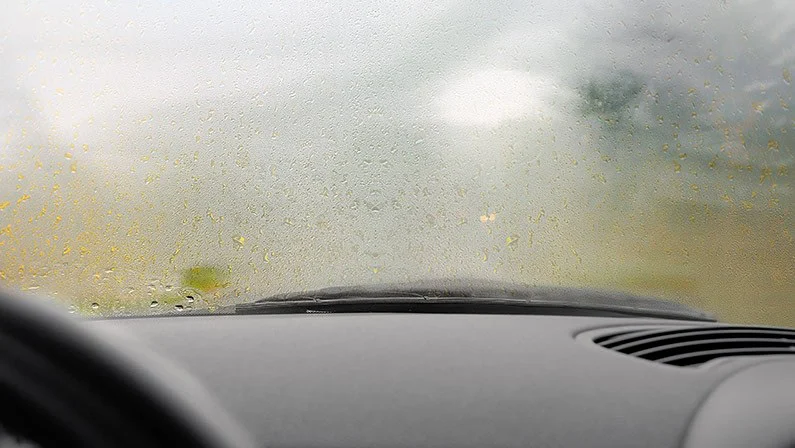
A fogged up car windshield due to a gummed up cabin air filter can be extremely dangerous
Most Critical
1. Why Does a Clogged Cabin Air Filter Fog Up Your Windshield on I-15 in Winter?
Category Most Critical
Can a dirty cabin air filter really keep your windshield from defrosting fast enough to drive safely on I-15 or Yellowstone Avenue in the winter?
Yes, and the mechanism is straightforward. Your defroster does not just blow warm air at the glass; it relies on the HVAC blower pulling enough volume of air through the cabin air filter to clear humidity and fog from the inside of the windshield quickly. When that filter is packed with road grit, dead leaves, and the fine dust that blows off the benches above the Portneuf Valley, airflow through it drops sharply. AAA notes that a restricted cabin air filter produces exactly this symptom, windows that fog easily and are slow to clear, alongside reduced airflow and added strain on the blower fan [1].
In Pocatello, where average snowfall runs near 38.5 inches a year and the record low sits at minus 33 degrees Fahrenheit, a slow-clearing windshield is not a minor annoyance [9]. It is minutes of reduced visibility on I-15 through the Portneuf Gap or on the icy grade along Yellowstone Avenue near Old Town, exactly where Idaho Transportation Department winter maintenance data shows serious-injury crashes have historically clustered before the state’s mobility index improved [8]. A cabin air filter that cannot move air fast enough directly undermines the one safety system built to keep your glass clear.
2. Does Your Cabin Air Filter Stop Wildfire Smoke From Reaching You on the Drive Home?
Category Most Critical
During a Mountain West wildfire-smoke event, can your car’s cabin air filter actually keep PM2.5 smoke particles out of the air you breathe while driving?
It depends heavily on what condition that filter is in and what it’s made of. The Idaho Department of Health and Welfare is explicit that ordinary filtration does not automatically stop the smallest wildfire particles, PM2.5, warning that regular filters often fail to remove this size of particulate and recommending HEPA-grade filtration rated at MERV 13 or higher during smoke events [6]. A cabin air filter in good condition, especially a HEPA or high-efficiency media filter, is built to catch particles down to roughly 0.3 microns at better than 99 percent efficiency, well within range of the fine smoke particles that drift over Pocatello during a bad wildfire season [3].
A cabin air filter that is already saturated with a summer’s worth of dust and pollen, though, has far less capacity left to catch smoke on top of it. Independent CDC/NIOSH-referenced testing found that while HEPA cabin filters reduced ultrafine particle concentration by an average of 93 percent, standard OEM filters managed only 41 to 65 percent, and an aged filter’s own particle pass-through ratio nearly tripled compared to a new one [2]. For Gate City residents who already spend late summer watching haze settle into the Portneuf Valley from fires burning across the Mountain West, that gap matters every time you roll down Yellowstone Avenue with the vents on.
3. Can a Neglected Cabin Air Filter Grow Mold Behind Your Dashboard?
Category Most Critical
Is it actually possible for mold, bacteria, or mildew to grow inside a cabin air filter that hasn’t been changed, and could that make you sick every time you turn on the AC?
Yes. A cabin air filter’s job is to trap organic material, and that is exactly what creates the problem when it goes too long without replacement. AAA and filter-industry researchers both document that a cabin air filter accumulates mildew, mold spores, fungi, bacteria, and even rodent droppings alongside the dust and pollen it’s designed to catch, and a filter sitting damp behind the dashboard for months is an ideal environment for that organic material to start growing rather than just sitting inert [1]. Every time the blower motor kicks on, air pushes directly through that colony and into the cabin.
Pocatello’s spring snowmelt along the Portneuf River and its share of nearly 93 precipitation days a year mean cabin filters here spend real time damp, not just dusty [9]. Combine that with a filter already loaded from a full winter of road grit and a late-summer pollen season, and the moisture-plus-organic-matter conditions for mold growth are common in Gate City vehicles that go past their service interval. A musty smell the moment the AC or heater kicks on is often the first sign this has already started.
4. How Many Miles Can Idaho State Commuters Really Put on One Cabin Air Filter?
Category High Priority
What’s the real mileage interval for replacing a cabin air filter if you commute daily around Idaho State University, Chubbuck, and the gravel benches above Pocatello?
The general factory guidance for a cabin air filter runs between 15,000 and 30,000 miles, though AAA is clear that the exact number depends on your specific vehicle and, just as importantly, on how dusty your regular driving environment actually is [1]. That range assumes relatively clean air. It is not written with Bannock County’s gravel access roads, unpaved lots around Idaho State University athletic facilities, or the dust kicked up on Chubbuck’s developing subdivisions in mind.
Drivers who commute daily between Old Town, the ISU campus, and outlying gravel roads around the benches are pulling in far more particulate per mile than a filter’s factory rating assumes, which means the lower end of that 15,000-to-30,000-mile range, or even below it, is the realistic target for a lot of Gate City commuters. A filter rated for 30,000 miles of clean-air suburban driving can reach the same saturation point at 18,000 or 20,000 miles once you factor in a Bannock County commute.
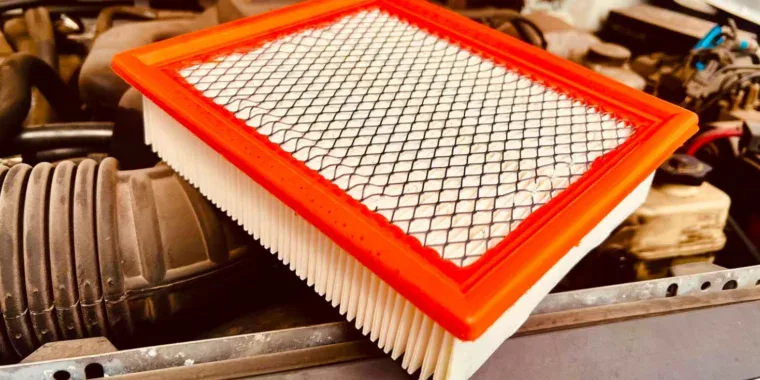
Choosing the correct cabin air filter is not a casual decision. If you don’t have the right filter for your vehicle, it can cause you problems.
5. HEPA, Carbon, or Standard: Which Cabin Air Filter Actually Fits Pocatello’s Air?
Category High Priority
With HEPA, activated-carbon, and standard particulate options, which type of cabin air filter makes the most sense for a Pocatello commuter dealing with both wildfire smoke and everyday road dust?
The three main cabin air filter media types are built for different jobs. A standard particulate filter catches larger debris, leaves, bugs, coarse dust, but has limited capacity against fine particulate. An activated-carbon filter adds a layer that adsorbs odors, exhaust gases, and volatile organic compounds, useful anywhere diesel trucks, agricultural equipment, or industrial exhaust are part of the daily air mix. A HEPA-grade cabin filter is built to capture particles down to about 0.3 microns at roughly 99.97 percent efficiency, the broadest protection of the three, including the ultrafine range that ordinary filters let through [3].
For a Pocatello driver, the case for stepping up from a bargain standard filter is strong: this is a city with a real wildfire-smoke season, a corridor of industrial employers including ON Semiconductor and Amy’s Kitchen, and agricultural operations across Bannock County that all put fine particulate and odor-bearing exhaust into the local air at different points in the year. A HEPA or carbon-HEPA combination filter is built for exactly that mixed exposure, where a filter designed only for a clean suburban commute is not.
6. Is Your Cabin Air Filter Making Your Allergies Worse on the Drive to Work?
Category High Priority
Could a saturated cabin air filter actually be making your seasonal allergy or asthma symptoms worse specifically during your commute, rather than helping them?
It can, and the scale of who this affects is larger than most drivers assume. The CDC’s most recent national data puts current asthma prevalence at 8.4 percent of Americans, about 27.8 million people, with 42.3 percent of them reporting at least one asthma attack in the past year, and that is before counting the much larger population managing seasonal allergies rather than diagnosed asthma [5]. A cabin air filter past its service life stops functioning as a barrier and starts functioning closer to a reservoir, holding accumulated pollen and dust right at the point where cabin airflow recirculates it toward your face every time the blower runs.
The Filter Manufacturers Council has reported that roughly 40 million Americans deal with allergies made worse by airborne particulates, and lists sneezing, watery eyes, and a runny nose among the direct effects, symptoms AAA also flags as driver distractions with real safety implications, not just discomfort [1]. In a city where weed pollen regularly reaches the moderate-to-high range by late summer, a commuter with a maxed-out filter may be dosing themselves with allergens every single trip rather than being protected from them [7].
7. Why Does Late-Summer Weed Pollen Hit Your Cabin Air Filter Harder Than Spring Bloom?
Category Important
Does Pocatello’s late-summer weed pollen season put more strain on a cabin air filter than the tree and grass pollen earlier in the year?
Current monitoring for the Pocatello area shows exactly this pattern: tree and grass pollen readings sitting negligible while weed pollen runs moderate and is forecast to climb into the high range within days, a seasonal shift typical for the Gate City as summer turns toward fall [7]. Weed pollen grains, along with the smaller fragments that break off intact grains, fall within a size range a cabin air filter is specifically built to intercept, and a filter that handled spring’s lighter pollen load without trouble can reach saturation fast once weed pollen season peaks [3].
This matters because the Portneuf Gap and the open benches above town funnel wind-blown weed pollen directly into the valley where Pocatello sits, concentrating what a filter has to catch compared with a more sheltered location. A filter installed in spring, checked once and forgotten, is often working at its hardest exactly when late-summer weed pollen peaks, the point at which most drivers have stopped thinking about their filter at all.
8. Does Idaho’s Winter Road Treatment on I-15 Clog Your Cabin Air Filter Faster?
Category Important
Does the salt and grit that Idaho Transportation Department crews spread on I-15 and city streets around Pocatello actually shorten how long a cabin air filter lasts?
Winter road treatment has driven real safety gains on Idaho’s highways, Idaho Transportation Department data shows the state’s winter mobility index climbing from 28 percent to 86 percent since 2010, with winter-condition crashes falling from 1,966 to 633 over roughly the same period [8]. That treatment works by putting salt, sand, and grit directly onto the driving surface, which means every vehicle traveling I-15 through the Portneuf Gap or along Yellowstone Avenue during a winter storm is drawing air laden with fine mineral dust and de-icing residue directly into its HVAC intake.
That residue behaves differently than ordinary road dust. Fine mineral grit and salt particles load a cabin air filter’s fibers quickly and do not break down the way organic debris does, meaning a filter that would otherwise last well into spring can reach capacity in the middle of a heavy Pocatello winter. Drivers who lean on their defroster hardest during exactly the storms that trigger the most road treatment are, without realizing it, putting the most load on their filter at the same time.
9. Can a Fully Clogged Cabin Air Filter Burn Out Your Blower Motor During Bengals Game Day?
Category Important
If a cabin air filter gets completely clogged, can the extra strain actually damage or burn out the HVAC blower motor itself, not just reduce airflow?
It can. A blower motor is engineered to push air against a certain amount of resistance, and a cabin air filter packed solid with debris raises that resistance well beyond design tolerance. AAA specifically identifies increased strain on the ventilation fan as a direct symptom of a restricted filter, and that added electrical and mechanical load, sustained over months of driving, is a recognized path to premature blower motor failure, turning a twenty-to-fifty-dollar filter into a far more expensive repair [1].
That strain peaks in exactly the conditions Gate City drivers hit hardest around Idaho State University home games and Old Town events, long stretches of stop-and-go traffic and idling on Yellowstone Avenue with the blower running at high speed to keep the cabin comfortable in a packed vehicle. A filter already loaded from a full season of Portneuf Valley dust and pollen forces the blower motor to work against maximum resistance during precisely the traffic conditions that already demand the most from it.
10. Can You Actually Check Your Own Cabin Air Filter Before It Fails on Old Town Streets?
Category Medium Priority
Is it realistic for a driver to visually inspect their own cabin air filter at home, or does checking cabin air filter condition really require a shop visit?
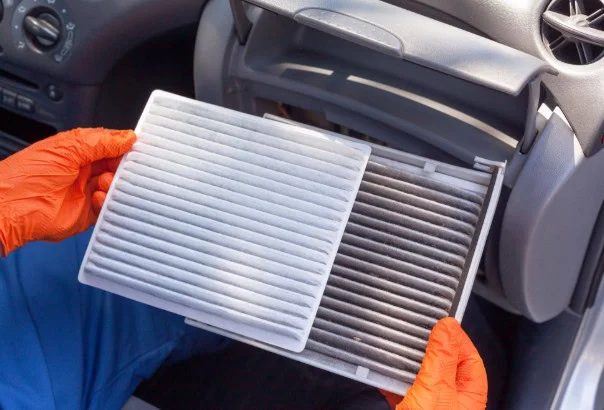
A basic visual check is genuinely doable at home for a lot of vehicles. AAA notes that most cabin air filters can be swapped in under fifteen minutes without specialized tools, though some vehicles require removing trim panels or fasteners to reach the housing, most commonly located behind the glove box or, on some models, under the hood near the base of the windshield [1]. Pulling the filter and holding it up to daylight is enough to spot the visible warning signs: matted-down debris, a gray or brown discoloration across the pleats, or visible mold spotting.
What a home check cannot reliably catch is how much fine particulate and microbial buildup sits deep in the filter’s pleats, especially with the mixed dust, pollen, and winter road grit typical of a Pocatello driving season, or whether the filter’s remaining capacity is actually adequate for the wildfire-smoke or pollen conditions coming up. A visual check is a good first step for Gate City drivers who want to stay informed between service visits, not a full substitute for a technician’s assessment.
An old cabin air filter that needs to be replaced can make for a bad smell in your vehicle’s air circulation
11. Why Does Your AC Smell Musty the Moment You Turn It On Near the Portneuf River?
Category Medium Priority
If your car’s AC or heater smells musty the instant it kicks on, is that actually a cabin air filter problem, and does living near the Portneuf River make it more likely?
A musty smell the moment the blower activates is one of the more reliable signs of a cabin air filter carrying trapped mold, mildew, or bacteria rather than a problem with the AC system itself. Filter research documents mildew, mold spores, and fungi among the organic material a saturated cabin air filter accumulates, and that smell is the blower pushing air directly across that buildup and into the cabin the moment it turns on [1].
Homes and vehicles near the Portneuf River corridor see more sustained humidity during spring runoff than higher, drier parts of town, and Pocatello as a whole logs close to 93 days of measurable precipitation a year, conditions that keep a cabin air filter damp longer after each storm or thaw [9]. A filter that dries out quickly in a drier part of the valley may stay damp for days near the river, giving mold and mildew more time to establish before the next hot, dry stretch finally dries it back out.
12. Why Do So Many Bannock County Drivers Not Know Where Their Cabin Air Filter Even Is?
Category Medium Priority
Is it true that a lot of drivers skip cabin air filter service simply because they don’t know where the filter is located on their specific vehicle?
It is, and the reason is straightforward: unlike an engine air filter or oil filter, a cabin air filter’s location varies significantly by make and model. Most sit behind the glove box, accessible by removing a panel or two, but a meaningful number of vehicles route theirs under the hood near the windshield base, under the dashboard on the passenger side, or behind the kick panel, and a driver checking under the hood alone may reasonably conclude their car doesn’t have one at all [1].
Across the mixed vehicle fleet common in Bannock County, farm and work trucks serving outlying agricultural operations, daily commuter sedans, and the student-heavy vehicle mix around Idaho State University, that variation means a lot of drivers have simply never located the part, let alone serviced it on schedule. A filter nobody can find is a filter nobody replaces, regardless of how much dust, pollen, or winter grit it has already absorbed.
13. Does a Clogged Cabin Air Filter Make Your AC Struggle During Pocatello’s 100-Degree Days?
Category Lower Priority
Can a restricted cabin air filter actually reduce how cold your air conditioning blows, not just how much air it moves, during Pocatello’s hottest summer days?
Yes. Air conditioning cooling capacity depends on volume of airflow across the evaporator core as much as on refrigerant charge, and a cabin air filter choked with dust and pollen reduces that volume regardless of how well the AC compressor itself is functioning. AAA lists reduced airflow through the HVAC system as a primary symptom of a restricted filter, and reduced airflow translates directly into a cabin that cools more slowly and never quite reaches the temperature the system is capable of [1].
Pocatello’s semi-arid climate has produced a recorded high of 104 degrees Fahrenheit, and while the valley’s dry heat is generally more tolerable than humid climates at the same temperature, a car with restricted airflow on one of those triple-digit afternoons on Yellowstone Avenue cools noticeably slower than one with a clean filter, extending the uncomfortable stretch before the cabin actually reaches a comfortable temperature [9].
14. Are You Breathing More Exhaust Idling on Yellowstone Avenue Than You Realize?
Category Lower Priority
During stop-and-go traffic or idling in the Yellowstone Avenue commercial corridor, does your cabin air filter meaningfully reduce the exhaust particulate you’re actually breathing?
A working cabin air filter matters most in exactly this scenario. Research comparing in-cabin to outside-air pollution levels found that pollution measured inside a moving or idling vehicle can run two to ten times higher than the air immediately outside it, largely because a car’s ventilation system draws in and concentrates whatever the vehicles directly ahead are emitting, a phenomenon most pronounced in stop-and-go traffic and idling queues rather than open-road driving [4]. The Yellowstone Avenue corridor’s mix of retail traffic, drive-thru queuing, and signal-heavy intersections creates exactly that idling pattern throughout the day.
A cabin air filter in good condition is the only thing standing between that concentrated exhaust and the inside of your car during those idling stretches. A filter already saturated from a full season of road dust and pollen has little capacity left to intercept the ultrafine exhaust particulate layered on top of it, meaning the corridor’s heaviest traffic hours are precisely when a neglected filter offers the least protection.
15. Could Your Cabin Air Filter Be Quietly Costing You at the Pump Around Pocatello?
Category Lower Priority
Does a restricted cabin air filter actually draw more electrical load from a vehicle’s blower motor in a way that affects fuel economy over time?
It does, in a small but measurable way. A blower motor forcing air through a clogged cabin air filter has to work harder to move the same volume of air, drawing more electrical current from the vehicle’s charging system to do it. That added electrical load is ultimately supplied by the alternator, which the engine drives directly, meaning a straining blower motor translates into a small but real increase in the engine’s own workload every time the HVAC fan runs on anything but its lowest setting [1].
At Pocatello’s 4,462-foot elevation, engines already work slightly harder to produce the same power than they would at sea level, since the air is thinner. Adding a straining blower motor’s extra electrical draw on top of that elevation penalty is a small effect per trip, but it compounds across a full commuting season for drivers logging regular miles between Old Town, Chubbuck, and the benches, and it is one more reason a fifteen-minute filter swap pays for itself in more than just cleaner air.
About Grease Monkey, 1055 Yellowstone Ave, Pocatello, ID 83201
Grease Monkey’s Yellowstone Avenue location, known internally as Center #28, is part of the FullSpeed Automotive network and sits at 1055 Yellowstone Ave, Pocatello, ID 83201, open Monday through Friday from 7:00 AM to 6:00 PM and Saturday from 8:00 AM to 5:00 PM, closed Sundays [12]. The location handles the full range of Grease Monkey’s service menu, including conventional, synthetic-blend, and full-synthetic oil changes, fluid exchanges, battery service, brake service, tire service, air conditioning service, engine service, filter replacement (cabin and engine air filters alike), headlight service, power steering service, transmission service, wiper replacement, car wash, windshield repair, and fleet service for Bannock County’s business vehicles [12].
The location has built a 4.7-star rating across more than 1,375 Google reviews, a track record Gate City drivers can check for themselves before their visit [12]. As part of a FullSpeed Automotive network that CARFAX recognized with 435 Top Shop honors in 2025, this Pocatello center draws on brand-wide training and service standards while still functioning as a local shop that knows the specific demands Yellowstone Avenue, Old Town, and the surrounding benches place on a vehicle’s cabin air system [11].
Author Information
Author Bio – Phillip Paul Gilliam
Phillip Gilliam is a veteran journalist and former Editor-in-Chief with 50+ years of publishing experience and thousands of published articles. Specializing in automotive, trucking, and digital publishing, he creates authoritative, search-optimized content built on real-world expertise and editorial excellence. To learn more about Phil, visit http://www.phillipgilliam.com/about.html or contact Phil at [email protected]. He would love to hear from you!
[2] Filterbuy. Do Cabin Air Filters Help with Allergies? What the Research Says. Filterbuy. Available at: https://filterbuy.com/resources/filters/cabin/do-cabin-air-filters-help-with-allergies/. (CDC/NIOSH-referenced comparative filtration testing: HEPA filters averaging 93 percent ultrafine particle reduction versus 41-65 percent for standard OEM filters; aged-filter PM2.5 pass-through data.)
[5] Centers for Disease Control and Prevention. Most Recent Asthma Data. CDC. Available at: https://www.cdc.gov/asthma-data/about/most-recent-asthma-data.html. (27.8 million Americans, 8.4 percent of the population, currently living with asthma; 42.3 percent reporting an attack in the past 12 months.)
[7] IQAir. Pocatello Pollen Count and Allergy Information. IQAir. Available at: https://www.iqair.com/us/pollen/usa/idaho/pocatello. (Current weed, tree, and grass pollen levels and short-term forecast for Pocatello, Idaho.)
[8] Idaho Transportation Department. Salt and Idaho Roads. ITD. Available at: https://apps.itd.idaho.gov/Apps/info/Salt_and_Idaho_Roads.pdf. (Winter mobility index rising from 28 percent to 86 percent since 2010; winter-condition crashes falling from 1,966 to 633 over the same period.)
[9] Wikipedia contributors. Pocatello, Idaho. Wikipedia. Available at: https://en.wikipedia.org/wiki/Pocatello,_Idaho. (Elevation of 4,462 feet, climate and temperature records, average annual snowfall of 38.5 inches, and precipitation-day totals.)
We use cookies to improve your browsing experience on our website. By closing this banner or interacting with our site, you acknowledge and agree to our privacy policy.