6 Reasons Aurora Drivers on Buckley Road Should Rethink the Engine Air Filter – Merging at Mile-High Altitude, Emissions Day, the Oil-Change Rhythm, the Filter on the Counter, Bargain Copies, and the Other Filter in Your Car
Location: Aurora, CO Topic: Grease Monkey Center #48 By: Phil Gilliam
An Authoritative Guide for Engine Air Filter Care Between the Plains and the Front Range
Grease Monkey, 1790 South Buckley Rd, Aurora, CO 80017. Has Over 2,800 Google Reviews With A 4.7 Star Rating.
A Note on Authority and Expertise: This article was researched and written by Phillip Paul Gilliam, a veteran journalist and former Editor-in-Chief with more than 50 years of publishing experience in automotive, trucking, and safety communications.
Most engine air filter advice is written for a generic driver at sea level. Aurora drivers live more than a mile up, inside a state emissions program, in a metro area where a quick-lube visit is part of the routine. This guide ties each engine air filter question to evidence: two Oak Ridge National Laboratory studies for the U.S. Department of Energy, the Colorado Department of Public Health and Environment and Air Care Colorado, the Colorado General Assembly, a factory maintenance schedule, an engineering study of replacement filters, a filter maker's technical guidance, and an experienced mechanic's inspection method. Where the evidence is limited, this guide says so.
The shop at 1790 South Buckley Rd is Grease Monkey Center #48, managed by Julian Armijo and operated by Threshold Automotive [1]. Grease Monkey was founded in 1978 and is headquartered in Denver [2], so this Aurora shop sits in the brand's home metro. Parent company FullSpeed Automotive, led since November 2025 by CEO Brian Maciak, reported more than 900 franchised and company-owned locations in January 2026 [3], and when the company was sold in 2020 it was already described as the fourth largest quick lube operator in the United States [4].
Aurora is Colorado's third most populous city, with an estimated 410,053 residents in 2025, and it spreads across Arapahoe, Adams, and Douglas counties at a posted elevation of 5,471 feet [5]. Buckley Space Force Base is its largest employer [5]. The store page describes the local driving as a mix of heavy snow, freezing sleet, dust blowing off the plains, summer heat, wildfire smoke, and steep climbs into the mountains [1]. Every one of those conditions passes through an engine air filter before it reaches an engine.
An Introduction to Engine Air Filters on Buckley Road and Across Aurora
Picture a weekday morning on Buckley Road. Commuters head for I-225 and E-470, a contractor's pickup turns toward a job site, a family SUV with a trailer hitch waits at the light, and an older sedan rolls toward its emissions test. Each of those vehicles depends on the same simple part: a pleated engine air filter that cleans every breath of air before it reaches the engine.
Aurora's semi-arid climate brings modest precipitation, about 18 inches a year, along with high winter winds and summer hailstorms [5]. Drivers here also face questions that are particular to the Denver metro: how a dirty engine air filter feels at more than 5,000 feet, whether it can hurt an emissions test, and how to fit engine air filter care into a quick oil change without overpaying or underservicing.
This guide answers six practical questions Aurora drivers ask about the engine air filter. It starts with the symptom drivers notice most, a car that feels slow when it needs to merge, and moves through emissions testing, service timing, judging a filter a technician shows you, choosing a quality replacement, and the difference between the engine air filter and the cabin filter. Each answer begins with a short, direct reply, then explains the evidence and what it means on Aurora roads.
The crew at Grease Monkey on Buckley Road includes a 16-point inspection with its oil changes and welcomes walk-ins, with a typical full-service oil change taking about 15 to 20 minutes [1]. That visit is an easy time to look at the engine air filter. Here is what is worth knowing.
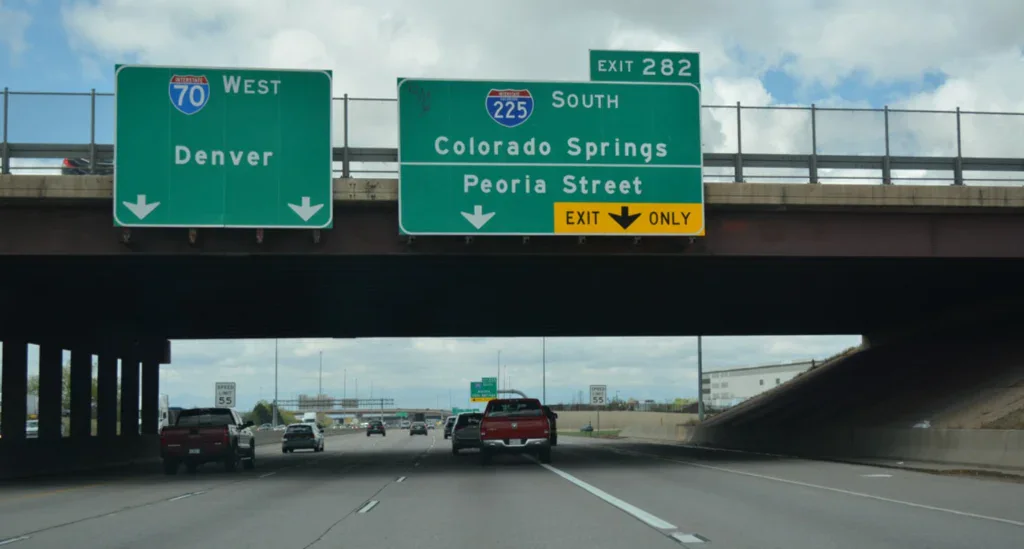
When you merge onto an interstate highway, you need all the power your engine can deliver! A dirty engine air filter robs you of power.
1. Merging Onto E-470 Feels Like a Chore? A Clogged Engine Air Filter Steals Power You Cannot Spare at 5,400 Feet
Can a dirty engine air filter make my car feel sluggish when I merge onto I-225 or E-470 in Aurora?
Quick Answer: Yes. Department of Energy testing found that every vehicle tested lost acceleration with a clogged engine air filter, even modern cars whose fuel economy did not change. At Aurora’s altitude, where engines already make less power, a restricted engine air filter is an easy first thing to check.
Most of the time, a car does not need all of its power. Cruising down Buckley Road or sitting in traffic on Mississippi Avenue uses a fraction of what the engine can do. The moment that changes is the on-ramp: merging onto I-225 or E-470, passing on a two-lane road, or pulling a trailer up I-70 toward the mountains, a trip the store page mentions specifically [1]. That is when a tired engine air filter shows itself.
Researchers at Oak Ridge National Laboratory tested this for the U.S. Department of Energy. They ran three modern fuel-injected cars, a 2007 Buick Lucerne, a 2006 Dodge Charger, and a 2003 Toyota Camry, along with an older carbureted car, using engine air filters restricted to different degrees. Clogging the filter had no significant effect on the fuel economy of the newer vehicles, but acceleration improved on all of the vehicles once a clean filter went in [6]. In other words, a modern car can hide a dirty engine air filter at a steady cruise and still feel it when the driver asks for full power.
The reason is simple. At light throttle, the throttle plate is the main restriction, so the engine air filter barely matters. At wide-open throttle, the throttle is out of the way and the engine wants all the air it can get. Now the engine air filter is the narrowest point in the path, and a filter packed with dust limits how much air, and therefore how much fuel and power, the engine can use.
Altitude makes that loss harder to absorb. Aurora’s posted elevation is 5,471 feet [5], and a common rule of thumb is that a naturally aspirated engine loses about 3 percent of its power for every 1,000 feet of elevation gain [7]. By that rule, a non-turbo engine in Aurora is already working with roughly 15 percent less power than it would make at sea level, before the engine air filter takes anything away. A restriction that might go unnoticed in a coastal city is easier to feel here.
Sluggish acceleration can have other causes, including worn spark plugs, fuel delivery problems, a slipping transmission, or a sensor fault. The engine air filter is simply the quickest and least expensive item to rule out. If the car feels flat on the on-ramp, start with an engine air filter inspection, and if a fresh filter does not bring the response back, the technician can move on to the next suspect.
2. Emissions Test Coming Up? What a Dirty Engine Air Filter Can and Cannot Do to Your Air Care Colorado Result
Will a dirty engine air filter make my car fail its Colorado emissions test in Aurora?
Quick Answer: Usually not on a modern car. Oak Ridge testing found modern vehicles’ emissions were insensitive to engine air filter condition. But a torn or poorly sealed engine air filter, a check engine light, or visible smoke can cause trouble, and older carbureted vehicles are more sensitive. Check it before testing.
Aurora drivers live inside Colorado’s vehicle emissions program. The state health department says gasoline vehicles in the Metro Denver and Front Range region must be inspected, and it lists Adams, Arapahoe, Boulder, Broomfield, Denver, Douglas, Jefferson, Larimer, and Weld counties [8]. Aurora spans Arapahoe, Adams, and Douglas [5]. The Colorado General Assembly notes that only portions of Adams and Arapahoe counties are in the program area [9], so it is worth confirming that your address is covered before your registration renewal.
The rules depend on the vehicle’s age. The seven most recent model years are exempt, model year 1982 and newer vehicles are inspected every two years, and 1981 and older vehicles are inspected every year [8]. Depending on the vehicle, the test may be an on-board diagnostics (OBD) check that reads the car’s computer, the I/M240 test on a dynamometer, or a two-speed idle test for the oldest vehicles, and the inspection includes a gas cap and smoke check [8]. Some vehicles can also qualify through drive-by remote sensing [8].
So where does the engine air filter fit? For modern cars, less than many drivers assume. A second Oak Ridge National Laboratory study tested four closed-loop vehicles from model years 2003 to 2007 and one 1972 carbureted vehicle, and it found insignificant fuel economy and emissions sensitivity to engine air filter condition for the modern vehicles, while the older vehicle was affected [10]. A modern engine computer measures incoming air and adjusts fuel to match, so a dirty engine air filter mostly costs performance rather than emissions.
That does not make the engine air filter irrelevant on test day. Air Care Colorado lists illuminated dashboard warning lights, a malfunctioning emissions system, and visible smoke among the reasons a vehicle can fail [11]. A torn engine air filter, a missing filter, or a cracked intake duct after the airflow sensor can let unmeasured air or dirt into the engine, and those problems can lead to warning lights or sensor trouble over time. Older carbureted vehicles that run annual tests are more sensitive to a restricted engine air filter, because they cannot correct the fuel mixture the way a modern computer can [10].
The practical plan is simple. A few weeks before a test, have the engine air filter and intake ducts inspected, replace the filter if it is loaded, torn, or poorly sealed, and make sure no warning lights are on. Air Care Colorado also advises having the gas cap present and sealed [11]. A clean, well-sealed engine air filter will not pass a broken car, but it removes one easy problem from the list.
3. Every Oil Change Is an Engine Air Filter Checkpoint – Here Is How to Sync the Two Without Overpaying
How should I time engine air filter replacement with my regular oil changes in Aurora?
Quick Answer: Use every oil change as an engine air filter inspection, not an automatic replacement. Many factory schedules call for checking the engine air filter at each oil service and replacing it at a longer interval. In Aurora dust, that often means a new engine air filter every few oil changes.
Oil and the engine air filter wear out on different clocks. Oil breaks down with heat, miles, and time. The engine air filter wears out as it fills with dust, which depends on how dirty the air is. That is why most manufacturers set two separate schedules, and why the smartest approach links them without treating them as the same job.
A Chevrolet example shows the pattern. The maintenance schedule for the 2013 Suburban 1500, as published by Kelley Blue Book, lists an oil change every 7,500 miles and an inspection of the engine air filter at that same 7,500-mile visit, while replacement of the engine air cleaner filter is listed at 45,000 miles [12]. That is six oil changes for every scheduled filter replacement, with an inspection at every one of them. Other vehicles use different numbers, so the owner’s manual for your car is the authority.
The inspection is the important part. A factory interval assumes average air. Aurora drivers who spend time on dusty roads east of town, near construction, or on gravel trailhead roads in the mountains can load an engine air filter well before the book says to replace it. Drivers who spend most of their time on paved city streets may reach the full interval with life to spare. Only a look at the filter tells you which one you are.
A quick-lube visit is built for that look. The Buckley Road shop’s full-service oil change typically takes about 15 to 20 minutes and includes a 16-point inspection, and walk-ins are welcome [1]. Opening the air box adds very little time. The habit to build is to have the engine air filter checked at every oil change, replace it when it is loaded or damaged or when the time and mileage limit arrives, and keep a note of the mileage at each replacement.
That record matters. Writing the engine air filter change mileage on your receipt or in a phone note turns guesswork into a pattern. After two or three cycles, you will know how many oil changes your engine air filter typically lasts in your own driving, and you can stop paying for filters too early or driving on one too long.
Not all failing engine air filters are this obvious. Learn how to determine if your engine air filter needs replaced or not.
4. The Technician Is Holding Up Your Old Engine Air Filter – Here Is How to Judge It Like a Pro in 30 Seconds
When a technician shows me my old engine air filter, how do I know if it really needs replacing?
Quick Answer: Look deep into the pleats, not at the surface color. Dirt packed into the bottom of the pleats, oil stains, a damaged gasket, or a collapsed shape mean the engine air filter should be replaced. A darkened face alone can be normal. Ask about mileage since the last engine air filter change, too.
It is one of the most familiar moments at any service counter. The technician walks out holding your engine air filter and says it is time for a new one. Some drivers say yes to everything, and some say no to everything. A better answer comes from knowing what to look for, which takes about 30 seconds.
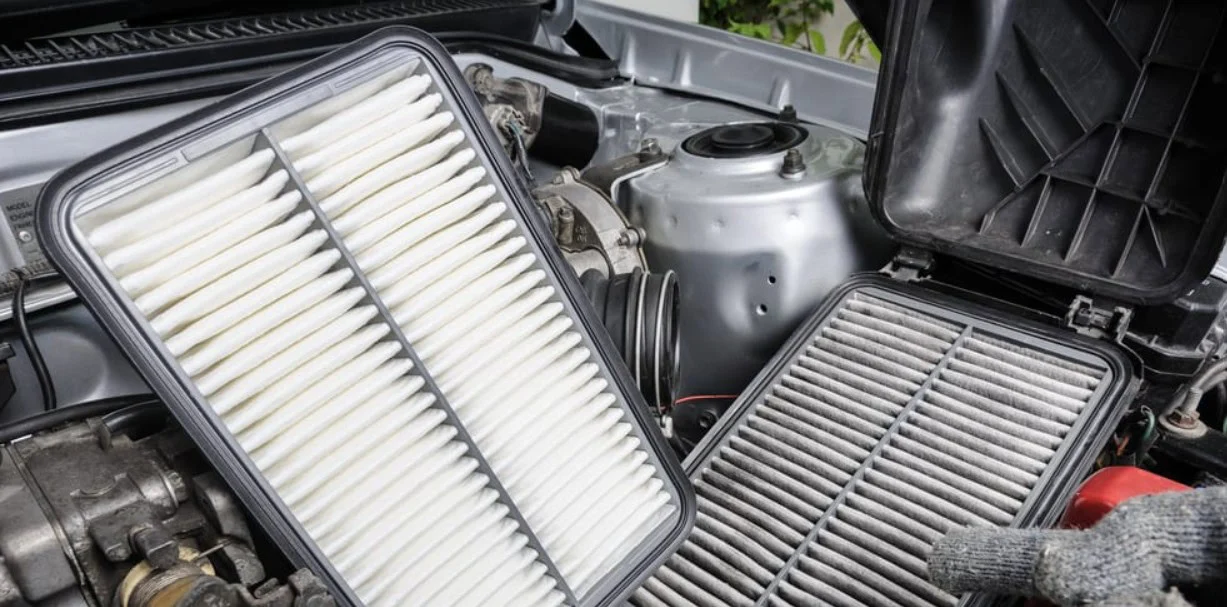
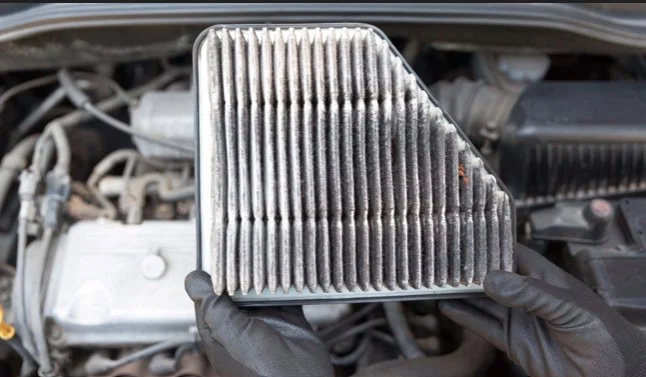
Start with the pleats, not the face. Mechanic Rick Muscoplat advises gently separating the pleats and looking deep inside them, because debris packed into the bottom of the pleats is the meaningful sign of a loaded engine air filter [13]. He also notes that the tops of the pleats often discolor quickly while the filter still has plenty of useful life left [13]. A gray or tan face by itself is not a verdict.
Next, check for damage that calls for replacement no matter how clean the media looks. Muscoplat lists oil staining, a damaged sealing gasket, and a collapsed filter as reasons to replace it [13]. Oil on an engine air filter can point to a crankcase ventilation issue, so it is worth asking the technician about the cause, not just the filter. Look at the rubber edge for cracks or flattening, too, because a seal that no longer presses evenly lets dirty air bypass the media.
Then ask a few simple questions. How many miles since the last engine air filter change? What does the owner’s manual call for, and does your driving count as dusty? Is there dirt on the clean side of the housing or in the intake duct? A good technician will welcome those questions and can show you the housing, not just the filter. If it helps, ask to see a new filter next to the old one so you can compare the depth of the pleats.
Aurora conditions make this habit worth the 30 seconds. Dust blowing off the plains and summer wildfire smoke [1] can load an engine air filter faster than the factory interval assumes, while a car that mostly sees paved city streets may be fine for another visit. Judging the filter yourself lets you replace it when it is truly loaded, not too early and not too late.
5. Bargain Engine Air Filters Can Look Identical on the Shelf – Here Is What Separates a Quality Replacement From a Cheap One
Is a bargain-priced engine air filter as good as a quality or factory-equivalent one?
Quick Answer: Not always. Two engine air filters can share a part number and shape but differ in media, pleat depth, seal quality, and how well they hold up as dust builds. A quality engine air filter that meets the vehicle maker’s specification and seals perfectly is the safer choice for Aurora dust.
Walk down a parts aisle or scroll an online store and you will find engine air filters for the same car at very different prices. They usually have the same outside dimensions, because they have to fit the same housing. What is harder to see is what happens inside: the media, the number and depth of the pleats, the quality of the seal, and how well the filter holds its shape after months of dust.
Engineering studies of replacement filters look at exactly those properties. A 2018 study published in the International Journal of Engineering and Technology compared filters from original-equipment brands Bosch and Fleetguard against an aftermarket brand, evaluating pressure drop, filter efficiency, media strength, and porosity to show how much the aftermarket filter varied from the original-equipment filters [14]. The abstract does not publish the numbers, but the method is the point: a filter’s quality shows up in airflow, capture, and strength, not in its outside shape.
A farm equipment engineer interviewed by The Western Producer made a related point. He said his company’s filters were field tested for the specific machines they protect, and that its engine air filters limit the dust entering the engine to less than one gram in 500 hours of operation [15]. Speaking about fluid filters, he added that a new original-equipment filter and a new cheaper filter may read the same on paper, but the cheaper one can start letting particles through after a period of use [15]. Those are a manufacturer’s claims, but they describe a real risk: a filter that looks fine when new and weakens in service.
Aftermarket does not automatically mean poor quality. Many well-known filter brands build replacement engine air filters to factory specifications. The trouble usually comes from the cheapest no-name parts. Before you buy, compare the replacement with the old filter. Look for a soft, even, fully bonded seal, pleats that are evenly spaced and not crushed, end caps glued all the way around, and any wire screen or support the original had. A loose fit or a flimsy seal is a reason to put it back.
Price matters, but the engine air filter is an inexpensive part protecting an expensive engine. In Aurora’s mix of plains dust and wildfire smoke [1], the small savings on a bargain filter are not worth a seal or media that gives up partway through its interval. Ask for an engine air filter that meets your vehicle maker’s specification, and have it installed and checked for a full seal.
6. Your Car Has Two Air Filters – Here Is Why the Engine Air Filter and the Cabin Filter Are Not Interchangeable
What is the difference between my engine air filter and my cabin air filter, and do I need to replace both?
Quick Answer: The engine air filter sits in the air intake and keeps dirt out of the engine. The cabin filter sits behind the dashboard or near the heating and air conditioning intake and cleans the air you breathe. They have different jobs, parts, and schedules, so check the engine air filter and cabin filter separately.
Many drivers are surprised to learn that their car has two air filters. When a service advisor mentions an air filter, the natural question is which one. The answer matters, because the engine air filter and the cabin filter protect different things, wear out on different schedules, and are not interchangeable.
Filter maker Fleetguard explains the difference clearly. The engine air filter sits in the air intake system and keeps dirt, dust, and debris out of the combustion chamber while still letting air reach the engine. The cabin filter is housed behind the dashboard or near the heating and air conditioning intake and traps dust, pollen, soot, and other airborne contaminants before they reach the people inside [16]. In short, the engine air filter protects the engine, and the cabin filter protects passengers and the heating and cooling system [16].
The warning signs are different, too. A neglected engine air filter tends to show up as sluggish performance, and on older vehicles as poorer mileage, while a clogged cabin filter shows up as weak airflow from the vents, musty smells, or extra dust inside the car [16]. If your vents are blowing weakly, a new engine air filter will not fix it. If your car feels slow on the on-ramp, a new cabin filter will not help.
The parts look different as well. An engine air filter is usually a sturdy rectangular or round panel with a thick rubber or urethane seal, sized for the engine’s airflow. A cabin filter is often thinner and more flexible and slides into a slot in the heating and cooling system. Some cabin filters include an activated carbon layer for odors. Neither one belongs in the other’s housing.
In Aurora, the same outside air feeds both filters. Plains dust, construction dust, and summer wildfire smoke [1] load the engine air filter and the cabin filter at the same time, but they are checked separately and replaced on their own schedules. At your next visit, ask the technician to check both, and to be specific about which one needs attention and why.
Two filters, two jobs, one stop. At Grease Monkey, 1790 South Buckley Rd, Aurora, CO, ask the crew to check your engine air filter and your cabin filter side by side so you know exactly which one needs replacing: https://www.greasemonkey.com/locations/co/aurora/1790-south-buckley-rd/.
About Grease Monkey, 1790 South Buckley Rd, Aurora, CO 80017
Grease Monkey Center #48 is open Monday through Friday from 8:00 AM to 6:00 PM and Saturday from 8:00 AM to 5:00 PM, and is closed Sunday. The shop can be reached at (720) 856-4911, and manager Julian Armijo leads the team [1].
The menu covers conventional, full synthetic, advanced and European synthetic, and premium synthetic oil changes, diesel and truck oil changes, a 16-point inspection, a mid-oil-change fluid check and vacuum, tune-ups, wiper blades, wheel balancing, transfer case service, tire services, serpentine belts, radiator service and fluid exchange, and pre-purchase inspections. Fleet services are also available [1].
Walk-ins are welcome, a full-service oil change typically takes about 15 to 20 minutes, and the shop is listed as a CARFAX preferred partner. Customers have given this Buckley Road location a 4.7-star rating across more than 2,800 Google reviews [1].
Author Information
Author Bio – Phillip Paul Gilliam
Phillip Gilliam is a veteran journalist and former Editor-in-Chief with 50+ years of publishing experience and thousands of published articles. Specializing in automotive, trucking, and digital publishing, he creates authoritative, search-optimized content built on real-world expertise and editorial excellence. To learn more about Phil, visit http://www.phillipgilliam.com/about.html or contact Phil at [email protected]. He would love to hear from you!
Full Citation List
[1] Grease Monkey. Oil Change & Auto Repair, 1790 South Buckley Rd, Aurora, CO. Grease Monkey. Available at: https://www.greasemonkey.com/locations/co/aurora/1790-south-buckley-rd/. (Center #48; manager Julian Armijo; operated by Threshold Automotive dba Grease Monkey; address, phone, hours; 16-point inspection; mid-oil-change fluid check and vacuum; fleet services; walk-ins welcome; full-service oil change in about 15 to 20 minutes; CARFAX preferred partner; elevation over 5,400 feet, heavy snow, freezing sleet, plains dust, summer heat, wildfire smoke, steep climbs, hauling a trailer up I-70; Buckley Road, I-225, E-470, Mississippi Avenue; current Google rating of 4.7 stars from 2,875 reviews, checked October 10, 2026.)
[5] Wikipedia contributors. Aurora, Colorado. Wikipedia. Available at: https://en.wikipedia.org/wiki/Aurora,_Colorado. (Third most populous city in Colorado; 2025 population estimate 410,053; spans Arapahoe, Adams, and Douglas counties; posted elevation 5,471 feet; Buckley Space Force Base is the largest employer; semi-arid climate with about 18.2 inches of annual precipitation, high winter winds, and common summer hailstorms.)
[6] Oak Ridge National Laboratory. Effect of Intake Air Filter Condition on Vehicle Fuel Economy. OSTI.gov record 948545, 2009. Available at: https://www.osti.gov/biblio/948545. (2007 Buick Lucerne, 2006 Dodge Charger, 2003 Toyota Camry, and an older carbureted vehicle tested; clogging the air filter had no significant effect on fuel economy of the newer vehicles; acceleration improved on all vehicles with a clean filter.)
[7] THE SHOP Staff. Turbocharging at Elevation. THE SHOP magazine, December 17, 2019. Available at: https://theshopmag.com/news/turbocharging-elevation/. (As a general rule, a naturally aspirated engine loses about 3 percent of its power for every 1,000 feet of elevation gain.)
[8] Colorado Department of Public Health and Environment. Emissions Inspections for Gasoline-Powered Vehicles. CDPHE. Available at: https://cdphe.colorado.gov/motor-vehicle-emissions/emissions-inspections-for-gasoline-powered-vehicles. (Gasoline vehicles in the Metro Denver and Front Range region must be inspected; counties listed: Adams, Arapahoe, Boulder, Broomfield, Denver, Douglas, Jefferson, Larimer, Weld; seven most recent model years exempt; 1982 and newer inspected biennially, 1981 and older annually; OBD, I/M240, and two-speed idle tests with gas cap and smoke check; remote sensing option.)
[9] Colorado General Assembly. Emissions. Colorado Legislative Council Staff. Available at: https://content.leg.colorado.gov/content/emissions. (Testing applies in Boulder, Broomfield, Denver, Douglas, and Jefferson counties plus portions of Adams, Arapahoe, Larimer, and Weld counties.)
[10] Oak Ridge National Laboratory. Effect of Intake Air Filter Condition on Light-Duty Gasoline Vehicles. OSTI.gov record 1050912. Available at: https://www.osti.gov/biblio/1050912. (Four modern closed-loop vehicles, model years 2003-2007, and a 1972 carbureted open-loop vehicle tested; insignificant fuel economy and emissions sensitivity of modern vehicles to air filter condition; the 1972 vehicle was affected; all vehicles showed an acceleration penalty with clogged filters.)
[11] Air Care Colorado. FAQ: Quick Consumer Information. Air Care Colorado. Available at: https://aircarecolorado.com/faq. (Failure reasons include exceeding emissions limits, OBD-detected problems, dashboard warning lights on during the test, missing or malfunctioning emissions equipment or gas cap, and visible smoke; address warning lights and make sure the gas cap is present and sealed before testing.)
[12] Kelley Blue Book. 2013 Chevrolet Suburban 1500 Maintenance Schedules. KBB.com. Available at: https://www.kbb.com/chevrolet/suburban-1500/2013/maintenance-schedules/. (Oil change every 7,500 miles; engine air filter inspected at 7,500 miles; engine air cleaner filter replaced at 45,000 miles.)
[13] Muscoplat, R. How to Inspect an Engine Air Filter. Rick's Free Auto Repair Advice, February 2, 2023. Available at: https://ricksfreeautorepairadvice.com/inspect-engine-air-filter/. (Gently separate the pleats and look deep inside; debris packed in the bottom of the pleats means replace; pleat tops discolor quickly while the filter still has useful life; oil staining, a damaged sealing gasket, or a collapsed filter also call for replacement; the light test has been debunked.)
[14] Srinivaas, A., and Vishnu, R. Performance Analysis and Testing of Aftermarket Filters. International Journal of Engineering and Technology (UAE) 7(3.8), 42-47, 2018. Amrita Vishwa Vidyapeetham. Available at: https://www.amrita.edu/publication/performance-analysis-and-testing-of-aftermarket-filters/. (OEM brands Bosch and Fleetguard compared with an aftermarket brand by pressure drop, filter efficiency, media strength, and porosity to show how much the aftermarket filter varies from OEM.)
[15] Lyseng, R. What Is the Difference Between OEM Filters and Aftermarket Products? The Western Producer, February 3, 2022. Available at: https://www.producer.com/crops/what-is-the-difference-between-oem-filters-and-aftermarket-products/. (New Holland engineer: filters field tested for specific machines; engine air filters limit dust entering the engine to less than one gram in 500 hours; new OEM and aftermarket fluid filter specs may read the same but the cheaper filter can start letting particles through over time. Manufacturer claims.)
[16] Fleetguard Filtrum. Air Filter vs Cabin Air Filter – What's the Difference and Why Both Are Critical. Fleetguard Filtrum blog. Available at: https://www.fleetguard-filtrum.com/resources/blog/air-filter-vs-cabin-air-filter-_-whats-the-difference-and-why-both-are-critical. (Engine air filter sits in the air intake system and keeps dirt out of the combustion chamber; cabin filter is behind the dashboard or near the HVAC intake and traps dust, pollen, and soot; engine filters protect the engine, cabin filters protect passengers and HVAC; symptoms differ.)
We use cookies to improve your browsing experience on our website. By closing this banner or interacting with our site, you acknowledge and agree to our privacy policy.