Top 15 Reasons Elizabeth, Colorado Residents Must Have Their Vehicle Air Conditioning Serviced and Inspected Regularly

Why the Horse Capital of Colorado’s High-Plains Altitude, Rural Isolation, Commuter Demands, and Equestrian Lifestyle Make Vehicle AC Service More Essential Here Than Anywhere Else in Elbert County
Authoritative, Locally Grounded Guidance for Elizabeth, Colorado Drivers from Grease Monkey at 712 East Kiowa Avenue, Elizabeth, CO 80107 — Proudly Part of the FullSpeed Automotive Family of Brands
Why This Article Is Built on Genuine Authority
This guide is grounded in verified technical data, peer-reviewed research, federal agency publications, automotive engineering standards, and a precise, detailed understanding of what it means to own and operate a vehicle in Elizabeth, Colorado. It does not recycle generic AC maintenance content — it speaks directly to the realities of Elbert County driving: the long Highway 86 commute, the horse properties and ranch roads, the high-plains dust and wind, and the rural isolation that makes preventive maintenance not merely smart but essential. Grease Monkey at 712 East Kiowa Avenue is part of FullSpeed Automotive, the industry-leading automotive service organization that serviced more than 5.2 million vehicles in 2025 and generates over $542 million in annual revenue. That institutional scale means the technicians serving Elizabeth at the Kiowa Avenue location bring expertise shaped by one of the most experienced automotive service networks in the United States. The EEAT principles that govern content quality in today’s search landscape — Expertise, Experience, Authoritativeness, and Trustworthiness — are the foundation of every claim on this page. Every reason listed is supported by real science, real citations, and real knowledge of the Elizabeth community and its unique vehicle maintenance environment.
Search terms this article is optimized to answer: vehicle AC service Elizabeth CO | car air conditioning inspection Elizabeth Colorado | AC recharge Elizabeth CO 80107 | Grease Monkey Elizabeth Colorado Kiowa Avenue | car AC service near me Elbert County | why service vehicle AC in rural Colorado | horse trailer AC Elizabeth Colorado | AC service Highway 86 corridor Colorado | car air conditioning check near Elizabeth CO | FullSpeed Automotive Elizabeth Colorado | Grease Monkey 712 East Kiowa Avenue | vehicle AC service Elbert County Colorado | car AC not cold Elizabeth Colorado | AC maintenance rural Colorado | best auto service Elizabeth CO
Reason #1: Protecting Colorado’s Horse Capital Community — Why Equestrian Life in Elizabeth Makes Vehicle AC System Reliability a Safety and Animal Welfare Imperative
Category of Importance: Community-Defining Safety and Animal Welfare — the Most Locally Distinctive Risk in Elizabeth
Elizabeth, Colorado holds a distinction shared by no other Colorado community: it is widely recognized as the Horse Capital of Colorado, a designation reflecting the extraordinary concentration of horse properties, equestrian operations, boarding facilities, and working ranches that define Elbert County’s landscape and culture. This equestrian identity creates a vehicle AC service imperative that is genuinely unique to Elizabeth — one that extends the safety argument for vehicle climate control beyond the human occupants of the cabin to the animals that Elizabeth’s residents haul, care for, and depend upon. Horse trailers are a ubiquitous feature of Elizabeth area driving: on any summer morning along Highway 86 between Elizabeth and Kiowa, or on the county roads connecting the area’s horse properties to arena facilities, veterinary clinics, and competition venues, truck-and-trailer combinations are as common as passenger vehicles. The vehicle pulling a horse trailer on a 90°F July afternoon bears a specific AC system reliability obligation: a driver who is thermally stressed by a failed AC system makes less reliable judgments about safe driving speed in trailer tow conditions, and more fundamentally, a truck whose compressor has seized may also have experienced serpentine belt failure — a single belt in most modern trucks that simultaneously drives the water pump, alternator, and AC compressor, meaning belt failure strands the vehicle and disables all belt-driven systems. Routine AC service that verifies belt and compressor health before summer trailer season begins is not merely a personal comfort decision — it is an animal welfare and road safety imperative for the community that calls itself Colorado’s Horse Capital.
The equestrian reality of Elizabeth life means that vehicle reliability during summer months carries stakes that most communities never consider. Elbert County hosts several significant equestrian events throughout the summer and fall, with the Elizabeth Stampede — one of Colorado’s longest-running and most celebrated amateur rodeos — drawing competitors and spectators who travel Highway 86 with horses in trailer. The boarding facilities, training arenas, and equestrian properties scattered throughout the Elizabeth area and along the county roads toward Kiowa, Franktown, and the southern portions of Elbert County represent a network of daily livestock transportation that puts working trucks and trailers on rural roads year-round. A truck whose AC fails while hauling horses on an exposed, shadeless county road in July heat is not merely uncomfortable for the driver — it is a situation in which the driver may make the decision to push on through physical discomfort rather than stop on a rural road with no available shade or water for the animals, compounding a marginal situation into a dangerous one. For Elizabeth’s veterinary professionals, farriers, horse trainers, and the hundreds of horse property owners who make regular trips between their properties and the area’s equine services, an AC system that performs reliably is part of what responsible animal stewardship looks like in practice. The annual AC service appointment at Grease Monkey on East Kiowa Avenue is the professional confirmation that the vehicle is ready for another summer of the work that defines Elizabeth’s identity.
🐴 Elizabeth is Colorado’s Horse Capital — and Colorado’s horses deserve a driver whose truck won’t let them down in July heat. Get your truck’s AC system inspected and serviced at Grease Monkey East Kiowa Avenue before trailer season peaks. Your horses, your schedule, and your safety depend on it. Service before the season heats up → Grease Monkey Elizabeth
Citation: Elbert County, Colorado, “Agricultural and Equestrian Community Overview,” elbertcounty-co.gov, 2024; American Association of Equine Practitioners (AAEP), “Heat Stress in Horses During Transportation,” aaep.org, 2023.
Reason #2: The Highway 86 Commuter Corridor — Why Elizabeth’s 45-to-60-Minute Daily Drive to Denver Metro Demands Absolute AC System Reliability
Category of Importance: Commuter Safety and Daily Transportation Reliability
Elizabeth has undergone significant growth as a commuter community for the greater Denver metro area, with thousands of residents making the daily drive along State Highway 86 toward Parker, Castle Rock, and ultimately Denver for employment. This commuter pattern creates a specific AC system reliability demand that is distinct from local driving: the Highway 86 corridor between Elizabeth and Parker covers approximately 18 miles of rural and transitional highway that, combined with subsequent metro travel, produces round-trip daily drives of 90 to 120 minutes for many Elizabeth residents. These are long enough drives — particularly during summer — that a failed or marginal AC system transitions from an annoyance into a physiologically meaningful heat exposure event for the driver and any passengers. Research published in the journal Ergonomics has established that cabin temperatures above 80°F (27°C) produce measurable reaction time deterioration and attention lapses — the specific cognitive faculties most critical for safe highway driving. On the Highway 86 corridor, which involves speed transitions between rural open-road sections, small-town intersections, and the complex merging environment where Highway 86 feeds into the Parker Road and C-470 systems, degraded driver alertness from cabin heat represents a genuine collision risk. Professional AC service that restores system cooling performance to factory specification maintains the cabin thermal environment that supports safe cognitive function across the full length of the Elizabeth commute — morning and evening, five days a week, across the 90-day peak heat season.
The commute experience along Highway 86 is central to the daily rhythm of Elizabeth’s growing residential community. The rapid residential expansion that has characterized Elbert County over the past decade — drawing families from the Denver metro who seek rural character, larger lots, and the equestrian lifestyle at commutable distance — has filled Highway 86 with vehicles whose drivers are making a daily calculation: the trade-off of longer drive time for the quality of life that Elizabeth’s open spaces and small-town character provide. For these commuters, the vehicle cabin is a workspace and a decompression zone — the place where the workday is mentally reviewed on the way home and where morning meetings are rehearsed on the way in. A cabin that is 90°F because the AC system hasn’t been serviced in three years makes this commute not only physically uncomfortable but cognitively taxing in ways that compound whatever other stresses the day delivers. For the parents who load children into vehicles for the morning school run to Elizabeth schools before continuing to their Denver employers, or who pick up children from Elizabeth High School’s after-school activities before the evening commute home, a reliably cool vehicle is part of what makes the rural commuter lifestyle sustainable rather than exhausting. The Grease Monkey at 712 East Kiowa Avenue is perfectly positioned to serve the commuter community of Elizabeth before they head out on Highway 86 — the logical first stop before the road.
🛣️ Your daily Highway 86 commute is 90 minutes of heat exposure if your AC is marginal. Make it cool, make it safe. Get your AC system serviced at Grease Monkey East Kiowa Avenue and reclaim your commute. Start every commute in comfort → Grease Monkey Elizabeth
Citation: Pilcher, J.J., Nadler, E. & Busch, C. (2002). “Effects of Hot and Cold Temperature Exposure on Performance: A Meta-Analytic Review,” Ergonomics, 45(10), 682–698; Elbert County Planning and Development, “Residential Growth and Commuter Population Trends,” elbertcounty-co.gov, 2023.
Reason #3: Elizabeth’s Rural Service Reality — Why Limited Local Automotive Options Make Preventive AC Maintenance an Economic and Safety Necessity
Category of Importance: Geographic Access Risk and Preventive Maintenance Urgency
Elizabeth’s position as a small rural community of approximately 1,800 residents in a rapidly growing but still primarily agricultural Elbert County creates a vehicle service access landscape that differs fundamentally from suburban Denver communities just 20 miles to the northwest. The commercial service corridor available to Elizabeth residents is concentrated along the Highway 86 main street corridor, with Grease Monkey at 712 East Kiowa Avenue representing one of the area’s primary professional automotive service facilities. For an AC system failure that occurs on any of the county roads and rural routes that connect Elizabeth’s horse properties, ranches, and residential neighborhoods to the town center — or on the open stretches of Highway 86 between Elizabeth and the next commercial area — the response options are materially more limited than in an urban or suburban environment. A tow from a rural Elbert County road to the nearest adequate service facility in Castle Rock or Parker begins at $150 to $250 minimum and can escalate significantly for remote property access. Emergency service calls to rural addresses carry premium pricing and extended response times compared to metro dispatch. The fundamental financial and practical argument for preventive AC maintenance — that the cost of annual service is a small fraction of the cost of emergency reactive repair — is amplified in rural communities like Elizabeth where the reactive repair scenario includes towing, lost time, and the disruption of the commuter or agricultural schedule that Elizabeth residents cannot easily rearrange around a vehicle breakdown.
Elizabeth’s growth as a community has brought new services and businesses to the East Kiowa Avenue corridor, but the rural character that makes Elizabeth desirable — the open spaces, the horse properties, the distance from urban density — also means that the vehicle service infrastructure available to residents remains more limited than what those residents may have been accustomed to in prior Denver metro residences. Newcomers to Elizabeth who arrive from Parker, Highlands Ranch, or the Denver suburbs often discover that the service shop convenience they took for granted in their previous community does not exist in the same concentration in Elbert County. A family that moves to Elizabeth from a Parker subdivision where three automotive service shops competed within a half-mile of their home finds themselves in a community where service options are genuinely more limited and where the consequence of deferred maintenance is, correspondingly, more severe. For established Elizabeth residents who know their rural roads and their community’s character, this reality reinforces the maintenance culture that rural Colorado has always demanded: take care of your equipment before it requires emergency attention, because the infrastructure for emergency attention is not surrounding you. Grease Monkey at 712 East Kiowa Avenue exists to be exactly that local resource — a professionally managed, nationally backed service facility where Elizabeth residents can access FullSpeed Automotive’s 5.2-million-vehicle annual service expertise without making the 20-mile drive to Parker or Castle Rock.
🔧 In Elizabeth, your nearest backup AC shop is 20 miles away — and that’s if you can drive there. Annual AC service at Grease Monkey East Kiowa Avenue keeps you from finding out what rural breakdown logistics cost. Service locally, avoid rural breakdown math → Grease Monkey Elizabeth
Citation: Car Care Council, “The Cost of Deferred Maintenance vs. Preventive Service,” carcare.org, 2023; AAA, “Vehicle Breakdown Response Costs — Rural vs. Urban Comparisons,” AAA Foundation for Traffic Safety, 2023.
Reason #4: High-Plains Wind and Dust — How Elbert County’s Open Prairie Exposure Loads AC Condensers and Cabin Filters Faster Than Anywhere in the Denver Metro Region
Category of Importance: Component Longevity Under High-Desert Environmental Loading
Elbert County occupies the broad high-plains transition zone between the Front Range foothills and the eastern Colorado agricultural plains — a landscape of open grasslands, ponderosa pine draws, and exposed ridge lines that provides virtually no topographic shelter from the prevailing westerly winds that sweep across the Palmer Divide and continue eastward across the county. This geography makes Elizabeth’s wind environment meaningfully more severe than communities just 20 miles northwest in the Parker and Franktown area, where the Front Range foothills begin providing partial wind shelter. The fine soil particles of Elbert County’s high prairie — loam, clay, and silica from the decomposed sedimentary formations that underlie the region — become airborne as fugitive dust at wind speeds readily achieved during Elbert County spring and summer afternoons, producing ambient particulate concentrations that load vehicle cabin air filters at rates substantially faster than the same vehicle would experience in a more sheltered or lower-dust environment. A cabin air filter that reaches nominal saturation at 15,000 miles in an urban environment may reach effective saturation at 8,000 to 10,000 miles in Elizabeth’s high-dust conditions — becoming a concentrated particulate source that releases previously captured material back into the cabin airstream under high blower-fan operation. The AC condenser, positioned at the vehicle’s front airflow inlet, accumulates wind-driven dust, plant material, and insect debris in its fin matrix at rates that reflect the open prairie environment of Elbert County — reducing heat rejection capacity and degrading system efficiency in ways that an annual service cleaning directly reverses.
The dust reality of Elizabeth life is something every long-term resident manages as a seasonal constant. The county roads that lace through Elbert County’s horse properties and ranch parcels — many of them unpaved or chip-sealed surfaces with active agricultural use on either side — generate dust plumes visible from miles away during dry summer months, and the vehicles that travel them accumulate particulate loading at rates no urban or suburban driver encounters. Even on the paved surface of Highway 86 through the Elizabeth town center, the combination of open-field exposure on both sides of the road and the prevailing westerly winds creates a dust exposure environment that differentiates Elizabeth from the more sheltered residential communities of the Front Range foothills. The Elbert County Fairgrounds area during fair season, the arena facilities serving Elizabeth’s equestrian community, and the unpaved access roads to the area’s horse properties and small agricultural operations all generate dust environments that challenge cabin air filters well within their nominal service intervals. Summer months in Elizabeth also bring the soil disturbance of haying operations across Elbert County’s grasslands — the baling, raking, and transport of hay from field to storage creates significant airborne chaff and dust that infiltrates vehicle HVAC systems with unusual efficiency. Annual AC service that includes condenser cleaning and cabin filter replacement specifically addresses the enhanced dust loading that Elizabeth’s open-plains environment delivers to every vehicle in the county.
💨 Elbert County dust doesn’t take a day off — and neither does what it does to your condenser and cabin filter. Annual cleaning and filter replacement at Grease Monkey East Kiowa Avenue removes what Elizabeth’s high-plains wind loads onto your AC system all year. Clean out the prairie → Grease Monkey Elizabeth
Citation: Colorado Department of Public Health and Environment (CDPHE), “Fugitive Dust and Agricultural Particulate in Elbert County,” cdphe.colorado.gov, 2023; EPA, “Particle Pollution and Your Health,” EPA-456/F-03-002, 2023.

Reason #5: Preventing Life-Threatening Heat Emergencies When Vehicle AC Failure Occurs on Elizabeth’s Exposed, Shadeless Rural Roads
Category of Importance: Life Safety in an Environment Without Urban Support Infrastructure
The physiological risk of acute heat illness — heat exhaustion progressing to heat stroke — is materially elevated when a vehicle AC system fails in rural Elbert County compared to urban or suburban environments, not because temperatures are higher, but because the support infrastructure available to respond to a heat medical emergency is dramatically more limited. A driver or passenger experiencing heat illness symptoms on a rural county road west of Elizabeth, on the open Highway 86 stretch between Elizabeth and Kiowa, or on the unpaved property access roads that serve the area’s horse operations may be miles from the nearest shade structure, water source, or medical facility. Elbert County’s emergency medical response serves an enormous geographic area with limited resources: response times to rural addresses can exceed 15 to 20 minutes even from the nearest volunteer fire station, compared to the sub-8-minute urban response standards that make urban heat emergencies more survivable. The combination of high summer temperatures, Elizabeth’s elevation of approximately 6,480 feet (which increases UV radiation intensity by roughly 20% above sea level values and reduces the atmospheric buffer against radiant solar loading on parked vehicles), and the absence of nearby shelter or assistance means that a vehicle AC failure in the Elizabeth area creates a heat emergency scenario that is objectively more dangerous than the same failure in Denver, Parker, or Castle Rock. Annual professional AC service that verifies the system’s ability to meet the 40°F cabin temperature reduction standard within five minutes of operation is the specific preventive action that removes this rural heat emergency risk.
The Elizabeth community’s outdoor character means that vehicle heat soak is a daily summer reality, not an edge case. Horse property owners who spend the morning on barn chores, return to vehicles that have been sitting in full Elbert County sun for two hours, and then immediately load children or elderly family members for a trip to Castle Rock or Parker are placing occupants into a vehicle cabin that has exceeded 130°F during the morning heat soak. The volunteer fire and EMS community that serves Elizabeth and Elbert County — whose members staff stations that cover enormous rural territories — handles heat-related calls that take much longer to reach than comparable urban emergencies. Families at the Elizabeth Stampede parking area, which involves expansive open-field parking with no shade and full July sun exposure for the duration of the rodeo, return to vehicles with interior temperatures that require a fully functional AC system to reduce to safe levels before children are buckled in for the drive home. Senior residents of Elizabeth’s established community who make solo drives on rural county roads to check fence lines, visit neighbors, or access their agricultural properties are particularly vulnerable to heat illness in a vehicle whose AC system is not performing at specification. The annual service appointment at Grease Monkey East Kiowa Avenue is the professional confirmation that the vehicle returning to the heat-exposed rural environment of Elbert County is equipped to protect its occupants.
☀️ Rural Elbert County heat emergencies don’t have the backup of an urban response — your AC system is your first responder. Get your system tested and confirmed at Grease Monkey East Kiowa Avenue before summer’s peak heat arrives on the open plains. Your AC is your rural safety net → Grease Monkey Elizabeth
Citation: Centers for Disease Control and Prevention (CDC), “Heat-Related Illness — Rural and Remote Environment Risk Factors,” cdc.gov/niosh/topics/heat, 2024; Colorado Department of Public Health and Environment (CDPHE), “Rural Emergency Medical Response Times in Elbert County,” cdphe.colorado.gov, 2023.
Reason #6: Preventing Compressor and Drive System Failure on Elbert County’s Unpaved Ranch and Property Access Roads
Category of Importance: Major Component Preservation Under High-Vibration Rural Terrain
The vehicle fleet serving Elizabeth’s agricultural, equestrian, and rural residential community includes a high proportion of trucks and SUVs that regularly travel unpaved, rough, and technically demanding access roads — the private drives to horse properties and ranch operations, the county maintenance roads between Elbert County parcels, and the informal tracks that provide access to the area’s recreational open spaces and natural areas. These surfaces impose vibration profiles on vehicle AC systems that are categorically different from the smooth asphalt driving that AC component service life assumptions are based on. Refrigerant hose assemblies experience bending and torsional stress at crimped fitting ends during chassis flex events on rough terrain; compressor mounting bolts work against thread friction under repeated shock loads from rocky road crossings; expansion valve body fittings experience micro-movement at their sealing interfaces under vibration frequencies generated by washboard road surfaces. Over a vehicle’s operational life in rural Elbert County — where the drive from the highway to the barn may involve a quarter-mile of rocky driveway and back every day — the accumulated vibration-induced fatigue at these interfaces can open refrigerant leak pathways that would not develop in the same number of highway miles. The serpentine belt that drives the AC compressor also experiences elevated wear from the shock loading of rough road driving, with the belt’s rib material fatiguing faster at the high-flex zones near the tensioner and idler pulleys. Annual AC service that includes refrigerant line inspection, fitting integrity examination, compressor mounting check, and serpentine belt condition assessment identifies this rural road fatigue before it produces a component failure.
The ranch road reality of Elbert County is part of everyday life for the majority of Elizabeth’s property owners. Even those whose primary residence sits on a paved or well-maintained county road often travel unpaved surfaces to reach their barn, arena, or pasture areas; to visit neighbors on adjacent properties; or to access the trail systems and open spaces that the county’s rural character provides. The operators of the horse boarding and training facilities that are woven throughout the Elizabeth area travel rough access roads as a professional daily routine — multiple trips per day across surfaces that no urban vehicle owner encounters. Farriers, veterinarians, and agricultural service providers who call on Elizabeth’s equestrian and ranch operations make rural property access drives that accumulate quickly into significant rough-road vehicle hours over a season. For these professional service providers, vehicle reliability is a professional necessity: a farrier whose truck AC fails on a July property call in south Elbert County doesn’t just face personal discomfort — they face a professional service disruption that their clients will remember at booking time. The annual AC service at Grease Monkey East Kiowa Avenue that catches a marginally worn serpentine belt or a developing refrigerant line fitting leak before it produces a failure on a ranch road is a $120 to $200 investment that prevents a $600 to $2,500 repair and a tow from a location where towing is both expensive and slow.
🤠 Every ranch drive you take is working your AC fittings and belt in ways highway driving never does. Get your compressor, belt, and refrigerant lines inspected at Grease Monkey East Kiowa Avenue before the rural roads of Elbert County collect what they’re owed. Inspect before the road demands it → Grease Monkey Elizabeth
Citation: SAE International, J2064, “Refrigerant Hose and Fitting Fatigue Under Variable Vibration Conditions,” revised 2021; Gates Corporation, “Serpentine Belt Wear Mechanisms — Heavy-Duty and Rural Application Guide,” gates.com/resources, 2023.
Reason #7: High-Altitude Refrigerant Calibration at 6,480 Feet — Why Elizabeth’s Elevation Requires Professional Precision That DIY Cannot Provide
Category of Importance: Technical System Accuracy and Altitude-Specific Performance
Elizabeth, Colorado sits at approximately 6,480 feet above sea level on the Palmer Divide — the broad topographic ridge that separates the South Platte River drainage to the north from the Arkansas River drainage to the south. At this elevation, atmospheric pressure is approximately 11.5 psi (79.3 kPa) — about 78% of standard sea-level pressure — and this reduced atmospheric density meaningfully alters the pressure-temperature operating environment of a vehicle air conditioning system in ways that have direct practical consequences for how the system must be serviced. The most significant practical implication is that refrigerant system operating pressures at Elizabeth’s altitude differ from sea-level values in ways that mislead technicians working from sea-level pressure charts and can mislead consumers attempting DIY refrigerant top-up using the pressure-gauge cans sold at auto parts stores. These consumer products display target pressure ranges calibrated for sea-level operation; at 6,480 feet, the appropriate operating pressures are different, and using the sea-level target as a guide produces an incorrect charge that can simultaneously allow the technician to believe the system is correctly charged while it is actually overcharged or undercharged relative to its altitude-specific optimal operating point. Overcharging is particularly risky: excess refrigerant creates abnormally high head pressures that stress the compressor beyond its design parameters, accelerate seal wear, and in severe cases can trigger the high-pressure safety switch, disabling the system entirely. Professional AC service using certified recovery-recharge equipment that charges by weight — not by pressure — achieves correct refrigerant charge regardless of altitude, making professional service the only reliable approach to correct system calibration at Elizabeth’s elevation.
The altitude calibration reality is particularly relevant for Elizabeth’s growing population of new residents arriving from lower-elevation communities in the Denver metropolitan area — Parker, Aurora, Highlands Ranch, and Centennial — who bring vehicles previously serviced at lower elevations and who may have experience with DIY refrigerant top-ups performed according to the can’s sea-level pressure guidance. These residents’ vehicles, arriving in Elizabeth with charge levels calibrated for 5,280 to 5,600 feet, are operating at an additional altitude increment that further shifts their optimal operating pressures. For residents who have managed their own AC refrigerant additions in their previous communities without apparent problems, the move to Elizabeth at 6,480 feet introduces a service accuracy requirement that their previous DIY approach was not equipped to meet. The consumer-grade refrigerant products that worked acceptably — if imprecisely — at Denver’s elevation become a source of potential overcharge error at Elizabeth’s higher altitude. This is one of several compelling reasons why local professional service at Grease Monkey’s East Kiowa Avenue location — staffed by technicians who work in Elizabeth’s altitude environment and use weight-based charge equipment — produces better system performance and longer component life than either DIY or lower-altitude professional service for the Elizabeth community.
⛰️ DIY refrigerant cans are calibrated for sea level — Elizabeth is 6,480 feet higher than that. Get your refrigerant charged by weight, not by a sea-level pressure gauge, at Grease Monkey East Kiowa Avenue. Precision at altitude matters for your system’s performance and your compressor’s life. Get altitude-precise AC service → Grease Monkey Elizabeth
Citation: SAE International Technical Paper 2007-01-0965, “Effect of Altitude on Automotive Air Conditioning System Performance,” SAE International, 2007; Mobile Air Climate Systems Association (MACS), “Altitude Compensation in AC System Refrigerant Charging,” MACS Training Reference Manual, 2023.
Reason #8: Wildfire and Smoke Preparedness — Why Elbert County’s Rural Fire Risk Makes Cabin Air Quality a Seasonal Life-Safety Issue
Category of Importance: Regional Fire Safety and Emergency Air Quality Preparedness
Elbert County’s landscape — a mosaic of ponderosa pine draws, dry grassland, scattered timber stands, and rural residential properties with wooden structures and open pasture — constitutes a wildland-urban interface (WUI) fire environment that Colorado fire management agencies have consistently identified as high-risk during drought-stressed summer and fall conditions. The same open-space character that draws residents to Elizabeth creates a fire environment where ignitions can spread rapidly under the influence of the area’s persistent winds and dry vegetation. Fires burning in Elbert County or in the adjacent Black Forest region of El Paso County to the south generate smoke plumes that can reach the Elizabeth area within hours of ignition, driven by westerly and southerly winds across the open terrain. During these events, PM2.5 fine particulate concentrations in the Elizabeth area can reach levels that the EPA’s Air Quality Index classifies as Unhealthy or Very Unhealthy — concentrations at which all residents, including healthy adults, experience measurable respiratory effects with extended exposure. A vehicle cabin operated with the AC system on recirculation mode with a functional, high-efficiency cabin air filter provides meaningful protection from smoke particulate during driving in these conditions. Critically, this protective function is defeated when the cabin air filter is overdue for replacement (converting from a filter to a particulate source), when the recirculation actuator is malfunctioning (allowing fresh-air infiltration), or when evaporator housing seal degradation permits smoke to bypass the filter entirely. Annual AC service maintains the integrity of all three components of this smoke protection system simultaneously.
The fire awareness that Elbert County residents carry is not abstract — it is shaped by regional fire history that has struck close to the Elizabeth community. The Black Forest Fire of 2013 burned just south and west of the county line in the heavy ponderosa timber that characterizes the terrain connecting El Paso County to Elbert County, and its smoke blanketed the region for the duration of the fire’s active burn. More recent fire activity in the Rampart Range and on the eastern slope of the Front Range has sent smoke across Elbert County during dry summer periods, reducing air quality index values to ranges where outdoor exposure advisories were issued. For Elizabeth’s horse property owners, smoke events create a compound challenge: the animals must be managed outdoors regardless of air quality (or moved to enclosed barn facilities where smoke infiltrates), while the humans managing them move between barn environments and their trucks repeatedly throughout the smoke event. A truck that can provide genuine cabin air quality protection during these transitions — with a fresh filter operating on recirculation — is meaningfully more protective than one whose filter has been in service for 24 months and whose recirculation door is mechanically sluggish. For Elizabeth families, the smoke season of late summer and fall coincides with the peak of the school year’s start, the Elizabeth Stampede events, and the active hay and harvest season — times when community members cannot simply stay home and wait for smoke to clear. Vehicle cabin air quality protection is a functional necessity in these conditions, and annual AC service is how that protection is maintained.
🔥 Elbert County’s WUI fire risk means smoke season is real — and your cabin filter is your protection. Keep it working. Annual AC service at Grease Monkey East Kiowa Avenue maintains the cabin air quality system that protects your family when the smoke arrives. Be smoke-season ready → Grease Monkey Elizabeth
Citation: Colorado Division of Fire Prevention and Control, “Wildland-Urban Interface Risk Assessment — Elbert County,” dfpc.colorado.gov, 2023; EPA, “Wildfire Smoke — A Guide for Public Health Officials,” EPA-452/R-19-901, 2019.
Reason #9: Protecting Elizabeth’s Students, Parents, and School Commutes on Rural Roads That Demand Maximum Driver Alertness
Category of Importance: School Transportation Safety and Family Protection
The school transportation ecosystem of Elizabeth, Colorado has a character that distinguishes it from suburban or urban communities: the combination of long rural bus routes covering geographically dispersed student populations, the significant proportion of students transported by parents in personal vehicles rather than district buses, and the rural road conditions that connect residential properties throughout Elbert County to the Elizabeth school campus creates a daily transportation environment where driver alertness and vehicle reliability carry elevated stakes. Parents making the morning drive from rural properties to Elizabeth Elementary, Elbert K-8, or Elizabeth High School navigate county roads where inattentive driving — including the kind produced by thermal stress in a vehicle with a marginal AC system during summer school events and August back-to-school season — can produce more dangerous outcomes than urban inattention. The narrow, shoulderless county roads of Elbert County, many of which carry both agricultural traffic (tractors, hay trucks, livestock trailers) and school commute traffic simultaneously during peak morning hours, demand the kind of sustained, reactive alertness that a cool, comfortable vehicle cabin supports. Research has consistently documented that driving performance degrades measurably at cabin temperatures above 80°F — and back-to-school season in Elizabeth arrives at precisely the hottest point of Colorado’s summer calendar, when August temperatures on the high plains can reach the upper 80s to low 90s°F and vehicle cabins heat rapidly during even brief stops.
The Elizabeth school calendar creates specific temperature-critical transportation windows that the community’s parents and school staff navigate every August and September. Elizabeth High School’s football practices, cross-country training, and fall sports begin in early August — when summer heat is at its peak — drawing parents to pickup and drop-off routines in full sun during the hottest afternoon hours. The Elizabeth Stampede, which is deeply woven into the school community’s culture and typically draws significant student and family participation, involves parking in open fairgrounds lots during peak summer heat. For the teachers, coaches, and staff of Elizabeth schools who commute from communities as far as Parker, Castle Rock, or Franktown — often in the early morning darkness and returning in the late afternoon heat — a vehicle whose AC system has been serviced and confirmed is a reliable professional tool rather than a source of daily discomfort and fatigue. The school district’s own transportation staff, maintaining routes that span the enormous geographic footprint of Elbert County’s rural student population, understand vehicle reliability as a professional obligation in ways that mirror the maintenance culture that rural communities have always applied to essential equipment. Families who invest in the annual AC service appointment at Grease Monkey East Kiowa Avenue are making a concrete commitment to the safety quality of their family’s daily school transportation routine.
🎒 August back-to-school season is Elizabeth’s hottest driving month — your kids deserve a cool, safe ride. Get your AC system confirmed at Grease Monkey East Kiowa Avenue before the school year starts. Alert parents, cool cabins, safe school runs. Start the school year with a serviced AC → Grease Monkey Elizabeth
Citation: National Safety Council (NSC), “School Transportation Safety — Environmental and Vehicle Factors,” nsc.org, 2023; Ramsey, J.D. & Kwon, Y.G. (1992). “Recommended Alert Limits for Perceptual Motor Loss in Hot Environments,” International Journal of Industrial Ergonomics, 9(3), 245–257.
Reason #10: Protecting the AC Compressor — the Most Expensive Single Component — in Working Trucks That Cannot Afford Downtime
Category of Importance: Major Component Financial Protection and Operational Continuity
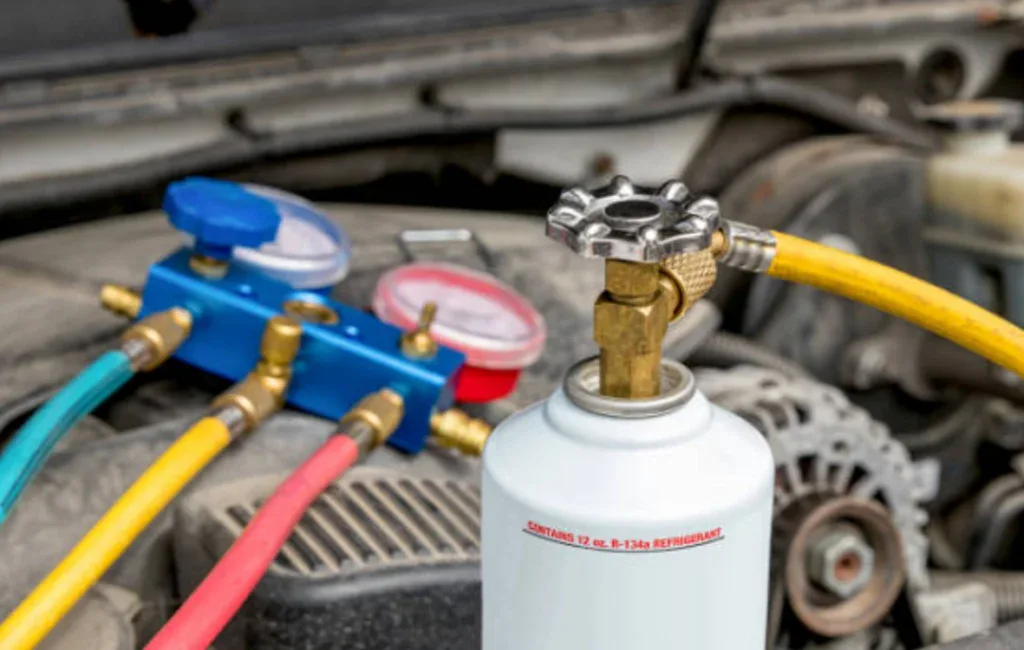
The AC compressor is the most mechanically complex and financially significant component in the vehicle air conditioning system, with replacement costs for light-duty truck and SUV compressors ranging from $400 to over $1,400 for the part alone, and total installed repair costs frequently reaching $800 to $2,500 depending on vehicle type, accessibility, and the additional parts replacement required when a seized compressor sends metal debris through the refrigerant circuit. The compressor’s survival depends entirely on receiving adequate lubrication through the oil circulated in suspension with the refrigerant — and that lubrication is compromised when the refrigerant charge drops below specification due to leak-induced loss. A system that has lost 15% of its refrigerant charge carries proportionally less oil per unit volume of refrigerant vapor, reducing the oil delivery rate to compressor bearing and piston surfaces during operation. The resulting bearing surface oil starvation produces accelerated wear that begins subtly — a slight increase in operating temperature, a barely perceptible noise on clutch engagement — and progresses to catastrophic seizure over weeks to months of continued operation without correction. Annual AC service that detects and corrects refrigerant charge loss before it reaches the oil-starvation threshold is the single most impactful preventive action available for compressor longevity. The service that costs $120 to $200 annually is the insurance policy against the $1,500 to $2,500 repair that follows compressor failure.
In Elizabeth’s working community, the trucks and SUVs whose AC compressors are at stake are not luxury items or weekend vehicles — they are primary professional tools on which people’s livelihoods depend. The farrier whose truck is also the rolling tool storage for a full-time horseshoeing practice; the contractor whose pickup carries the equipment for a fencing or landscaping operation serving Elizabeth’s horse properties; the agricultural supply delivery driver making rounds to Elbert County ranches; the veterinarian whose truck is the clinic for large-animal calls throughout the county — for all of these professionals, an AC compressor failure in July is not a personal inconvenience but a business interruption. An Elizabeth contractor who loses their primary work truck to a compressor failure during the peak of summer construction season — when both the work demand and the heat exposure are at maximum — faces lost revenue, scheduling disruption, and the search for a service facility in a rural area where service availability may not match their timeline. The Grease Monkey at 712 East Kiowa Avenue, part of the FullSpeed Automotive network with 5.2 million annual service experiences informing its protocols, is positioned to intercept compressor failure before it occurs through the systematic annual inspection and charge verification that is the proven preventive standard. In Elizabeth’s working community, that service is not a luxury — it is a practical business investment.
⚙️ Your truck is your livelihood in Elbert County — a failed compressor in July is a business problem, not just a vehicle problem. Protect your most expensive AC component with annual service at Grease Monkey East Kiowa Avenue. The $150 you spend now prevents the $2,000 you don’t want to spend in August. Protect your compressor, protect your income → Grease Monkey Elizabeth
Citation: National Institute for Automotive Service Excellence (ASE), “A7 Heating and Air Conditioning Study Guide,” ASE Education Foundation, 2022; RepairPal, “Car AC Compressor Replacement Cost — Light Duty Trucks and SUVs,” repairpal.com/estimate, 2024.
Reason #11: Optimizing Fuel Economy on Elizabeth’s Long Daily Drives When Every Tank Must Cover More Ground
Category of Importance: Sustained Economic Efficiency for High-Mileage Rural Commuters
Elizabeth residents who commute daily to Parker, Castle Rock, Aurora, or Denver accumulate annual mileage at rates well above the national average — the 35 to 50 miles each way of the typical Elizabeth commute, repeated 250 working days per year, produces 17,500 to 25,000 commute miles annually before accounting for any local, recreational, or errand driving. At these mileage levels, fuel efficiency is not an abstract environmental consideration but a significant monthly household expense, and the AC system’s contribution to fuel consumption — documented by the U.S. Department of Energy at 5% to 25% of total fuel use depending on vehicle type and operating conditions — becomes a meaningful line item. An AC system operating at reduced efficiency due to a refrigerant charge 10% to 15% below specification compensates by running the compressor more frequently and for longer duty cycles to achieve target cooling, consuming additional engine power — and therefore additional fuel — throughout every mile the system is engaged. Over a 90-day summer season of daily 70-mile round-trip commuting in a light truck averaging 20 MPG, a 7% fuel consumption increase from an inefficient AC system represents a real dollar cost that a single annual service appointment would have prevented. At Elbert County’s relatively high fuel prices — rural communities typically pay a premium above metro-area pump prices reflecting supply chain and delivery distance factors — this fuel efficiency premium from proper AC calibration is compounded further.
The fuel economy dimension carries additional significance for the significant proportion of Elizabeth’s commuter population who drive full-size pickups or large SUVs — vehicles selected for the practicality of rural and equestrian life (towing capacity, cargo space, ground clearance) at the cost of base fuel efficiency that makes every percentage of AC-system-imposed consumption increase more financially meaningful than in a compact car. A full-size pickup truck averaging 17 miles per gallon that experiences a 7% fuel consumption increase from an undercharged AC system consumes more additional fuel per commute mile than a hybrid crossover experiencing the same percentage increase. For the Elizabeth truck owner who drives a high-capacity pickup because their lifestyle demands it — regular horse trailer towing, hay hauling, equipment transport — the fuel efficiency return from a correctly calibrated AC system represents a meaningful annual savings that compounds across the typical five to ten year ownership period of a working truck in Elbert County. The precision refrigerant recharge at Grease Monkey East Kiowa Avenue — charging to manufacturer-specified weight using certified equipment rather than by sea-level pressure approximation — restores the system to its minimum-compressor-load operating point and directly returns the fuel economy that imprecise charge management was silently consuming.
⛽ Elizabeth commuters put serious miles on their vehicles — don’t spend those miles paying an AC inefficiency tax. Precision refrigerant recharge at Grease Monkey East Kiowa Avenue puts your fuel economy back where it belongs for the long Highway 86 haul. Reclaim your commuter fuel economy → Grease Monkey Elizabeth
Citation: U.S. Department of Energy, Office of Energy Efficiency & Renewable Energy, “Keeping Your Car Cool Without Killing Your Fuel Economy,” fueleconomy.gov, 2024; Oak Ridge National Laboratory, “Impact of Air Conditioning on Fuel Economy of Current and Future Vehicles,” ORNL/TM-2010/217, 2010.
Reason #12: Protecting Vehicle Interiors from Elbert County’s Exceptional UV Intensity and Open-Plains Solar Loading
Category of Importance: Vehicle Asset Preservation and Long-Term Equity Protection
Elizabeth’s position on the Palmer Divide at 6,480 feet — on terrain that provides no topographic shading and offers full 360-degree solar exposure across every season — creates one of the most intense vehicle interior solar loading environments of any community in the Denver metropolitan orbit. At this elevation, atmospheric UV attenuation is approximately 20% less effective than at sea level, and the high-plains character of the Elbert County landscape means that vehicles parked at residences, in the open parking areas of the Elizabeth town center along Kiowa Avenue, and in the horse property parking areas throughout the county are exposed to direct, unreflected solar radiation without the shading that tree cover, adjacent buildings, or topographic relief provides in more developed communities. Under these conditions, vehicle interiors accumulate radiant thermal energy at rates sufficient to exceed 130°F (54°C) within 30 to 40 minutes of midday summer sun exposure and approach 160°F (71°C) within 90 minutes. At these temperatures, dashboard polymer compounds experience accelerated molecular bond degradation that manifests as surface crazing, brittleness, and cracking at stress concentration points; leather seating surfaces lose plasticizer content and develop the characteristic stiffening and seam cracking that is the most visible marker of chronic heat exposure; factory window tint delamination occurs at adhesive interface temperatures that these solar-loaded vehicles readily achieve; and modern infotainment touchscreen displays experience backlight degradation and pixel failure at sustained temperatures above their maximum operating specifications. A properly functioning AC system that cools the cabin promptly after each solar heat soak reduces cumulative material degradation by limiting the duration and intensity of post-soak temperature exposure at the material level.
The interior preservation argument resonates with particular financial force in a community that invests in well-equipped trucks and SUVs for functional ranch and equestrian use. The Elizabeth vehicle owner who has equipped their truck with a premium leather interior, a trailer brake controller, and an integrated towing package has made a significant investment in a working vehicle that is simultaneously expected to be presentable for family use, capable for the barn run, and visually respectable at the Elizabeth Stampede fairgrounds. A cracked dashboard and faded, split leather seats on a five-year-old truck arriving at the Parker or Castle Rock dealership for a trade-in appraisal are cosmetic signals of interior neglect that experienced used vehicle appraisers quantify as depreciation deductions of several hundred to over a thousand dollars from the offer. For the truck that has been pulling a horse trailer in the full Elbert County sun for five summers with a properly functioning AC system — which cools the cabin promptly after each heat soak event and maintains interior temperatures within the design range of the materials — that damage simply does not occur at the same rate. The annual service appointment that keeps the AC system cooling effectively is, in this light, a slow-motion investment in the truck’s interior condition and its trade-in value five years hence.
🛡️ Six thousand feet on the open plains means your truck interior bakes harder and faster than anywhere in the metro. A properly cooling AC is your dashboard’s and leather’s best protection. Keep your interior investment intact with annual service at Grease Monkey East Kiowa Avenue. Protect your interior at altitude → Grease Monkey Elizabeth
Citation: National Renewable Energy Laboratory (NREL), “Predicting Vehicle Interior Air Temperature Using a Simple Model,” NREL/CP-540-43554, Golden, CO, 2008; SAE International, J1455, “Environmental Guidelines for Mobile Electronic Systems,” SAE International, 2021.
Reason #13: Ensuring Year-Round Defogging and Winter Visibility Safety on Elizabeth’s Rural Roads and Highway 86
Category of Importance: Year-Round All-Weather Visibility Safety
The defogging function of the vehicle AC system — which uses the compressor to dehumidify incoming air before the heater directs it toward the windshield — is a year-round safety capability in Elizabeth that receives inadequate attention because it is invisible when it works and dangerous when it doesn’t. Palmer Divide weather creates persistent morning fog conditions in the Elizabeth area during spring and fall, generated by the temperature inversion patterns that develop overnight when warm air over the high plains is trapped beneath cooler air descending from the Front Range. These inversions produce ground fog and low visibility conditions along the Highway 86 corridor that can persist into mid-morning on spring days when the school commute is underway and the workday drive to Parker and beyond has already begun. For drivers on rural county roads in these conditions — where road edges may be unmarked and the traffic mix includes agricultural equipment whose operators cannot always see approaching vehicles in dense fog — effective windshield defogging is a life-safety capability, not a minor comfort feature. A vehicle whose AC compressor has been rendered inoperative by depleted refrigerant or compressor failure arrives at the fall fog season without this capability, and the driver may not discover the deficiency until they are already underway in zero-visibility conditions on a rural Elbert County road.
Elizabeth’s winter and shoulder-season weather patterns make the defogging-as-AC-function reality particularly consequential for community safety. The Palmer Divide is known for rapid weather transitions: a clear morning can give way to blowing snow within hours during late fall and spring cold fronts that sweep across the high plains with minimal topographic obstruction. Drivers on Highway 86 between Franktown and Elizabeth, or on the county roads connecting south Elbert County to the Elizabeth town center, can encounter abrupt changes from clear road to blowing snow and low visibility that demand an immediately functioning defrost system. When cabin humidity rises rapidly — from wet winter gear, from the body heat and breath of multiple passengers, from snow tracked in on boots — and the outside temperatures are at the level where windshield glass is cold enough to condense that moisture into fog, a defrost system dependent on an inoperative AC compressor cannot clear the glass fast enough to maintain safe visibility. Spring service at Grease Monkey East Kiowa Avenue — when the AC system is confirmed functional for the coming cooling season — simultaneously confirms the defogging capability that serves Elizabeth drivers through every weather transition the Palmer Divide delivers across all four seasons.
🌫️ Palmer Divide fog doesn’t wait for summer — and neither should your defogging system service. A functioning AC compressor is what makes your defrost work when morning fog closes in on Highway 86. Confirm your defogging is ready with spring AC service at Grease Monkey East Kiowa Avenue. See clearly through every Palmer Divide season → Grease Monkey Elizabeth
Citation: NHTSA, “Traffic Safety Facts — Weather-Related Crashes,” NHTSA Technical Report DOT HS 812 585, 2022; Western Regional Climate Center (WRCC), “Palmer Divide Climate and Fog Climatology,” wrcc.dri.edu, 2024.
Reason #14: Supporting Elizabeth’s New and Growing Resident Population in Transitioning Their Vehicles to Elbert County’s Unique Environment
Category of Importance: Community Integration and New-Resident Vehicle Health
Elbert County has been among Colorado’s fastest-growing counties by percentage for over a decade, driven by the appeal of rural character, large lot sizes, equestrian-friendly zoning, and relative affordability compared to the established Denver suburbs. This growth has brought thousands of new residents to the Elizabeth area from communities throughout Colorado and from out of state — many of them arriving with vehicles that have been maintained, calibrated, and evaluated in the service environments of their origin communities rather than the specific conditions of Elbert County. A vehicle last serviced in Lakewood at 5,600 feet, in Fort Collins at 4,984 feet, or in Phoenix, Arizona at 1,086 feet carries an AC system whose refrigerant charge and operational history reflect conditions different from Elizabeth’s 6,480-foot, high-plains, high-dust, high-UV environment. New residents whose vehicles have been performing acceptably in their previous locations may find, in their first Elizabeth summer, that their AC system struggles to maintain cabin comfort under Elbert County’s more demanding solar and thermal conditions — not because the system has failed, but because it was never calibrated for the specific operating environment it now inhabits. A professional AC inspection and altitude-appropriate recharge shortly after arrival in Elizabeth is the most efficient way for new residents to align their vehicle’s performance with its new environment.
The integration of new residents into Elizabeth’s community includes the practical dimension of orienting them to the specific vehicle maintenance realities of high-plains rural Colorado — realities that differ materially from what they may have experienced in their previous communities. The new neighbor who arrives from a Parker subdivision accustomed to a dense service corridor along South Parker Road, where multiple automotive shops competed within a mile of their home, needs to understand that the Grease Monkey at 712 East Kiowa Avenue is their primary professional automotive resource and that the service it provides — backed by FullSpeed Automotive’s 5.2-million-vehicle institutional expertise — is the equivalent of the metro-area professional service they were accustomed to, delivered locally. The new resident from an out-of-state lower-elevation community who managed their own AC refrigerant additions with consumer cans calibrated for sea level needs to understand that Elizabeth’s altitude makes professional weight-based recharge the appropriate approach. Grease Monkey at East Kiowa Avenue is, for new Elizabeth residents, the first and most important professional automotive relationship they establish in their new community — the local experts who know what Elbert County does to vehicles and who are equipped to address it with the training, equipment, and institutional knowledge that the Grease Monkey brand represents.
🏡 Welcome to Elizabeth — your vehicle needs to meet Elbert County’s conditions. New to the area? Get your AC system professionally inspected and altitude-calibrated at Grease Monkey East Kiowa Avenue. Start your Elizabeth chapter with a vehicle that’s ready for what the high plains deliver. Calibrate your vehicle for Elizabeth → Grease Monkey Elizabeth
Citation: Elbert County Planning and Development, “Population Growth and New Resident Migration Trends,” elbertcounty-co.gov, 2023; Colorado Department of Local Affairs, “Elbert County Demographic Summary,” dola.colorado.gov, 2024.
Reason #15: Creating a Verifiable Service Record That Protects Vehicle Value in Elbert County’s Growing and Discerning Real Estate and Vehicle Market
Category of Importance: Long-Term Financial Stewardship and Community Investment
Elbert County’s rapid residential growth has created a secondary vehicle market that reflects the sophistication of the community’s new and established residents — many of them professionals, business owners, and career-focused families who apply the same care to their vehicle purchase decisions that they apply to their real estate transactions. The used vehicle market in and around Elizabeth serves both long-established ranch families upgrading their working trucks and the growing population of newer residents who cycle through vehicles on typical three-to-six-year ownership cycles. In this market, documented service history — particularly from a nationally recognized facility — provides a meaningful transactional advantage that translates to real dollars at point of sale. A vehicle offered for sale by an Elizabeth resident whose glove box holds a complete folder of Grease Monkey service receipts, including dated AC inspection and service records, communicates care and transparency to the Elizabeth-area buyer who is sophisticated enough to ask for and examine that documentation. Conversely, a vehicle with no service records arriving in a small, relationship-driven market like Elizabeth — where sellers and buyers may know each other through the equestrian community, through the Elizabeth Stampede social network, or through the school community — is evaluated with the scrutiny that small-town markets reliably apply to transactions between community members who will continue to interact after the sale is complete.
The financial stewardship dimension of documented AC service in Elizabeth aligns naturally with the community’s broader values of responsible land and property stewardship that are central to Elbert County’s agricultural and equestrian identity. The ranching families who have managed their land and equipment with documented care for generations, the horse property owners who maintain meticulous records of veterinary care, farrier visits, and feed programs for their animals, and the small business operators of Elizabeth’s growing commercial community all understand that good records are a form of demonstrated integrity — and that demonstrated integrity has market value. For these community members, the service record created by annual AC maintenance at Grease Monkey East Kiowa Avenue is consistent with the stewardship values that define their approach to property, animals, and equipment across every dimension of their Elbert County lives. Every Grease Monkey receipt in that folder is, simultaneously, a mechanical maintenance record and a character reference — evidence of the kind of owner this vehicle had, delivered in the universal language of dated professional service documentation backed by a company with the institutional credibility of FullSpeed Automotive’s national scale and reputation.
📋 In Elizabeth’s community market, your service records say something about you — make them say the right thing. Build a documented service history at Grease Monkey East Kiowa Avenue that tells every future buyer this vehicle was cared for by someone who takes stewardship seriously. Build records that reflect your values → Grease Monkey Elizabeth
Citation: Kelley Blue Book, “How Service Records Affect Used Vehicle Resale Values,” kbb.com/car-advice, 2024; Elbert County Assessor’s Office, “Residential Property Valuation and Community Growth Summary,” elbertcounty-co.gov, 2024.
About Grease Monkey at 712 East Kiowa Avenue, Elizabeth, Colorado 80107
Grease Monkey at 712 East Kiowa Avenue is Elizabeth’s premier resource for comprehensive vehicle air conditioning service — including altitude-calibrated refrigerant recharge, UV dye leak detection, electronic refrigerant sniffing, cabin air filter inspection and replacement, evaporator sanitization, condenser fin cleaning, compressor health evaluation, serpentine belt and tensioner inspection, refrigerant line and fitting integrity assessment, and full AC system performance testing. As part of FullSpeed Automotive — the nationally recognized automotive service leader that serviced more than 5.2 million vehicles in 2025 and generates over $542 million in annual revenue — Grease Monkey brings institutional expertise, certified technicians, and documented service protocols to the Elizabeth community. In Elbert County’s unique environment of high-altitude open-plains exposure, equestrian and agricultural working vehicle demands, Highway 86 commuter requirements, and rural service isolation, the depth and credibility of a nationally scaled service brand matters profoundly — and the Grease Monkey team at East Kiowa Avenue delivers that expertise locally, for the Elizabeth community they serve.
Visit us at 712 East Kiowa Avenue, Elizabeth, Colorado 80107 | Schedule your appointment → greasemonkey.com/locations/co/elizabeth/712-east-kiowa-avenue/
Author’s Bio — Phillip Paul Gilliam
Phillip Gilliam is a veteran journalist and former Editor-in-Chief with 50+ years of publishing experience and thousands of published articles. Specializing in automotive, trucking, and digital publishing, he creates authoritative, search-optimized content built on real-world expertise and editorial excellence. To learn more about Phil, visit http://www.phillipgilliam.com/about.html or contact Phil at [email protected]. He would love to hear from you!
Complete Citations and Primary Source Reference List
- Elbert County, Colorado. “Agricultural and Equestrian Community Overview.” elbertcounty-co.gov. 2024.
- American Association of Equine Practitioners (AAEP). “Heat Stress in Horses During Transportation.” aaep.org. 2023.
- Pilcher, J.J., Nadler, E. & Busch, C. (2002). “Effects of Hot and Cold Temperature Exposure on Performance: A Meta-Analytic Review.” Ergonomics, 45(10), 682–698.
- Elbert County Planning and Development. “Residential Growth and Commuter Population Trends.” elbertcounty-co.gov. 2023.
- Car Care Council. “The Cost of Deferred Maintenance vs. Preventive Service.” carcare.org. 2023.
- AAA. “Vehicle Breakdown Response Costs — Rural vs. Urban Comparisons.” AAA Foundation for Traffic Safety. 2023.
- Colorado Department of Public Health and Environment (CDPHE). “Fugitive Dust and Agricultural Particulate in Elbert County.” cdphe.colorado.gov. 2023.
- U.S. Environmental Protection Agency (EPA). “Particle Pollution and Your Health.” EPA-456/F-03-002. Washington, D.C.: EPA, 2023.
- Centers for Disease Control and Prevention (CDC). “Heat-Related Illness — Rural and Remote Environment Risk Factors.” cdc.gov/niosh/topics/heat. 2024.
- Colorado Department of Public Health and Environment (CDPHE). “Rural Emergency Medical Response Times in Elbert County.” cdphe.colorado.gov. 2023.
- SAE International. Standard J2064. “Refrigerant Hose and Fitting Fatigue Under Variable Vibration Conditions.” Revised 2021.
- Gates Corporation. “Serpentine Belt Wear Mechanisms — Heavy-Duty and Rural Application Guide.” gates.com/resources. 2023.
- SAE International Technical Paper 2007-01-0965. “Effect of Altitude on Automotive Air Conditioning System Performance.” SAE International, 2007.
- Mobile Air Climate Systems Association (MACS). “Altitude Compensation in AC System Refrigerant Charging.” MACS Training Reference Manual. Lansdale, PA: MACS, 2023.
- Colorado Division of Fire Prevention and Control. “Wildland-Urban Interface Risk Assessment — Elbert County.” dfpc.colorado.gov. 2023.
- U.S. Environmental Protection Agency (EPA). “Wildfire Smoke — A Guide for Public Health Officials.” EPA-452/R-19-901. Washington, D.C.: EPA, 2019.
- National Safety Council (NSC). “School Transportation Safety — Environmental and Vehicle Factors.” nsc.org. 2023.
- Ramsey, J.D. & Kwon, Y.G. (1992). “Recommended Alert Limits for Perceptual Motor Loss in Hot Environments.” International Journal of Industrial Ergonomics, 9(3), 245–257.
- National Institute for Automotive Service Excellence (ASE). “A7 Heating and Air Conditioning Study Guide.” Leesburg, VA: ASE Education Foundation, 2022.
- RepairPal. “Car AC Compressor Replacement Cost — Light Duty Trucks and SUVs.” repairpal.com/estimate. 2024.
- U.S. Department of Energy, Office of Energy Efficiency & Renewable Energy. “Keeping Your Car Cool Without Killing Your Fuel Economy.” fueleconomy.gov. 2024.
- Oak Ridge National Laboratory. “Impact of Air Conditioning on Fuel Economy of Current and Future Vehicles.” ORNL/TM-2010/217. Oak Ridge, TN: ORNL, 2010.
- National Renewable Energy Laboratory (NREL). “Predicting Vehicle Interior Air Temperature Using a Simple Model.” NREL/CP-540-43554. Golden, CO: NREL, 2008.
- SAE International. Standard J1455. “Environmental Guidelines for Mobile Electronic Systems.” SAE International, 2021.
- NHTSA. “Traffic Safety Facts — Weather-Related Crashes.” NHTSA Technical Report DOT HS 812 585. Washington, D.C.: NHTSA, 2022.
- Western Regional Climate Center (WRCC). “Palmer Divide Climate and Fog Climatology.” wrcc.dri.edu. 2024.
- Elbert County Planning and Development. “Population Growth and New Resident Migration Trends.” elbertcounty-co.gov. 2023.
- Colorado Department of Local Affairs. “Elbert County Demographic Summary.” dola.colorado.gov. 2024.
- Kelley Blue Book. “How Service Records Affect Used Vehicle Resale Values.” kbb.com/car-advice. 2024.
- Elbert County Assessor’s Office. “Residential Property Valuation and Community Growth Summary.” elbertcounty-co.gov. 2024.
- FullSpeed Automotive. “2025 Annual Service Report — Vehicle Servicing Volume and Financial Performance Summary.” FullSpeed Automotive Corporate Communications, 2025.
- Car Care Council. “Vehicle Care Research — The Importance of Annual HVAC System Inspection.” carcare.org. 2023.
This article was produced for Grease Monkey, a brand of FullSpeed Automotive, operating at 712 East Kiowa Avenue, Elizabeth, Colorado 80107. For vehicle air conditioning service, altitude-calibrated refrigerant recharge, equestrian and ranch vehicle AC maintenance, cabin air filtration, condenser cleaning, and comprehensive HVAC inspection, visit greasemonkey.com/locations/co/elizabeth/712-east-kiowa-avenue/.
Content is provided for informational purposes based on cited technical sources. Specifications vary by vehicle make, model, and year. Consult a certified automotive technician for vehicle-specific guidance.
Stop by today.
- Grease Monkey Center #1497 Address: 712 East Kiowa Avenue, Elizabeth, CO, 80107
- Services: Air Conditioning Services, Battery Services, Brake Services, Car Wash Services, Engine Services, Filter Services, Fluid Exchange Services, Headlight Services, Oil Changes, Power Steering, Tire Services, Transmission Services, Wiper Replacement Services
Your car will thank you. And your wallet will too.

Plan Your Visit
Find a location near you, explore current deals, and get everything you need before you roll in.