6 Reasons Jerome's Wind Puts Your Engine Air Filter on the Front Line – I-84 Dust Storms, Clean-Side Clues, Sensor Grit, and the Big Rigs at the Interchange
Location: Jerome, ID Topic: Grease Monkey Center #1510 By: Phil Gilliam
An Authoritative Guide for Engine Air Filter Care Where Magic Valley Wind Meets the Interstate
Grease Monkey, 2703 South Lincoln Avenue, Jerome, ID 83338. Has Over 195 Google Reviews With A 4.6 Star Rating.
A Note on Authority and Expertise: This article was researched and written by Phillip Paul Gilliam, a veteran journalist and former Editor-in-Chief with more than 50 years of publishing experience in automotive, trucking, and safety communications.
Covering trucking for five decades means covering wind, dust, and the interstate, and the way those three combine on the Snake River Plain. This guide draws on news coverage of a deadly I-84 dust storm near Hazelton, a Freightliner service bulletin, heavy-duty filtration guidance from Donaldson, Fleetguard, and Baldwin as reported in the trucking press, a Bosch engineering patent on airflow sensor contamination, peer-reviewed engine wear research, and the 2022 Census of Agriculture. Each claim was checked against its source, and the limits of the evidence are noted where they matter.
The shop at 2703 South Lincoln Avenue is Grease Monkey Center #1510, managed by Chevy Duff and operated by Threshold Automotive as part of the FullSpeed Automotive family [1]. Grease Monkey was founded in 1978 and is headquartered in Denver [2]. FullSpeed reported more than 900 franchised and company-owned locations across its Grease Monkey and SpeeDee brands in July 2026 [3], and CARFAX named 435 FullSpeed centers 2025 Top Shop winners [4].
Jerome sits at about 3,700 feet on the north rim of the Snake River Canyon, with hot, dry summers, cold winters, and what the store calls Magic Valley wind [1]. It is a working county. Jerome County's 448 farms sold more than $944 million in products in 2022, fourth in Idaho, with milk sales ranking third in the state and more than 40,000 acres of hay and forage, 25,000 acres of silage corn, and 17,500 acres of sugar beets [5]. Add Interstate 84, Highway 25, and the truck traffic around the interchange [1], and the engine air filters on Lincoln Avenue face a combination of wind, dust, and miles found in few other places.
An Introduction to Engine Air Filters on Lincoln Avenue and Along the I-84 Corridor
When the wind comes up in Jerome, you can watch it happen. The fields across the county go hazy, the horizon disappears, and dust drifts across Lincoln Avenue and the interstate in long brown sheets. Every car, pickup, and semi on the road pulls that air through an engine air filter, and on the worst days the filter does more work in an afternoon than it does in weeks of calm weather.
Wind is only part of the story, though. In a place this dusty, small things decide whether the engine air filter actually protects the engine: whether the filter is in place at all, whether it seals, whether the sensor right behind it stays clean, whether the last person who changed it dropped dirt into the intake, and whether a big truck's filter is being changed at the right time or the wrong one.
This guide answers six questions Jerome drivers and truckers ask about the engine air filter, starting with what a dust storm does to it and ending with how long-haul rigs at the interchange should be serviced. Each answer begins with a short, direct reply, then explains the engineering and the evidence and what it means on Lincoln Avenue, on I-84, and on the farm roads around the county.
The crew at Grease Monkey on South Lincoln Avenue replaces engine, cabin, and fuel filters, handles diesel and truck oil changes, runs a fleet program, and checks the engine air filter as part of the 16-point inspection that comes with every oil change [1]. Here is what to know.
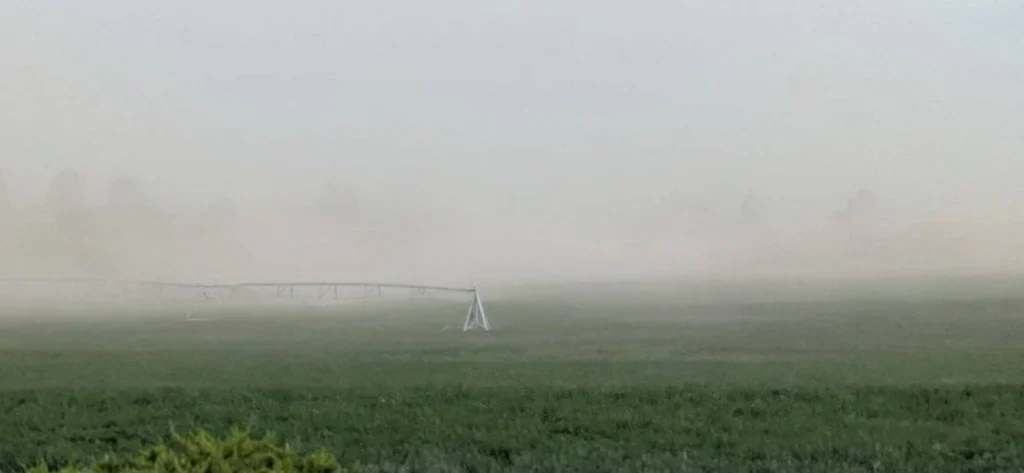
A single afternoon in a Magic Valley Dust Storm can cause havoc for your vehicle’s engine air filter.
1. One Afternoon in a Magic Valley Dust Storm Can Age an Engine Air Filter More Than a Month of Calm Days
What does driving through a dust storm on I-84 do to my engine air filter, and what should I do afterward?
Quick Answer: It can load the engine air filter fast. A dust storm puts far more dust in every breath the engine takes, so the engine air filter can pick up weeks of dirt in a single drive. Have it checked after any trip through blowing dust, and replace it if it is heavily loaded or damaged.
Dust storms on the Snake River Plain are not just a nuisance. On a westbound stretch of Interstate 84 near Hazelton, a sudden dust storm during heavy winds and rain covered the lanes, drivers slowed or stopped in the poor visibility, and six vehicles, including four semi trucks, collided. One man was killed, several people were hurt, and the westbound interstate was closed for five hours [6]. The first and most important rule in a dust storm is about safety, not maintenance: slow down, get well off the road if you can, and do not stop in a travel lane.
Once you are safe, the engine air filter deserves attention. A filter’s restriction does not rise at a steady pace measured in miles. It rises with the amount of dust it collects. Engineers at Cummins Filtration cite a widely used filtration model in which the pressure drop across a dust-loaded filter rises linearly with time and with the concentration of dust in the air [7]. Double the dust in the air and you roughly double how fast the filter loads. In a true dust storm, the concentration can be many times higher than on a normal windy day.
That means a single drive through blowing dust can push an engine air filter much closer to its restriction limit than the odometer suggests. Filtration makers are clear that restriction, not appearance or mileage, decides when a filter is done [8], and a dust storm is exactly the kind of event that makes the calendar meaningless.
A storm can also expose problems that were hiding. Fine, wind-driven dust finds any gap at the filter seal, any crack in an intake hose, and any lid clip that was not fully latched. If the engine air filter comes out looking unevenly loaded, with streaks of dust past its edges, the air box needs a closer look for leaks.
After a dust storm, the practical steps are simple. Have the engine air filter inspected at the next opportunity rather than waiting for the next oil change. If the media is heavily loaded or the truck feels short of power on grades, replace it. And if you drive I-84 through the Magic Valley often, keep an eye on the forecast: a windy, dusty week is the week to plan an engine air filter check.
2. Driving Without an Engine Air Filter, Even ‘Just to the Shop,’ Is a Gamble Jerome Dust Always Wins
Is it safe to drive my vehicle without an engine air filter for a short time?
Quick Answer: No. Without an engine air filter, every bit of dust in the air goes straight into the engine, where it wears rings, pistons, and cylinders and can foul the airflow sensor. Heavy-duty filter makers warn an engine can be ruined in a few hundred miles without proper air filtration. Install an engine air filter first.
It happens more often than people admit. An engine air filter is pulled to be inspected and the box of replacements turns out to be the wrong size. A filter falls apart during a change. Someone takes it out to see whether the truck runs better without it. Then the thought arrives: it is only a few miles to the parts store, so what could it hurt?
Truck makers answer that plainly. Freightliner’s service bulletin for its Donaldson air cleaners warns not to operate the engine with the air cleaner removed, and explains that dirt and dust entering the engine can fuse into an abrasive, glass-like material during combustion that grinds piston rings, pistons, and cylinder liners [9]. In the trucking press, filter maker Baldwin has warned that an engine can be ruined in as few as 500 miles without proper air filtration [10].
The reason is volume. An engine moves an enormous amount of air, and a good engine air filter normally stops about 99 percent of the dust in it. Take the filter away and that 99 percent goes straight into the cylinders. In Jerome’s dry, windy air, that is a lot of grit. Much of it is the fine, hard mineral dust in the 5 to 20 micrometer range that does the most abrasive damage to engine parts [11].
The engine air filter also protects the sensor behind it. On most modern vehicles, the mass airflow sensor sits just downstream of the filter, and dust that reaches it can coat its sensing element and throw off the engine’s fuel calculations, as explained in reason four below. A few miles without a filter can mean a sensor cleaning or replacement on top of the wear the engine took.
If you are ever caught without the right engine air filter, the safer choices are to leave the old filter in place until the new one arrives, have the vehicle towed or wait for the part, or drive only the shortest possible distance on calm, clean pavement and never in blowing dust. The best choice is to confirm the right part before you take the old filter out.
Never let your engine breathe Jerome air unfiltered. If your engine air filter is missing, damaged, or the wrong size, call Grease Monkey, 2703 South Lincoln Avenue, Jerome, ID, and get the right one installed before the next mile: https://www.greasemonkey.com/locations/id/jerome/2703-south-lincoln-avenue/.
3. Reading the Clean Side: What Dust Behind Your Engine Air Filter Is Trying to Tell You
What does it mean if I find dust on the clean side of my engine air filter housing?
Quick Answer: It means dust is getting past the engine air filter instead of through it. The pattern points to the cause: streaks at the edge suggest a seal gap, dust at a hose joint suggests a crack or loose clamp, and a fine film throughout can mean torn media. Find and fix the leak, then replace the engine air filter.
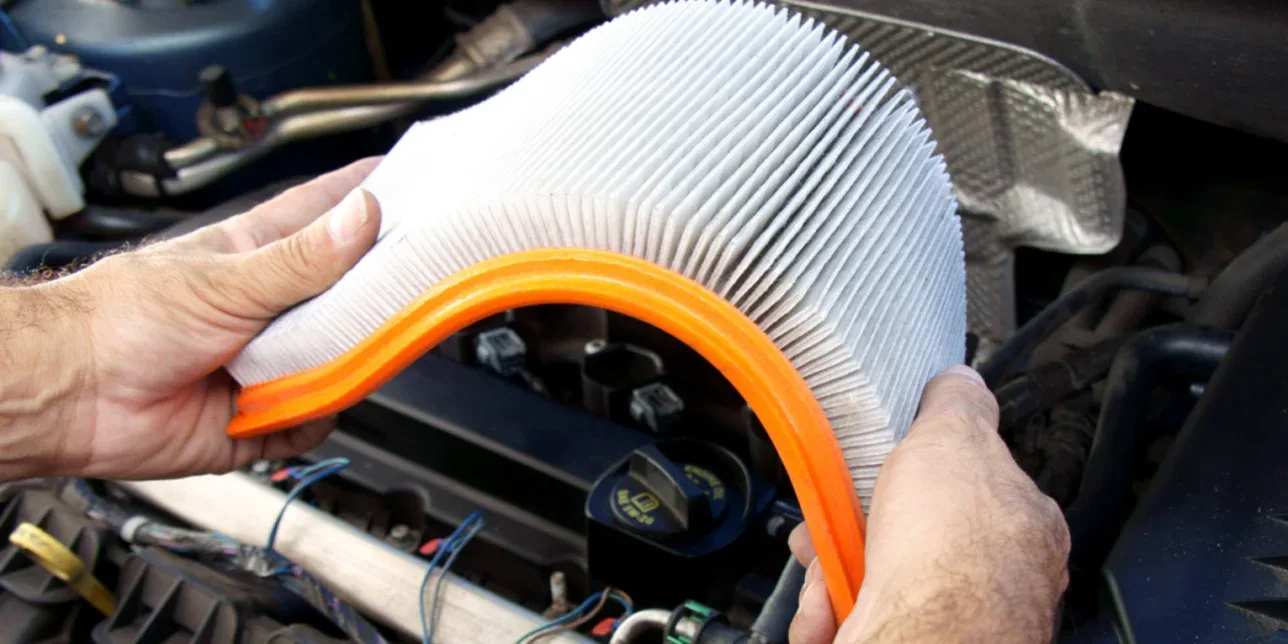
Every engine air filter housing has two sides. The dirty side, where outside air enters, is supposed to look dusty, especially in Jerome. The clean side – the part of the housing and the duct between the engine air filter and the engine – should look like the inside of a new part. When a technician finds dust there, it is one of the most important clues an engine can offer.
Filtration makers treat that clue seriously. Donaldson’s guidance for heavy-duty air cleaners is that dust found on the downstream safety element means the safety element should be replaced and a root cause analysis done to find out how dust got past the primary engine air filter [12]. The same logic applies to any vehicle: dust where it should not be is evidence of a path, and the path has to be found.
The pattern of the dust usually points to the path. Streaks or a ridge of dust along the edge of the housing where the filter seals suggest the seal was not seated, was the wrong shape, or was damaged. Freightliner’s service procedure for Donaldson air cleaners has technicians verify the gap between the seal and its channel at every point, because an improperly seated element can let enough dirt in to damage the engine [9]. Dust concentrated at a joint in the intake duct or around a clamp points to a crack or a loose connection. A fine, even film throughout the clean side can mean torn or damaged media in the engine air filter itself.
Oil analysis can confirm what the eyes suggest. WearCheck engineers note that dust entering through a defective air cleaner or damaged induction system shows up as rising silicon together with top-end wear metals, and they describe a quick leak test used in the field: with the engine idling, the air intake is blocked, and the engine should stall within about three seconds; if it keeps running, air is getting in somewhere else [13].
Whatever the cause, the order of operations matters. Fix the leak first – the seal, the clamp, the duct, or the housing – then clean the clean side carefully so the dust does not get pulled into the engine, and only then install a new engine air filter. Replacing the filter without fixing the path just gives the dust a fresh filter to go around.
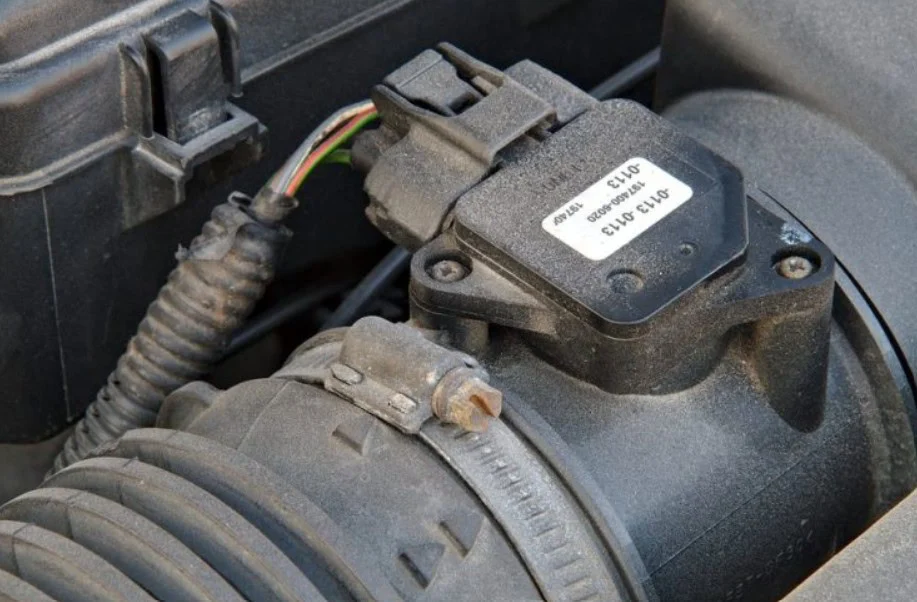
Your Mass Airflow sensor hates dust and airborne contaminants as much as your engine air filter!
4. The Sensor Right Behind Your Engine Air Filter Hates Jerome Dust Even More Than the Engine Does
Can dust get past my engine air filter onto the mass airflow sensor and cause problems?
Quick Answer: Yes. The mass airflow sensor sits just behind the engine air filter and measures every bit of incoming air. Dust that slips past a damaged or poorly sealed engine air filter can coat its sensing element and skew the reading, causing poor running, hesitation, or a check engine light.
On most modern gasoline engines, the first thing air meets after the engine air filter is the mass airflow sensor. It uses a heated wire or film that cools as air flows past, and the engine computer turns that cooling effect into a measurement of how much air is entering the engine. That number decides how much fuel is injected. It is a precise instrument sitting in a dusty air stream, and the engine air filter is its only shield.
Sensor engineers know contamination is a threat. A Bosch patent on reducing contamination of hot-film air-mass sensors describes how oil, water, particles, or salt crystals carried in with the intake air can corrupt the sensor’s output signal briefly or permanently, producing measuring errors [14]. In laboratory testing described in a 2022 review of intake-air pollution, a layer of mineral dust on an airflow meter’s sensing element reduced its output signal by 17.9 percent [11].
A reading that far off matters. If the sensor underreports airflow, the engine computer injects less fuel than the engine needs and the mixture runs lean. Diagnostic guidance from mechanic Vlad Samarin notes that dust or debris can block the sensor’s measuring element, that a contaminated sensor must be checked and cleaned, and that the resulting airflow-sensor codes can come with symptoms such as stalling, hard starting, a lack of power, and an unstable idle [15].
In Jerome, the risk comes mainly from leaks and damage rather than from a healthy filter. A properly sealed engine air filter stops the dust that would reach the sensor. A torn filter, a seal that is not seated, a cracked duct, or a period of driving without a filter lets fine, wind-driven dust land right on the sensing element. Over-oiled reusable filters add a second contaminant, oil, which can make dust stick even more readily.
If your vehicle starts hesitating or sets an airflow-sensor code, have the engine air filter and its seal checked along with the sensor. Cleaning a contaminated sensor with a cleaner made for that purpose can restore it in many cases, but if the engine air filter or the intake path is letting dust through, the sensor will just get dirty again.
5. A Do-It-Yourself Engine Air Filter Change Can Drop More Dirt Into the Engine Than a Month of Driving
What are the most common mistakes people make when changing an engine air filter themselves?
Quick Answer: The big ones are knocking dirt into the intake while pulling the old engine air filter, not wiping out the housing, installing the wrong part, pinching or folding the seal, and leaving a clip or clamp loose. Each one can let dust bypass a brand-new engine air filter.
Changing an engine air filter is one of the easiest jobs on a vehicle, which is exactly why mistakes are so common. It takes a few minutes and few tools, and it is often done in a windy driveway or parking lot. In Jerome, the wind adds its own challenge: an open air box is an open invitation.
Heavy-duty filter makers warn about the first mistake. In guidance reported in the trucking press, Luber-finer cautioned that lifting a loaded element out carelessly can drop dirt into the intake, and advised against pulling elements out just to look at them or rapping them to knock dirt loose [10]. Every time a dirty engine air filter is tipped, twisted, or bumped on the way out, some of what it caught can fall onto the clean side, where the engine will inhale it on the next start.
The second mistake is skipping the cleanup. Before the new engine air filter goes in, the dirty side of the housing should be wiped out with a clean, damp rag, and the sealing surfaces should be clean so the new seal can seat flat. Do not blow the housing out with compressed air while it is open to the engine.
The rest are fit and fastening mistakes. A near-miss part number that is a little short or narrow, a seal that gets folded under as the lid closes, a lid that is not fully seated before the clips are snapped, or a clamp that is left loose on the duct can each leave a gap. Diagnostic guidance notes that when an airflow-sensor problem shows up right after an air filter replacement, the installation itself should be the first thing checked [15].
A careful do-it-yourself change looks like this: work out of the wind if you can, unclip the lid and lift the old engine air filter straight up and out without tipping it, wipe the housing, compare the new filter to the old one, seat it evenly, close the lid without forcing it, latch every clip, and check every clamp. Then glance at the clean side for anything that fell in.
6. The Semis at the Interchange Can Run Hundreds of Thousands of Miles on One Engine Air Filter – Here Is Why
How often should a long-haul semi truck’s engine air filter be changed, and why is it so different from a car?
Quick Answer: Long-haul trucks are best serviced by restriction, not a fixed mileage. Their large heavy-duty engine air filters can last hundreds of thousands of miles in highway service, and pulling them early to inspect can do more harm than good. Change the engine air filter when the restriction indicator says so.
The truck stops and interchange near Jerome see a steady stream of Class 8 tractors running I-84 between Salt Lake City, Boise, and points beyond, along with local freight and dairy haulers. Their engine air filters look nothing like the panel in a pickup. They are large canisters, often with radial seals – molded polyurethane or rubber ends that seal like an O-ring inside the housing [10] – built to hold huge amounts of dust while feeding a big diesel engine.
Because they are built for capacity, their service lives can be startling. In reporting by Overdrive, Donaldson said operators who had been changing heavy-duty engine air filters at 150,000 miles could go 300,000 miles or more before replacing them, and that some of its extended-life filters had passed 400,000 miles in field tests with acceptable restriction [10]. Those are manufacturer claims for highway trucks in relatively clean air, but they show how far a properly sized heavy-duty filter can go.
The tool that makes those intervals safe is the restriction indicator. Fleetguard field engineers advise that fleets which change filters on mileage or hour schedules should rely on restriction indicators to determine the best time to change them [16]. The same reporting notes that a dirty-looking filter may have plenty of life left while a clean-looking one may be clogged, and that pulling elements out to inspect them can drop dirt into the intake [10]. On a big truck, the less often the housing is opened unnecessarily, the better.
Local and regional trucks are a different case. A dairy hauler or feed truck that spends its days on dusty farm roads around Jerome will load its engine air filter far faster than a highway tractor, and the restriction indicator will say so. The rule stays the same: let restriction decide, and buy a quality replacement. Fleetguard’s engineers also warn that a cheap filter can lead to more downtime, towing, and hassle, and that reputable manufacturers build filters to the engine maker’s specifications [16].
For owner-operators and small fleets, the takeaway is to keep the restriction indicator working and readable, log its reading at each service, change the engine air filter when it reaches the limit, and install the new one with care so the seal is fully seated.
Big rigs run on big numbers, but restriction is the one that matters. Bring your truck or fleet to Grease Monkey, 2703 South Lincoln Avenue, Jerome, ID, and let the crew read the indicator before anyone touches the engine air filter: https://www.greasemonkey.com/locations/id/jerome/2703-south-lincoln-avenue/.
About Grease Monkey, 2703 South Lincoln Avenue, Jerome, ID 83338
Grease Monkey Center #1510 is open Monday through Friday from 8:00 AM to 6:00 PM and Saturday from 8:00 AM to 5:00 PM, and is closed Sunday. The shop can be reached at (208) 907-4814, and manager Chevy Duff leads the team [1].
The menu covers conventional, synthetic, and premium oil changes, diesel and truck oil changes, engine, cabin, and fuel filter replacement, fluid exchanges, batteries, A/C, brakes, tires, tune-ups, wipers, serpentine belts, radiator and transfer case service, and wheel balancing, with a 16-point inspection on every oil change. Services carry a limited warranty of three months or 3,000 miles [1].
A national fleet program offers centralized billing with no appointment needed across the FullSpeed network. Discounts are available for military and rideshare drivers, and the lobby offers free Wi-Fi, a coffee station, refreshments, and a window into the service bay. Customers have given this Lincoln Avenue location a 4.6-star rating on Google [1].
Author Information
Author Bio – Phillip Paul Gilliam
Phillip Gilliam is a veteran journalist and former Editor-in-Chief with 50+ years of publishing experience and thousands of published articles. Specializing in automotive, trucking, and digital publishing, he creates authoritative, search-optimized content built on real-world expertise and editorial excellence. To learn more about Phil, visit http://www.phillipgilliam.com/about.html or contact Phil at [email protected]. He would love to hear from you!
Full Citation List
[1] Grease Monkey. Oil Change & Auto Repair, 2703 South Lincoln Avenue, Jerome, ID. Grease Monkey. Available at: https://www.greasemonkey.com/locations/id/jerome/2703-south-lincoln-avenue/. (Center #1510; manager Chevy Duff; operated by Threshold Automotive dba Grease Monkey, part of the FullSpeed Automotive family; address, phone, hours; engine, cabin, and fuel filter replacement; diesel and truck oil changes; fleet program; 16-point inspection; elevation about 3,700 feet, Magic Valley wind and dust, hot dry summers and cold winters; I-84, Highway 25, Snake River Canyon, and the Jerome Flying J; 3-month/3,000-mile limited warranty; rating of 4.6 stars shown with 200 reviews, checked October 10, 2026.)
[5] USDA National Agricultural Statistics Service. 2022 Census of Agriculture County Profile: Jerome County, Idaho. Available at: https://nass.usda.gov/Publications/AgCensus/2022/Online_Resources/County_Profiles/Idaho/cp16053.pdf. (448 farms; $944 million in products sold, 4th in Idaho; milk sales of $519 million, 3rd in Idaho; forage 40,045 acres, corn for silage 25,138 acres, sugar beets 17,530 acres.)
[9] Freightliner. Service Bulletin: Replacing the Engine Air Filter Element, Donaldson Air Cleaner. July 2013. NHTSA. Available at: https://static.nhtsa.gov/odi/tsbs/2013/SB-10053492-3845.pdf. (Do not operate the engine with the air cleaner removed; dirt entering the engine can fuse into abrasive glass-like material that grinds rings, pistons, and liners; an improperly installed element can damage or fail the engine; verify the seal-to-channel gap at all points.)
[10] Overdrive Staff. Clean Air. Overdrive, May 28, 2001. Available at: https://www.overdriveonline.com/business/article/14878425/clean-air. (Baldwin: an engine can be ruined in as few as 500 miles without proper air filtration; Donaldson: operators changing at 150,000 miles can go 300,000 or more, with extended-life filters passing 400,000 miles in field tests; Luber-finer: careless removal can drop dirt into the intake, and elements should not be pulled to inspect or rapped to clean; radial seal filters use molded ends that seal like O-rings; visual inspection is unreliable.)
[11] Dziubak, T., and Dziubak, S.D. A Study on the Effect of Inlet Air Pollution on the Engine Component Wear and Operation. Energies 15(3), 1182, 2022. Available at: https://www.mdpi.com/1996-1073/15/3/1182. (Hard mineral dust grains of about 5-20 micrometers most often cause abrasive wear; a mineral dust layer on an airflow meter's sensing element reduced its output by 17.9 percent.)
[13] Evans, J., and Blevins, G., WearCheck. How to Spot the Signs and Symptoms of Silica Contamination. Machinery Lubrication. Available at: https://machinerylubrication.com/Articles/Print/830?id=830. (Rising silicon with top-end wear metals points to dust entering through a defective air cleaner or damaged induction system; leak test: with the air intake blocked at idle, the engine should stall within three seconds.)
[14] Robert Bosch GmbH. Device and Method for Reducing the Contamination of a Sensor. U.S. Patent 7,487,034. Available at: https://patents.google.com/patent/US7487034. (Hot-film air-mass sensors can be contaminated by oil, water, particles, or salt crystals carried in with intake air, corrupting the output signal briefly or permanently and producing measuring errors.)
[15] Samarin, V. P0101 – Mass Air Flow Sensor Circuit Range/Performance. Samarins.com. Available at: https://www.samarins.com/diagnose/p0101.html. (Dust or debris can block the hot-wire measuring element, which must be checked and cleaned if dirty; symptoms include stalling, hard starting, lack of power, and unstable idle; if problems begin after an air filter replacement, check the installation and the sensor.)
[16] Fleet Equipment. When to Change Your Trucks' Filters (and How to Pick a High-Quality Replacement). Fleet Equipment Magazine. Available at: https://www.fleetequipmentmag.com/change-truck-filters/. (Fleetguard field service engineers: fleets should rely on restriction indicators to decide when to change air filters; cheap filters can lead to more downtime, towing, and hassle; reputable manufacturers build to engine maker specifications.)
We use cookies to improve your browsing experience on our website. By closing this banner or interacting with our site, you acknowledge and agree to our privacy policy.