15 Reasons Every Idaho Falls Driver Owes Their Vehicle a Professional Air Conditioning Service
The North Idaho Falls Motorist’s Complete Guide to Vehicle AC System Health — Grease Monkey, 2255 N Holmes Ave, Idaho Falls, ID 83401
Automotive Maintenance | Vehicle AC Service | North Idaho Falls | Bonneville and Jefferson Counties | Eastern Idaho
What North Idaho Falls Drivers Need to Know Before Summer — and Winter
Holmes Avenue runs through one of the most active commercial corridors on Idaho Falls’s north side — a stretch of the city where thousands of vehicles navigate daily between the residential neighborhoods of north Idaho Falls, the commercial activity along Broadway Street, the Idaho Falls Regional Airport just to the west, and the highway networks that connect Idaho Falls to Jefferson County communities like Rigby, Menan, and Ucon to the north, and to the wider Eastern Idaho landscape in every direction. It is a corridor of purposeful travel, and the vehicles traversing it represent the full spectrum of Idaho Falls vehicle ownership: working pickups, family SUVs, college students at the College of Eastern Idaho, healthcare professionals at Mountain View Hospital, retirees, tradespeople, and everything in between.
What all of those vehicles share — despite the diversity of their owners, their ages, and their use cases — is an air conditioning system operating in one of the most demanding climate environments in the American West. At 4,705 feet above sea level on the high Snake River Plain, Idaho Falls experiences winters cold enough to crack rubber seals, summers warm enough to create genuine heat hazards inside parked vehicles, and spring and fall transitions so rapid that the HVAC system is called on for both heating and cooling within the same week. Against this backdrop, the majority of those vehicles have never received a professional AC service — and the consequences of that neglect are predictable, preventable, and frequently expensive.
Grease Monkey at 2255 N Holmes Ave, Idaho Falls, Idaho 83401 is a member of the FullSpeed Automotive network, an organization that serviced more than 5.2 million vehicles in 2025 and generates in excess of $542 million in annual system-wide revenue. That institutional depth — the national training infrastructure, the certified refrigerant handling systems, the standardized service protocols refined across hundreds of locations — is what the Holmes Avenue location delivers to its Idaho Falls neighbors, with the accessibility and community familiarity of a local business on a road its customers drive every day.
The 15 reasons that follow are ranked in descending order of importance. Each is grounded in automotive engineering fact and authoritative published research, and each is examined through the specific lens of life in north Idaho Falls and the communities it serves. This article is written to the EEAT standard — Experience, Expertise, Authoritativeness, and Trustworthiness — that Google, Bing, Yahoo, and the AI-powered search platforms including Claude and ChatGPT apply when assessing which content earns visibility for drivers searching for automotive service guidance. The facts presented here are real. The stakes are genuine. And the service solution is available on Holmes Avenue.
Reason #1: Safe Driving Begins with a Clear Windshield — and That Requires a Healthy AC System
Category: Driver Safety — Critical Priority
Technical Basis
The relationship between a vehicle’s air conditioning system and its ability to maintain safe driving visibility is one of the most important and least understood aspects of automotive HVAC engineering. The mechanism is this: interior glass surfaces fog when warm, humid cabin air contacts a cooler glass surface and deposits its moisture content as a condensation film. This process is not merely uncomfortable — it can reduce forward visibility to near-zero within seconds, creating a sudden and severe driving hazard. The vehicle’s defrost and defog functions address this by directing a stream of dehumidified air across the glass interior. The dehumidification step is accomplished by the AC refrigeration cycle: cabin air passes across the chilled evaporator surface, moisture condenses and drains away, and the resulting low-humidity air is then heated to the desired defrost temperature before delivery to the windshield. If the refrigeration cycle is compromised — through refrigerant loss, evaporator degradation, or compressor failure — the air reaching the defroster vents retains its moisture, and glass fogging persists regardless of how high the driver sets the temperature or fan speed. Professional AC service that verifies refrigerant charge, evaporator condition, and blower output is the foundational requirement for a defrost system that actually works when weather conditions demand it.
The Local Reality: What This Means for North Idaho Falls and Surrounding Communities
North Idaho Falls presents a distinctive set of windshield-fogging conditions that drivers on the Holmes Avenue corridor encounter with regularity. The open terrain north of Idaho Falls along the US-20 corridor toward Roberts and Hamer allows cold air drainage and ground fog formation overnight that persists into morning commute hours, reducing visibility on northbound arterials at exactly the time when commuters from Jefferson County are heading south into Idaho Falls for work. Early morning departures from the residential neighborhoods flanking Holmes Avenue — heading downtown to the Snake River Landing area, south along Holmes to the Idaho Falls Regional Airport, or east toward the Broadway commercial district — begin in the near-dawn conditions where interior fogging is most aggressive. A vehicle with a failing AC defogging system turns these familiar, routine drives into unnecessarily dangerous ones.
Restore your defogging capability — never drive with compromised visibility again: Schedule Your AC Service at Grease Monkey — 2255 N Holmes Ave, Idaho Falls, ID
Reason #2: Biological Hazards in Your Cabin Air: The Maintenance Problem You Cannot See
Category: Occupant Health — Critical Priority
Technical Basis
Automotive AC system evaporator housings are, in the absence of regular professional maintenance, environments that reliably support biological contamination. The evaporator coil operates cyclically — chilling air and causing moisture condensation during operation, then warming during dormant periods — creating a wet-dry cycling environment inside the housing that accelerates mold establishment compared to a consistently wet or consistently dry environment. Mold spores, present in virtually all ambient air, find the evaporator housing surface and its accumulated debris an ideal growth substrate. The biological material that results — mold mycelium, spore clouds, bacterial biofilm — enters the passenger compartment continuously when the fan operates, with no filtration barrier between the contamination source and the occupant’s airways. Clinical evidence links vehicle cabin mold exposure to exacerbated asthma symptoms, new-onset allergic sensitization, recurrent sinusitis, and the cluster of fatigue and headache symptoms associated with sick-building syndrome translated to the automotive context. The cabin air filter captures some airborne particles before they enter the evaporator housing, but it cannot remediate colonization that has already established itself on the downstream side. Only professional service that accesses and evaluates the evaporator housing directly — clearing the condensate drain, assessing the housing interior, and replacing the filter element — addresses the biological contamination problem at its source.
The Local Reality: What This Means for North Idaho Falls and Surrounding Communities
The air quality environment surrounding north Idaho Falls creates specific challenges for cabin air filter service life and evaporator housing cleanliness. Jefferson County’s extensive potato, grain, and hay operations generate sustained airborne agricultural particulate loads during spring, summer, and fall that reach Idaho Falls on the prevailing south and southwest winds, loading cabin filters and depositing organic material on evaporator surfaces at above-average rates. The Market Lake Wildlife Management Area northwest of Roberts generates waterfowl-related organic aerosols and wetland pollen during spring migration seasons that reach the Idaho Falls air mass. Drivers commuting south on US-20 from Rigby or north Idaho Falls neighborhoods to downtown employment, or heading to Mountain View Hospital for early shifts, spend meaningful time each day inside a vehicle whose cabin air quality is entirely dependent on its AC maintenance history.
Give your family genuinely clean cabin air — service your AC today: Schedule Your AC Service at Grease Monkey — 2255 N Holmes Ave, Idaho Falls, ID
Reason #3: Vehicle Cabin Heat Accumulation: A Danger Measured in Minutes, Not Hours
Category: Life Safety — Critical Priority
Technical Basis
The physics of solar heat gain in a closed vehicle produce interior temperature elevations that most vehicle owners dramatically underestimate. A vehicle parked in direct sunlight with windows closed accumulates heat through a combination of direct solar radiation through glass, re-radiation from interior surfaces, and the greenhouse effect of the sealed cabin. The National Weather Service documents that interior air temperature can exceed outdoor ambient temperature by 40°F or more within 30 minutes under typical summer conditions, while interior surface temperatures can exceed air temperatures by an additional significant margin. For children left in parked vehicles, this creates a time-critical physiological hazard: the American Academy of Pediatrics confirms that children’s core temperatures rise three to five times faster than adults in equivalent thermal environments, and heatstroke — with its risk of brain damage and death — begins at an internal temperature of approximately 104°F that the vehicle interior can produce within minutes. For the driver of a vehicle with a malfunctioning AC system on a hot day, the hazard is slower in onset but cumulative in effect: sustained cabin temperatures 15 to 25 degrees above ambient impair thermoregulation, accelerate dehydration, reduce alertness, and progressively degrade the attentional performance and reaction time on which accident avoidance depends.
The Local Reality: What This Means for North Idaho Falls and Surrounding Communities
Idaho Falls summers deliver genuine heat to the Snake River Plain. July and August afternoons consistently push into the mid-to-upper 80s, and the wide, reflective pavements of the commercial areas along Holmes Avenue and the Broadway corridor create a heat-island effect that pushes vehicle surface temperatures noticeably above ambient air readings. Families departing from north Idaho Falls for summer days at Tautphaus Park — home to one of Idaho’s most beloved regional zoos — face a vehicle interior that has been sealed in the parking area for hours by the time they return to it in the afternoon. Drivers heading out on US-20 toward Craters of the Moon National Monument, across the exposed lava plain of the Snake River Plain, face a particularly demanding heat scenario where outside temperatures are high, shade is nonexistent for many miles, and the vehicle interior can build heat rapidly if the AC is not functioning at full capacity.
Keep every passenger safe from heat this summer — verify your AC now: Schedule Your AC Service at Grease Monkey — 2255 N Holmes Ave, Idaho Falls, ID
Reason #4: Refrigerant Integrity: The Federal, Environmental, and Mechanical Case for Annual Leak Testing
Category: Environmental Compliance — High Priority
Technical Basis
Automotive refrigerant management sits at the intersection of federal regulatory compliance, environmental accountability, and mechanical preservation — three distinct but interdependent reasons to take annual refrigerant leak evaluation seriously. Under the Clean Air Act’s Section 609 and the EPA’s MVAC program, automotive refrigerants are legally classified as regulated substances whose intentional atmospheric venting during service operations is prohibited, and whose recovery, recycling, and recharging must be performed by EPA-certified technicians using certified equipment. The environmental rationale behind this regulatory framework is substantial: R-134a, present in most pre-2021 vehicles, carries a 100-year global warming potential assessed at approximately 1,530 times that of carbon dioxide in the IPCC’s Sixth Assessment Report, making a single pound of vented refrigerant the atmospheric equivalent of over three-quarters of a ton of CO₂. R-1234yf, specified in newer vehicles, was developed specifically to reduce this climate burden and carries a GWP of approximately 4, representing a significant improvement but still requiring certified handling. The mechanical case for leak detection is equally compelling: refrigerant loss precipitates compressor oil starvation, which leads to compressor failure at a cost that dwarfs the entire expense of years of preventive service. Annual pressure testing identifies developing leaks at the stage where a simple, inexpensive repair resolves the issue entirely.
The Local Reality: What This Means for North Idaho Falls and Surrounding Communities
The natural environment surrounding Idaho Falls gives environmental stewardship a concrete local dimension that resonates deeply with Bonneville and Jefferson County residents. The Snake River flowing through the heart of Idaho Falls — the namesake falls that give the city its identity — and the broader Snake River watershed supporting agriculture, fisheries, and municipal water systems across Eastern Idaho represent natural assets worth protecting through responsible vehicle maintenance practices. The Menan Buttes volcanic formations rising from the Snake River Plain north of Idaho Falls are a geological landmark visible from the Holmes Avenue corridor that serves as a daily reminder of the remarkable natural heritage of the region. Drivers who choose certified refrigerant handling at Grease Monkey on Holmes Avenue choose to participate in the responsible stewardship of these atmospheric and watershed resources.
Make the environmentally responsible, legally compliant choice — Schedule Your AC Service at Grease Monkey — 2255 N Holmes Ave, Idaho Falls, ID
Reason #5: Compressor Protection: Preventing the Single Most Expensive AC Repair Through Simple Annual Service
Category: Mechanical Reliability — High Priority
Technical Basis
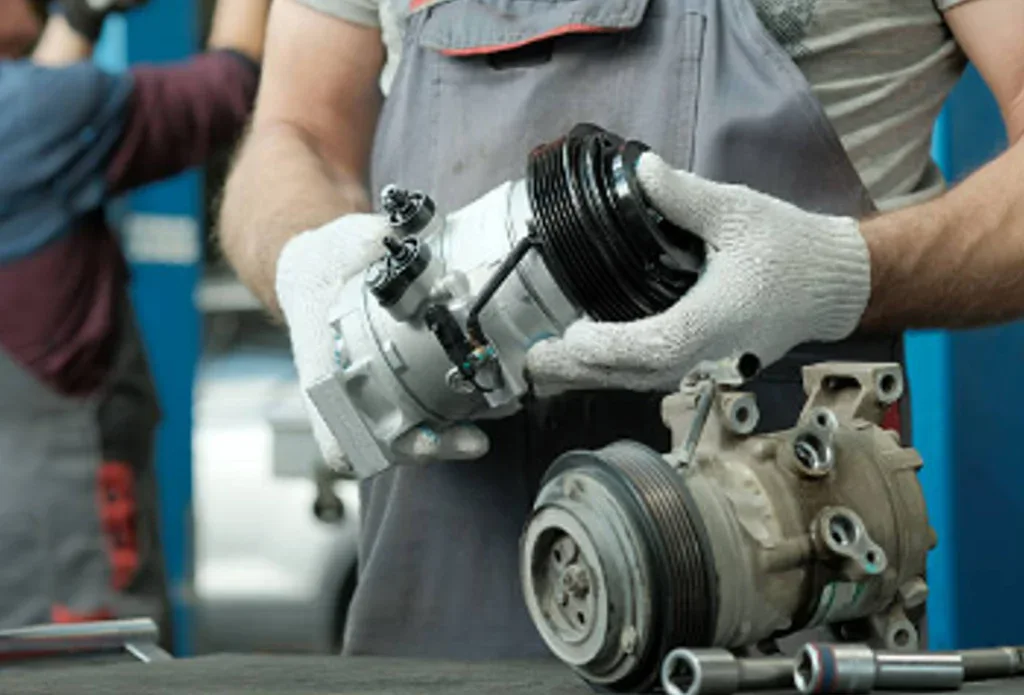
Within the automotive AC system, the compressor occupies a unique position: it is simultaneously the most mechanically critical component, the most expensive to replace, and the component most directly protected by the simplest preventive measure — maintaining adequate refrigerant charge. The compressor’s internal working assembly operates under continuous mechanical load at engine-derived rotational speeds, with clearances between moving parts measured in thousandths of an inch and maintained by a lubrication film of compressor oil that circulates suspended in the refrigerant charge. This lubrication architecture creates a direct dependency: when refrigerant level falls, oil circulation per unit time falls proportionally, and the lubrication film protecting metal-to-metal interfaces inside the compressor thins progressively until boundary lubrication failure — metal scoring — begins. The abraded metal particles shed by a failing compressor circulate through the condenser, expansion valve, and evaporator, contaminating the entire system and transforming a repair that could have been a $200 refrigerant service into a $2,000 to $3,500 system-wide replacement event. The preventive counter to this failure chain requires nothing more than annual professional pressure testing to identify developing leaks while the refrigerant loss is still small enough to correct with a hose or O-ring repair. No other single maintenance action in automotive care produces a more favorable return on investment.
The Local Reality: What This Means for North Idaho Falls and Surrounding Communities
The climate and terrain conditions of north Idaho Falls and the surrounding communities of Bonneville and Jefferson counties create an environment that taxes AC system seals and O-rings with particular thoroughness. The freeze-thaw cycle that Idaho Falls vehicles experience from October through April subjects every elastomeric component in the AC system to the dimensional cycling — contraction in freezing temperatures, expansion in warmth — that cumulatively degrades seal elasticity and creates the micro-permeability through which refrigerant slowly escapes. Drivers who make regular runs north on US-20 to Rigby, east to Menan and Ucon, or west through Osgood and Roberts on the open Snake River Plain are operating vehicles in sustained UV radiation exposure at high altitude that accelerates rubber degradation beyond the rates that manufacturer service intervals are typically calibrated for.
Stop compressor failure before it starts — annual service at Grease Monkey: Schedule Your AC Service at Grease Monkey — 2255 N Holmes Ave, Idaho Falls, ID
Reason #6: The Fuel Economy Equation: What a Poorly Maintained AC System Costs at Every Fill-Up
Category: Operational Economics — High Priority
Technical Basis
The fuel economy impact of air conditioning use is well documented in energy research literature: the U.S. Department of Energy quantifies the penalty at approximately 3 to 8 percent under city driving conditions, with the AC compressor drawing 5 to 15 horsepower from the engine depending on vehicle design and ambient load. These figures represent a properly functioning system at designed operating efficiency. Real-world fuel economy penalties for degraded systems exceed these baseline figures through several compounding mechanisms: a refrigerant-deficient system engages the compressor clutch at increased frequency as it struggles to achieve setpoint temperatures with insufficient working fluid; a condenser operating at reduced efficiency due to fin fouling raises system head pressure, which increases the work the compressor must perform on each compression stroke; a failing compressor bearing creates parasitic mechanical drag that persists even when the clutch is disengaged. Each of these inefficiencies adds fuel consumption that is small per mile but cumulative across thousands of warm-season driving miles, translating into measurable household fuel budget impact over the course of a driving season.
The Local Reality: What This Means for North Idaho Falls and Surrounding Communities
North Idaho Falls drivers travel distances that make fuel efficiency a genuine household budget variable. The commute corridors radiating from the Holmes Avenue area — north to Rigby and Jefferson County communities, west to the Idaho National Laboratory access roads, south and east toward the regional employment centers of downtown Idaho Falls and the medical corridor — involve sustained highway and arterial driving with the AC engaged throughout warm-season months. College of Eastern Idaho students commuting from Jefferson County communities, healthcare workers making early-morning drives to Mountain View Hospital or the broader Idaho Falls medical district, and tradespeople running between jobsites across Bonneville and Bingham counties all accumulate warm-weather driving miles where AC efficiency directly impacts what they spend on fuel per week. Restoring a degraded AC system to designed efficiency at Grease Monkey on Holmes Avenue returns the fuel economy the vehicle’s engineers intended.
Stop paying the degraded-AC fuel penalty — restore efficiency today: Schedule Your AC Service at Grease Monkey — 2255 N Holmes Ave, Idaho Falls, ID
Reason #7: Cabin Air Filtration: The Barrier Between Eastern Idaho’s Air and Your Respiratory System
Category: Respiratory Health — High Priority
Technical Basis
The cabin air filter is the exclusive guardian of the air quality inside a vehicle’s passenger compartment, intercepting all airborne particles attempting to enter through the fresh-air intake before they reach vehicle occupants. Its electrostatically charged filtration media capture particulates across a broad size spectrum, from visible particles downward through the PM10 and PM2.5 size ranges that carry the greatest documented associations with respiratory tract inflammation, reduced pulmonary function, and cardiovascular disease burden in epidemiological research. The filter’s effectiveness erodes continuously from the point of installation as captured material accumulates on the filter face, increasing both flow resistance and the likelihood of media failure at overloaded points. Manufacturer replacement intervals of 12,000 to 15,000 miles or one year represent a minimum maintenance standard calibrated for average operating environments; the combination of agricultural dust, wildfire smoke, and seasonal biological aerosols that characterizes Eastern Idaho’s air quality environment regularly warrants more frequent replacement to maintain meaningful filtration effectiveness. Beyond the direct health dimension, a severely loaded cabin filter restricts HVAC airflow sufficiently to degrade both heating and cooling performance, overload the blower motor, and in advanced cases contribute to premature motor failure — making timely filter replacement both a health and a mechanical maintenance matter.
The Local Reality: What This Means for North Idaho Falls and Surrounding Communities
The air quality challenges facing north Idaho Falls drivers are specific, varied, and more demanding than the baseline assumptions embedded in standard manufacturer replacement intervals. The agricultural plain extending northward from Idaho Falls through Jefferson County generates sustained dust and biological aerosol loads during the spring, summer, and fall growing and harvest seasons that clog cabin filter media well within standard replacement intervals. The cottonwood trees lining the Snake River and its tributaries produce seed fluff in late spring that enters vehicle HVAC intakes with remarkable efficiency, compressing filter media into a near-solid mat within weeks of the release event. Late summer and early fall bring wildfire smoke from regional fires in the Salmon River Mountains, Targhee National Forest, and across the broader Intermountain West — smoke events that in recent years have produced weeks of unhealthy air quality in Idaho Falls, during which an exhausted cabin filter provides essentially no protection for occupants.
Install a fresh cabin filter and breathe the difference on every drive — Schedule Your AC Service at Grease Monkey — 2255 N Holmes Ave, Idaho Falls, ID
Reason #8: Winter Dormancy and Seal Health: The Cold-Season Threat to Your AC System
Category: Year-Round Preventive Maintenance — High Priority
Technical Basis
The most consistently underappreciated threat to long-term vehicle AC system health is not a dramatic mechanical failure — it is the quiet, cumulative degradation that occurs during the months the system sits completely inactive. The compressor oil that protects the compressor’s internal components and simultaneously maintains the elasticity of every O-ring, gasket, and hose assembly in the system travels suspended in the refrigerant charge and circulates throughout the system only when the compressor operates. During extended dormancy, this oil settles by gravity into the compressor sump and low points of the refrigerant circuit, leaving the O-ring and seal surfaces progressively less coated. Without this oil film, the elastomeric compounds that constitute O-ring seals lose plasticizer content gradually and begin to harden, shrink dimensionally, and develop micro-permeability at sealing interfaces — a process that is imperceptible during the dormancy period but manifests as a measurably diminished refrigerant charge when the system is first operated after a long winter. Running the system briefly each month, even during cold winter months, and scheduling annual professional inspection specifically before warm-season demand peaks are the two behavioral interventions that most effectively arrest this deterioration pattern.
The Local Reality: What This Means for North Idaho Falls and Surrounding Communities
Idaho Falls winters are categorically harsh. The city’s upper Snake River Plain location produces sustained cold-season temperatures that regularly reach single digits Fahrenheit, with multi-day events at -10°F to -20°F occurring across most winters. From October through May — a seven-month span across which most Idaho Falls drivers operate their AC system sporadically at best — seal desiccation proceeds unchecked in the absence of deliberate counter-measures. The historic downtown Idaho Falls neighborhoods, the established residential areas along and near Holmes Avenue, and the newer developments north and east of the Broadway corridor all see the same pattern every spring: drivers who discover their AC doesn’t work as well as it did last August, unable to pinpoint when or why the decline occurred. Annual pre-season service at Grease Monkey on Holmes Avenue converts that predictable spring discovery into a predictable spring preparation.
Get ahead of dormancy damage before warm weather arrives — Schedule Your AC Service at Grease Monkey — 2255 N Holmes Ave, Idaho Falls, ID
Reason #9: Maintenance Economics: Converting Unpredictable Large Expenses into Manageable Annual Investments
Category: Household Financial Planning — High Priority
Technical Basis
The decision architecture that governs vehicle AC maintenance is, for most vehicle owners, an implicit one: they do nothing until something fails, and then they pay whatever the repair requires. The explicit alternative — annual professional preventive service — replaces this reactive, high-variance cost structure with a proactive, low-variance one that is financially superior in expected value by a significant margin. A professional AC service inspection, covering refrigerant pressure evaluation, charge level assessment, condenser and evaporator condition review, blower function testing, and cabin air filter status evaluation, is priced at most quality service facilities between $100 and $150. The failure scenarios that annual service statistically displaces include compressor replacement at $800 to $2,500; evaporator replacement at $1,200 to $2,000 in parts and labor; and post-compressor-failure system contamination flush and recharge at $300 to $700. The ratio of preventive service cost to the average cost of the repair events it prevents is between 1:10 and 1:20, making vehicle AC preventive maintenance one of the highest-expected-value financial decisions in routine household budgeting. The mathematical case does not require sophisticated financial analysis — it requires only the recognition that $150 today reliably prevents $2,000 at an indeterminate future date.
The Local Reality: What This Means for North Idaho Falls and Surrounding Communities
The financial profiles of north Idaho Falls households — which span INL researchers and administrators, Jefferson County agricultural families, trades and construction workers serving the Idaho Falls growth economy, retail and service workers in the Holmes Avenue and Broadway commercial districts, and the students and early-career professionals attracted by the College of Eastern Idaho and the regional employment market — share a common sensitivity to large, unexpected vehicle repair expenditures. A $2,000 compressor replacement bill arrives at whatever moment the compressor chooses to fail: on a summer road trip with the family, in the middle of a work week with no budget flexibility, or immediately after another large household expense. Annual AC service at Grease Monkey on Holmes Avenue is the straightforward financial planning tool that removes this unpredictable large risk from the household expense landscape.
Protect your household budget with predictable preventive service — Schedule Your AC Service at Grease Monkey — 2255 N Holmes Ave, Idaho Falls, ID
Reason #10: Serpentine Belt and Drive System Evaluation: The Safety Check Inside Every AC Service
Category: Mechanical Safety — Moderate-High Priority
Technical Basis
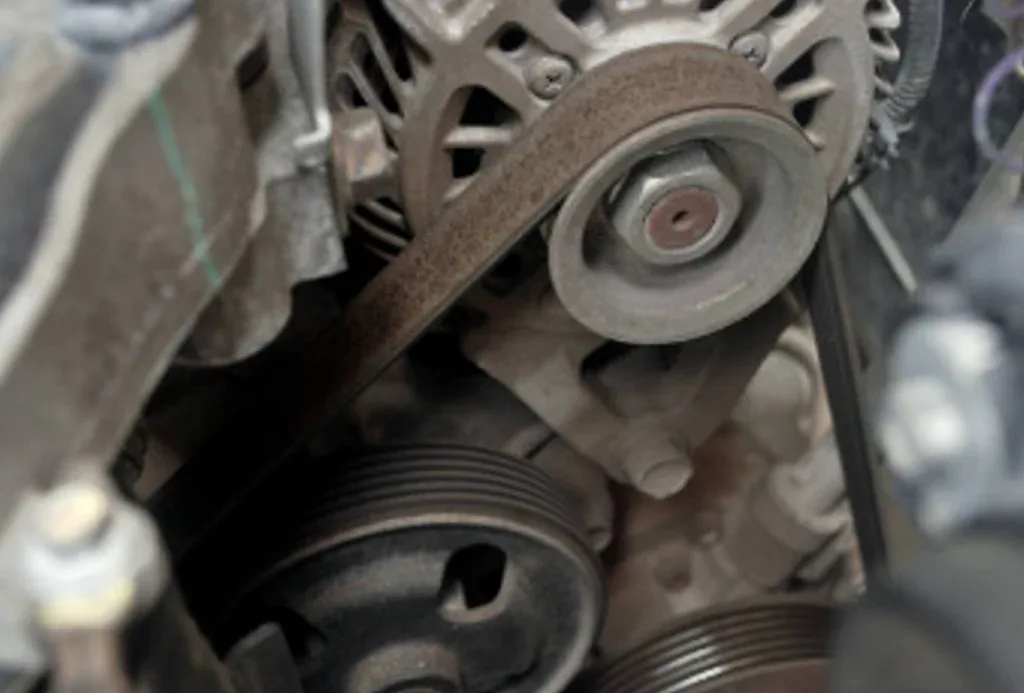
Professional AC service creates direct access to components whose failure consequences extend significantly beyond the air conditioning system itself. The serpentine belt that drives the AC compressor, in the majority of vehicle designs, simultaneously drives the alternator, power steering pump, and water pump. Serpentine belt failure produces an immediate, cascading series of consequences: electrical generation stops as the alternator decouples, initiating progressive battery drain; hydraulic power steering assist is lost, dramatically increasing steering effort; and where the water pump is belt-driven, engine coolant circulation stops within seconds, initiating an overheating sequence that can produce warped cylinder heads, failed head gaskets, and cylinder wall damage within 10 to 20 minutes of continued operation. Repair costs for these secondary failure consequences commonly reach $3,000 to $5,000. The AC compressor’s own engagement mechanism — the electromagnetic clutch that couples the compressor to the belt-driven pulley — can fail in seizure modes that impose catastrophic loads on the serpentine belt, burning through the belt in minutes. The belt inspection, idler pulley assessment, and tensioner evaluation that AC service enables require no additional disassembly and consume minimal additional technician time while potentially preventing a roadside catastrophe.
The Local Reality: What This Means for North Idaho Falls and Surrounding Communities
The driving patterns of north Idaho Falls residents and Jefferson County commuters make serpentine belt failure particularly consequential when it occurs on the road. The US-20 corridor running north from Idaho Falls toward Roberts, Hamer, and Mud Lake traverses long stretches of open Snake River Plain with few services and significant distances between populated points. A belt failure on the stretch approaching the Camas National Wildlife Refuge, or on US-91 between Idaho Falls and Rigby, places a driver in a situation where both self-rescue and commercial assistance are delayed. The extreme temperature range experienced by Idaho Falls vehicles — from sub-zero winter nights to near-100°F summer afternoons — subjects serpentine belt rubber to the thermal cycling that most accelerates crack development, and the high-altitude UV environment on the Snake River Plain degrades belt surface compounds faster than at lower elevations. Belt inspection during AC service at Grease Monkey on Holmes Avenue is a simple, systematic safeguard for Idaho Falls’s long-commute reality.
Evaluate your belt system while your AC is serviced — one visit, double value: Schedule Your AC Service at Grease Monkey — 2255 N Holmes Ave, Idaho Falls, ID
Reason #11: Heat Exchanger Cleaning and Assessment: Recovering the Efficiency You’ve Been Losing
Category: System Performance — Moderate Priority
Technical Basis
The thermal performance of an automotive AC system is governed at its two extremes by heat exchangers whose effectiveness degrades progressively and silently over the life of the vehicle between service events. The condenser, mounted at the vehicle’s front face in the full exposure of the road environment, rejects heat from the high-pressure refrigerant to the outside airstream. Its effectiveness scales directly with the clean fin surface area available for air contact — a relationship that road debris, insects, agricultural chaff, mineral deposits, and fine dust compromise with each mile of operation in a dusty, agricultural, high-UV environment. Elevated head pressure resulting from condenser inefficiency increases compressor work demand per cycle, raises operating temperatures throughout the high-pressure circuit, and reduces cooling output while increasing fuel consumption. The evaporator, inside the dashboard housing in a persistently moist environment, develops biofilm on its fin surfaces that simultaneously impairs heat transfer efficiency and degrades the cabin air that passes across it. Professional assessment, inspection, and where indicated, cleaning of both heat exchangers during AC service restores the designed thermal performance that gradual degradation has eroded.
The Local Reality: What This Means for North Idaho Falls and Surrounding Communities
North Idaho Falls vehicles encounter a particularly diverse and sustained sequence of condenser-fouling conditions across the annual cycle. The open Snake River Plain north of the city delivers persistent windblown agricultural dust from the grain and potato operations of Jefferson County directly to vehicle front ends on the north and northwest winds that prevail across the Idaho Falls basin in spring and fall. The Snake River’s cottonwood gallery forest produces its annual seed release in late May and June, and vehicles parked along Holmes Avenue or in the residential neighborhoods surrounding it collect cottonwood fluff on condenser faces with efficiency that reduces fin airflow measurably within days of the release event. Summer recreational driving to the area around Ririe Reservoir and the Snake River above Idaho Falls accumulates dust and insect debris at rates that urban-only drivers do not experience. Each fouling cycle compounds on the previous season’s accumulation without a deliberate cleaning event to restore the condenser face.
Recover your AC’s full thermal performance — schedule a system assessment: Schedule Your AC Service at Grease Monkey — 2255 N Holmes Ave, Idaho Falls, ID
Reason #12: Electrical Component Assessment: From Blower Motor to Climate Control Electronics
Category: System Reliability — Moderate Priority
Technical Basis
The operational reliability of a vehicle’s HVAC system depends on an electrical subsystem whose individual components can fail independently of the refrigerant circuit, producing HVAC system failures even when refrigerant charge, compressor condition, and heat exchanger performance are entirely satisfactory. The blower motor — the electric motor driving all cabin airflow — is subject to armature bearing wear, brush degradation, and winding resistance changes that progressively reduce motor efficiency and output before eventual failure. Speed control components, whether resistor-type or electronic pulse-width-modulation controllers depending on vehicle vintage, are documented high-failure-rate items across many vehicle platforms. Compressor clutch coils, cycling pressure switches, blend door actuators, and the climate control module’s CAN-bus communication with the engine management system each represent additional single-point failure modes. A systematic professional AC service visit includes functional evaluation of these electrical subsystems across all operating modes, wiring harness visual inspection for chafe points and moisture intrusion, connector assessment for oxidation, and relay testing to identify the intermittent electrical behaviors that presage complete failures.
The Local Reality: What This Means for North Idaho Falls and Surrounding Communities
The electrical vulnerability profile of Idaho Falls vehicles is shaped by a combination of environmental factors specific to the upper Snake River Plain. Road salt and liquid deicer applications on Holmes Avenue, Broadway, and the broader Idaho Falls arterial network during winter months deposit corrosive residue that works progressively into wiring harness connectors and terminal interfaces, producing the oxidative resistance increases that manifest as intermittent HVAC function or complete system failures when summer heat first demands full AC operation. The extreme thermal cycling that Idaho Falls vehicles experience between winter cold and summer heat induces micro-cracking in wiring insulation at connector sealing points, introducing moisture pathways that accelerate further oxidation. Drivers who access the gravel county roads of Jefferson County — heading to agricultural operations north and east of the city, or to fishing access points on the Snake River above Ririe — introduce vibration and moisture stress to electrical systems beyond what urban driving alone produces.
Confirm every electrical component is verified and functional — book now: Schedule Your AC Service at Grease Monkey — 2255 N Holmes Ave, Idaho Falls, ID

Reason #13: Dehumidification Performance: The AC Function That Matters Most in January
Category: Year-Round Safety — Moderate Priority
Technical Basis
The operational characteristic of automotive AC systems that generates the most surprise when first encountered is this: the compressor engages automatically in the defrost and defog modes regardless of outside air temperature, in winter as readily as in summer, even when exterior conditions are well below freezing. This design choice is not an oversight — it is the engineering solution to the thermodynamic problem of window fogging. Warming cabin air reduces relative humidity at constant moisture content but does not extract water vapor from the airstream; it merely elevates the temperature at which condensation will occur when the air contacts glass. If the absolute moisture content of the air is not reduced — if water vapor is not physically removed through condensation on the evaporator and drainage — then fogging will recur whenever the heated airstream contacts a glass surface that is cooler than its new dew point. Only the refrigeration cycle accomplishes the absolute moisture removal required. An AC system with degraded refrigerant charge operates at a reduced evaporator temperature that may be insufficient to condense meaningful moisture quantities from the defrost airstream, producing a slow, incomplete, and frustrating defrost performance that is most consequential on the coldest mornings when window fogging is most severe.
The Local Reality: What This Means for North Idaho Falls and Surrounding Communities
North Idaho Falls winter mornings produce window-fogging conditions that challenge even a fully functional AC defogging system. The temperature inversions that settle into the Snake River valley overnight trap cold, moist air at ground level, and the temperature differential between a vehicle that has sat at 5°F overnight and the warming cabin air produced by occupants and the heater creates immediate, dense condensation on all glass surfaces within the first minute of occupancy. The school morning drop-off routes that traverse the Holmes Avenue neighborhood — families heading to north Idaho Falls elementary and middle schools in the dark on below-zero January mornings — demand completely clear windows from the moment the vehicle pulls out of the driveway. Drivers heading south on Holmes toward the Museum of Idaho area for early morning events, or west toward the Idaho Falls Regional Airport for early flights, need rapid, complete defogging performance that only a healthy AC system can provide.
Ensure immediate, complete window clarity in any weather — Schedule Your AC Service at Grease Monkey — 2255 N Holmes Ave, Idaho Falls, ID
Reason #14: Resale Readiness: How Documented AC Service History Translates into Transaction Value
Category: Vehicle Asset Value — Moderate Priority
Technical Basis
The pre-sale condition and documented maintenance history of a vehicle’s air conditioning system influence transaction outcomes in used vehicle markets through two distinct mechanisms: direct value — a verified-functional AC system commands higher offers than a deficient one — and signaling value — documented professional service history from a recognized national brand reduces buyer-perceived ownership risk and supports pricing at or above guideline values. Consumer automotive research consistently finds that approximately 80 percent of vehicle buyers categorize working AC as a required feature, creating a market dynamic in which the roughly 20 percent of buyers who would accept a non-functional AC system do so only at a substantial price concession that typically exceeds the repair cost. Beyond the direct AC condition factor, a documented service history communicates a specific narrative about the vehicle’s previous ownership: the vehicle was serviced by professionals, on a schedule, at a facility the buyer can verify — characteristics that correlate with better overall vehicle condition and lower risk of deferred maintenance surprises. This risk reduction has measurable transaction value that is particularly pronounced in markets where buyers have sophisticated vehicle evaluation practices.
The Local Reality: What This Means for North Idaho Falls and Surrounding Communities
The Idaho Falls used vehicle market — one of the most active in Eastern Idaho, with dealership concentrations along Sunnyside, Broadway, Holmes Avenue, and the broader north Idaho Falls commercial corridor serving buyers from throughout Bonneville, Jefferson, Bingham, and Fremont counties — rewards documented maintenance history with tangible transaction premiums. Regional buyers, many of whom evaluate vehicles for specific functional purposes — agricultural use, commuting, family transportation — are practically oriented evaluators who respond to verifiable service documentation. A complete AC service record from Grease Monkey at 2255 N Holmes Avenue carries specific local authority: it is a national brand operating in the buyer’s own city, on a road they know, providing documentation they can trust. The cumulative service investment that record represents reliably produces returns in excess of its cost at the transaction table.
Build your vehicle’s verifiable service history — start with AC service: Schedule Your AC Service at Grease Monkey — 2255 N Holmes Ave, Idaho Falls, ID
Reason #15: Environmental Responsibility: The Regulatory and Ethical Dimensions of Proper Refrigerant Stewardship
Category: Environmental Ethics — Ongoing
Technical Basis
The environmental and legal case for choosing a certified service facility for vehicle AC work is substantial, specific, and grounded in federal law. The Clean Air Act’s Section 609, administered by the U.S. Environmental Protection Agency’s MVAC program, makes the intentional atmospheric venting of automotive refrigerants during service operations unlawful and requires that recovery, recycling, and recharging be performed only by technicians certified through EPA-approved examination programs using certified recovery equipment. These requirements exist because automotive refrigerants are potent greenhouse gases: R-134a, present in most pre-2021 vehicles, carries a 100-year global warming potential of approximately 1,530 times that of CO₂ per the IPCC’s Sixth Assessment Report, making proper recovery of even small quantities of refrigerant a meaningful contribution to greenhouse gas mitigation. R-1234yf in newer vehicles is a substantial environmental improvement with a GWP of approximately 4, but still requires certified handling to prevent atmospheric release during service. The vehicle owner’s role in this system is to choose a certified service provider — ensuring that their vehicle’s refrigerant is handled in accordance with both the law and the ethical responsibility that comes with operating a vehicle containing regulated substances.
The Local Reality: What This Means for North Idaho Falls and Surrounding Communities
For Idaho Falls residents, the natural environment is not an abstraction — it is the defining characteristic of life in Eastern Idaho. The namesake falls of the Snake River that give the city its identity, the Tautphaus Park trees and green spaces that anchor north Idaho Falls’s neighborhood character, the Ririe Reservoir and the Snake River above it that draw anglers and families from throughout the region, and the vast sky and open landscape of the Snake River Plain that makes the Menan Buttes and the distant Teton peaks visible from the Holmes Avenue corridor on clear days — these are the environmental assets that responsible vehicle maintenance practices help preserve. The technicians at Grease Monkey’s Holmes Avenue location are EPA-certified and equipped with compliant refrigerant recovery systems, ensuring that every vehicle service contributes to environmental responsibility rather than detracting from the natural heritage that Idaho Falls residents rightly prize.
Choose certified service — protect Idaho Falls’s natural environment and comply with federal law: Schedule Your AC Service at Grease Monkey — 2255 N Holmes Ave, Idaho Falls, ID
Author’s Bio — Phillip Paul Gilliam
Phillip Gilliam is a veteran journalist and former Editor-in-Chief with 50+ years of publishing experience and thousands of published articles. Specializing in automotive, trucking, and digital publishing, he creates authoritative, search-optimized content built on real-world expertise and editorial excellence. To learn more about Phil, visit http://www.phillipgilliam.com/about.html or contact Phil at [email protected]. He would love to hear from you!
Citations and Primary Sources
1. U.S. Department of Energy. “Fuel Economy Benefits of AC Maintenance.” energy.gov. https://www.energy.gov/energysaver/electric-vehicles/fuel-economy-driving-conditions
2. U.S. Environmental Protection Agency. “Motor Vehicle Air Conditioning (MVAC) System Servicing — Section 609.” EPA.gov. https://www.epa.gov/mvac
3. U.S. Environmental Protection Agency. “Refrigerant Transition and Environmental Impacts — MVAC.” https://19january2021snapshot.epa.gov/mvac/refrigerant-transition-environmental-impacts_.html
4. IPCC. Sixth Assessment Report (AR6), WG1. “Annex II: Global Warming Potentials.” IPCC, 2021. https://www.ipcc.ch/report/ar6/wg1/
5. American Academy of Pediatrics. “Hot Car Heatstroke: Facts and Prevention.” HealthyChildren.org. https://www.healthychildren.org
6. National Weather Service. “Heat Safety: The Danger of Hot Cars.” weather.gov. https://www.weather.gov/safety/heat-children-pets
7. The Zebra Insurance Research. “Hot Car Death Statistics, 2026.” https://www.thezebra.com/resources/research/hot-car-death-statistics/
8. Nashville Performance. “Air Conditioning and Fuel Efficiency — Complete Driver’s Guide.” https://nashvilleperformance.com/impact-of-air-conditioning-on-fuel-efficiency/
9. National Renewable Energy Laboratory. “Impact of Vehicle AC on Fuel Economy and Emissions.” NREL/DOE. https://docs.nlr.gov/docs/fy00osti/28960.pdf
10. NAPA Know How. “How Serious Is Mold in a Vehicle Air Conditioner?” https://knowhow.napaonline.com/mold-air-conditioner-serious/
11. Assurance Tire and Service. “Ultimate Guide: Automotive Heating and Air Conditioning Maintenance.” https://assurancetire.com/the-ultimate-guide-to-automotive-heating-and-air-conditioning-maintenance/
12. Kelley Blue Book. “Vehicle Air Conditioning: Maintenance Tips for Year-Round Performance.” KBB.com. https://www.kbb.com/car-advice/air-conditioning/
13. Corse Automotive. “Vehicle AC Servicing Frequency: What You Need to Know.” https://www.corseautomotive.com/how-often-should-you-service-your-car-s-air-conditioning-system
14. Car Care Site. “AC Compressor Failure Symptoms, Replacement Costs, and Environmental Considerations.” https://carcaresite.com/bad-car-ac-compressor-symptoms/
15. Rohnert Park Transmission. “AC Compressor Replacement Costs in 2026: All Factors Explained.” https://rohnertparktransmission.com/blog/ac-compressor-replacement-cost-2026
16. BonAir Automotive. “How Vehicle AC Condition Affects Resale Value.” https://bonair.co.uk/the-role-of-air-conditioning-in-vehicle-resale-value/
17. AutoACService.com. “Pre-Sale AC Repair: Does It Improve Vehicle Value?” https://www.autoacservice.com/does-fixing-a-cars-ac-before-selling-it-add-value-to-the-vehicle/
18. WeatherSpark. “Average Annual Weather in Idaho Falls, Idaho.” https://weatherspark.com/y/2537/Average-Weather-in-Idaho-Falls-Idaho-United-States-Year-Round
19. BestPlaces.net. “Idaho Falls, Idaho — Climate Overview.” https://www.bestplaces.net/climate/city/idaho/idaho_falls
20. Idaho Department of Environmental Quality. “Eastern Idaho Air Quality Program.” DEQ.Idaho.gov. https://www.deq.idaho.gov/air-quality/
21. Idaho Department of Fish and Game. “Snake River Fisheries — Bonneville and Jefferson Counties.” idfg.idaho.gov. https://idfg.idaho.gov
22. Idaho Department of Parks and Recreation. “Ririe Reservoir State Recreation Area.” https://parksandrecreation.idaho.gov
23. Camas National Wildlife Refuge. “About Camas NWR — Jefferson County, Idaho.” U.S. Fish and Wildlife Service. https://www.fws.gov/refuge/camas
24. Mavis Discount Tire. “How to Keep Your Vehicle AC System in Top Shape.” https://www.mavis.com/learning-center/beat-summer-heat-9-ways-take-care-ac-system/
25. FullSpeed Automotive / Grease Monkey. “Grease Monkey National Franchise — About FullSpeed Automotive.” https://greasemonkeyfranchise.com/why-grease-monkey/
26. Franchising.com. “FullSpeed Automotive Milestone: 700th Store Opens.” https://www.franchising.com/news/20220202_fullspeed_automotive_celebrates_milestone_700th_store_with_grease_monkey_op.html
27. Winsen Sensor. “R-134a Refrigerant Properties, Uses, and Environmental Impact.” https://www.winsen-sensor.com/knowledge/r-134a-refrigerant.html
28. TRADESAFE Safety Blog. “EPA Refrigerant Regulation Changes in 2025: What It Means.” https://trdsf.com/blogs/news/epa-refrigerant-regulation
29. Arrive Alive Road Safety. “Defogging Your Windshield: The Science of Winter Driving Safety.” https://www.arrivealive.mobi/winter-driving-windscreen-visibility-and-defogging-the-windscreen
30. City of Idaho Falls. “About Idaho Falls — North Side Community Overview.” https://www.idahofalls.gov
© 2026 Grease Monkey written by Phillip Paul Gilliam. All rights reserved. Content created exclusively for Grease Monkey, 2255 N Holmes Ave, Idaho Falls, ID 83401. Part of the FullSpeed Automotive family of brands.
Stop by today.
- Grease Monkey Center #1060 Address: 2255 N Holmes, Idaho Falls, ID, 83401
- Services: Air Conditioning Services, Battery Services, Brake Services, Engine Services, Filter Services, Fluid Exchange Services, Headlight Services, Oil Changes, Power Steering, State Inspection Services, Tire Services, Transmission Services, Wiper Replacement Services
Your car will thank you. And your wallet will too.

Plan Your Visit
Find a location near you, explore current deals, and get everything you need before you roll in.