6 Reasons Colorado Springs Drivers on Dublin Boulevard Should Rethink the Engine Air Filter – The Pikes Peak Climb, PCS Season, Rideshare Miles, Miller Moths, Oiled Cotton Filters, and the Warning Light After a Filter Change
Location: Colorado Springs, CO Topic: Grease Monkey Center #685 By: Phil Gilliam
An Authoritative Guide for Engine Air Filter Care in the Shadow of Pikes Peak
Grease Monkey, 1702 Dublin Blvd, Colorado Springs, CO 80918. Has Over 700 Google Reviews With A 4.6 Star Rating.
A Note on Authority and Expertise: This article was researched and written by Phillip Paul Gilliam, a veteran journalist and former Editor-in-Chief with more than 50 years of publishing experience in automotive, trucking, and safety communications.
Colorado Springs asks unusual things of a car. Drivers here climb one of the highest paved roads in North America, arrive and leave on military orders, drive for rideshare companies, and share their June evenings with clouds of migrating moths. This guide ties each engine air filter question to evidence: a Colorado State University Extension entomologist, Army and Marine Corps moving-season guidance, Hyundai's published maintenance conditions, an independent ISO 5011 laboratory comparison of paper and oiled cotton filters, two veteran diagnostic writers on lean-condition codes, and reporting from The Gazette. Where the evidence is limited, this guide says so.
The shop at 1702 Dublin Blvd is Grease Monkey Center #685, managed by Austin Thomason and operated by Threshold Automotive as part of the FullSpeed Automotive family [1]. Grease Monkey was founded in 1978 and is headquartered in Denver [2]. FullSpeed, led since November 2025 by CEO Brian Maciak, reported more than 900 franchised and company-owned locations in January 2026 [3], and when the company was sold in 2020 it was already described as the fourth largest quick lube operator in the United States [4].
Colorado Springs is the second most populous city in Colorado, with an estimated 494,743 residents in 2025, and sits at about 6,000 feet at the foot of 14,115-foot Pikes Peak [5]. The area is home to Fort Carson, Peterson and Schriever Space Force Bases, the U.S. Air Force Academy, and Cheyenne Mountain, with nearly 45,000 active-duty troops as of 2021 [5]. The store page describes thin air, steep mountain climbs, sudden snowstorms, summer dust, dry air, and big temperature swings [1]. Every one of those conditions passes through an engine air filter.
An Introduction to Engine Air Filters on Dublin Boulevard and Across the Pikes Peak Region
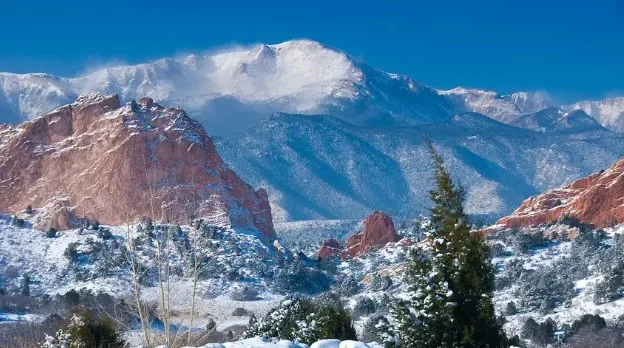
From the Grease Monkey lot on Dublin Boulevard, the view runs west to Pikes Peak. It is a reminder that drivers in Colorado Springs start every trip more than a mile above sea level and can be above 14,000 feet by lunch. That makes the air an engine breathes, and the engine air filter that cleans it, a little more important here than in most cities.
Colorado Springs also has a population that turns over and drives hard. Thousands of military families arrive and leave each summer. Rideshare drivers pile on miles between Chapel Hills Mall, UCCS, downtown, and the airport. And every June, the miller moths pass through on their way to the mountains, sheltering in any dark crack they can find, including the ones in parked cars.
This guide answers six questions Colorado Springs drivers ask about the engine air filter. It starts with the drive to the top of Pikes Peak, moves through moving season, rideshare driving, and moth season, and finishes with two questions about filter choice and installation: whether an oiled cotton filter is a good idea here, and why a warning light sometimes appears right after an engine air filter change. Each answer begins with a short, direct reply, then explains the evidence and what it means in the Pikes Peak region.
The crew at Grease Monkey on Dublin Boulevard checks both the engine air filter and the cabin air filter, replaces engine, cabin, and fuel filters, and offers free engine check diagnostics, with most oil changes completed in about 15 minutes [1]. Here is what is worth knowing.
Going up Pikes Peak for the first time can be a scary experience. It can also be scary for your engine power if you have a dirty engine air filter!
1. Driving to the Top of Pikes Peak? Your Engine Air Filter Matters More at 14,115 Feet Than Anywhere Else You Will Drive
Should I check my engine air filter before driving the Pikes Peak Highway to the 14,115-foot summit?
Quick Answer: Yes. Engines lose power steadily as air thins, and by the summit a non-turbo engine has far less than it does in town. A clean, well-sealed engine air filter keeps restriction from adding to that loss. Check the engine air filter, along with brakes and fluids, before the climb.
For many Colorado Springs families, the drive up Pikes Peak is a rite of passage, and for visiting relatives it is often the first request. The Gazette describes the Pikes Peak Highway as a scenic 19-mile road climbing to a summit of 14,115 feet, with switchbacks that make some drivers nervous and a checkpoint halfway down where rangers check brake temperatures [6]. The road was not fully paved until 2011 [5], and today it is the same route used by the Pikes Peak International Hill Climb each June [5].
The climb is hard on engines because the air gets thinner with every switchback. A common rule of thumb is that a naturally aspirated engine loses about 3 percent of its power for every 1,000 feet of elevation gain [7]. By that rule, an engine that has already given up roughly 18 percent of its sea-level power in Colorado Springs gives up something like 40 percent by the summit. Turbocharged engines compensate better, but they still have to pull more volume through the engine air filter to do it.
That is where the engine air filter comes in. On a steep climb in a low gear, the engine is working near full throttle for long stretches, which is exactly when the engine air filter is the narrowest point in the air path. A loaded filter adds restriction on top of thin air. The car may still make it to the top, but it will feel weaker, work harder on the grade, and leave less reserve for passing a slow vehicle or pulling away from a switchback.
The ranger advice in The Gazette is about brakes and gears, and it is worth following: be familiar with your vehicle’s gears and use them on the way down, because brakes can overheat easily on the descent [6]. The engine air filter matters mostly on the way up. Going down, the engine is coasting against compression and moving little air.
A sensible pre-trip check for the Pikes Peak Highway includes brake condition and fluid, coolant level, tire pressure, and the engine air filter. If the engine air filter is loaded, torn, or poorly sealed, replace it before the drive. It is an inexpensive way to make sure the engine has every bit of air it can get when the air is thinnest.
2. New Orders, New Altitude: Why Military Families Arriving in Colorado Springs Should Reset Their Engine Air Filter Baseline
I just moved to Colorado Springs on military orders. Should I have my engine air filter checked after the drive?
Quick Answer: Yes. A cross-country drive across the plains loads the engine air filter quickly, and Colorado Springs’ dry, dusty, high-altitude driving may call for different intervals than your last duty station. Have the engine air filter inspected soon after arrival and use that visit to set a new baseline.
Colorado Springs is one of the country’s great military towns. The area is home to Fort Carson, Peterson and Schriever Space Force Bases, the U.S. Air Force Academy, and Cheyenne Mountain, and it counted nearly 45,000 active-duty troops as of 2021, with military and defense contractors supplying more than 40 percent of the regional economy [5]. That means a steady stream of families arriving and leaving, with most of the movement in summer. The Army describes moving season as running from June to August and potentially into September [8], and the Marine Corps defined its 2024 peak season as May 15 through August 31 [9].
Many of those families drive their own vehicles to their new station, often across the Great Plains on I-70 or up I-25. Long days at highway speed move a great deal of air through the engine air filter, and summer crosswinds on the plains can carry dust and field debris. A car can arrive at Fort Carson with an engine air filter that has done more work in a week than in several months of commuting back home.
The new station changes the math, too. A family coming from a humid coastal base is moving to a dry, semi-arid city at about 6,000 feet [5], with dust in summer and sand and deicer on the roads in winter. Hyundai’s published maintenance guidance is a useful example of how manufacturers think about this: it calls for replacing the air cleaner filter more frequently when the vehicle is driven on dusty, muddy, unpaved, gravel, or salt-treated roads, or where sand or dust can enter the engine [10]. Training areas, range roads, and dirt parking lots can put a daily driver in exactly those conditions.
That is why the first oil change after a move is a good time to reset the baseline. Have the engine air filter inspected, replace it if the trip loaded it, and note the mileage. Then ask yourself whether your new routine includes gravel roads, dusty parking, or frequent mountain trips, and adjust your engine air filter checks to match.
The same advice applies on the way out. Before a long drive to the next assignment, a fresh look at the engine air filter, tires, and fluids is cheap insurance against a breakdown somewhere between duty stations.
Driving an Uber around the Springs can be financially rewarding, but you will need to check your engine air filters more frequently.
3. Driving for Uber or Lyft Around the Springs? Your Engine Air Filter Hits Its Mileage Limit Months Sooner Than You Think
How often should rideshare drivers in Colorado Springs check or replace the engine air filter?
Quick Answer: More often by calendar, though not necessarily by mileage. Rideshare driving adds miles quickly, so a normal engine air filter interval can arrive in months. Many manufacturers treat taxi-style use as severe service. Have the engine air filter checked at every oil change and follow its mileage limit.
Rideshare driving is a big part of the Colorado Springs economy, and it shows up at the shop. The Dublin Boulevard store lists discounts for Uber and Lyft drivers [1]. Rideshare vehicles live a different life from ordinary commuters: long shifts, many short trips between riders, airport runs, and plenty of time waiting with the engine running. Gridwise, a company that tracks rideshare driving, says drivers using its app log more than 100,000 miles a day across the United States [11].
Manufacturers recognize that commercial driving is different. Hyundai’s list of severe usage conditions includes use as a patrol car, taxi, or other commercial purpose, alongside heavy traffic and frequent stop-and-go driving [10]. Interestingly, Hyundai ties more frequent air cleaner filter replacement specifically to dusty, unpaved, gravel, or salt-treated roads and to conditions where sand or dust can enter the engine, not to taxi use itself [10]. In other words, the engine air filter cares mostly about the air, not about who is riding in the back seat.
The real issue for rideshare drivers is the calendar. A driver who puts on 1,000 miles a week reaches a 30,000-mile engine air filter interval in about seven months. Much of that driving happens in town, where streets are dustier than open highway, and some of it happens on construction detours and gravel lots at venues and trailheads. An engine air filter that would last two years on a commuter car may be due twice a year on a rideshare car.
Rideshare drivers also have a reason to care about the engine air filter beyond engine wear. A restricted filter costs acceleration, which matters when merging onto I-25 or Academy Boulevard with a passenger aboard, and a car that feels sluggish does not help ratings. Since the engine computer usually will not warn you about a clogged engine air filter, a regular visual check is the only reliable way to know.
The simplest system is to have the engine air filter checked at every oil change, which will come often at rideshare mileage, replace it at the mileage limit in the owner’s manual or sooner if it is loaded, and keep the receipts with your mileage log. That record also helps at tax time and when you sell the car.
4. Miller Moth Season Hides in More Than Your Garage – Why June Is a Good Month to Open Your Engine Air Filter Housing
Can miller moths get into my engine air filter housing during the Colorado Springs moth migration?
Quick Answer: Yes. Miller moths hide by day in dark cracks, including openings in parked cars, and some find their way into the air inlet and onto the engine air filter. A few do little harm, but piles of dead moths block media and smell. Check the engine air filter housing after the June flight.
Anyone who has lived in Colorado Springs for a few springs knows the moment: you open the car door on a June morning and a moth flutters out. Colorado State University Extension entomologist Whitney Cranshaw explains that the miller moth is the adult army cutworm, which migrates westward each spring from eastern Colorado and nearby states toward higher elevations to spend the summer feeding on flower nectar [12]. In outbreak years, the flights usually begin between mid-May and early June and last five to six weeks, and the return flight east starts in the latter half of September [12].
The moths travel at night and hide by day in dark, tight spaces. Cranshaw notes that small cracks in the doorways of homes, garages, and cars make perfect hiding spots, and that moths often shelter in vehicles and emerge while cars idle at stoplights, sometimes drawing swallows to busy intersections to feed [12]. Colorado Springs sits right on their route from the plains to the mountains.
The air inlet that feeds the engine air filter is just the kind of dark opening a moth looks for, especially on cars parked outside overnight. Once a moth is inside the housing, the next engine start can pull it against the face of the engine air filter. One or two moths do not matter much. In a heavy year, though, the dirty side of the housing can collect dozens of moths, along with the scales and debris they shed, which blocks part of the filter surface.
Dead moths also bring the problem Cranshaw describes in homes: occasional odor from large die-offs [12]. A mat of decaying insects in a warm air box can leave a stale smell under the hood. And a housing that has collected moths is often collecting other debris, such as cottonwood fluff and leaves, from the same parking spot.
The fix takes a few minutes. After the main June flight has passed, open the engine air filter housing, remove any moths and debris from the dirty side, and look at the filter face. If it is matted or discolored, replace the engine air filter. Check the cabin filter while you are at it, since moths find their way into the ventilation intake, too. Repeat the check after the fall return flight in late September if your car parks outside.
5. Thinking About a Washable Oiled Cotton Engine Air Filter? Here Is What an Independent Lab Test Found Before You Switch
Is a reusable oiled cotton engine air filter a good choice for driving in dusty Colorado Springs conditions?
Quick Answer: It is a trade-off. Oiled cotton filters flow more air, but an independent ISO 5011 test found one passed far more dirt than a paper engine air filter and held less dust. Over-oiling can also foul sensors. In dusty conditions, a quality paper engine air filter usually protects better.
Reusable oiled cotton filters have a loyal following, and the pitch is easy to understand: more airflow, a washable element, and no more buying a new engine air filter every year or two. In a city at 6,000 feet, where drivers already feel down on power, the idea of freeing up a little more air is especially tempting. The question is what you give up in filtration.
An unusually useful independent test addressed exactly that. A Duramax diesel owner arranged for a testing laboratory to run several replacement air filters for his engine through ISO 5011, the standard test for engine air cleaners. According to the published results, the factory-style AC Delco paper filter passed 0.4 grams of dirt over a 60-minute test and accumulated 574 grams, while the K&N oiled cotton filter passed 7.0 grams over a 24-minute test and accumulated 221 grams [13]. An Autoblog summary of the same testing noted that the oiled filter flowed with about half the restriction of the paper filter, but that the difference amounted to roughly a half percent of engine power, and that a filter’s ability to trap dust tends to fall as its flow rises [14].
In plain terms, the paper engine air filter in that test let far less dirt through and held more than twice as much before reaching its limit. The oiled filter flowed more freely, but the power difference was small. In a dusty climate, where the engine air filter’s main job is keeping abrasive grit out of the cylinders, that trade does not favor the oiled filter.
There is a second risk with oiled filters: the oil itself. Veteran mechanic Rick Muscoplat explains that oil-soaked cotton fibers can break away from a reusable filter and stick to the hot wire in the mass airflow sensor, where they burn into a film that makes the sensor under-read airflow and can set a lean code [15]. Over-oiling after cleaning makes that more likely.
If you already run an oiled cotton engine air filter, service it exactly as its maker directs, use only the recommended amount of oil, let it dry fully, and keep an eye on sensor performance. If your priority is engine protection in Colorado Springs dust, a quality paper engine air filter that meets your vehicle maker’s specification is the safer choice.
6. Check Engine Light Right After an Engine Air Filter Change? The Most Likely Culprits Are Under the Lid, Not in the Filter
Why did my check engine light come on right after my engine air filter was replaced?
Quick Answer: Usually because something was disturbed: an intake duct not fully seated, a loose clamp, an unplugged airflow sensor connector, a lid not latched, or an oiled engine air filter fouling the sensor. Air leaking in after the sensor can set a lean code. Have the engine air filter housing rechecked first.
It is one of the more confusing experiences in car ownership. You replace the engine air filter, or have it replaced, and a day later the check engine light comes on. It is natural to blame the new filter. In most cases, the filter is not the problem. Something around it was disturbed during the change.
The engine computer depends on knowing how much air enters the engine. On most cars, the mass airflow sensor sits just downstream of the engine air filter and measures every bit of air headed for the throttle. Rick Muscoplat explains that if there is a leak in the duct between the airflow sensor and the throttle body, air bypasses the sensor, the computer’s fuel calculation is thrown off, and the engine runs lean; he calls that the number one cause of lean codes, and notes that even a tiny split in an intake boot can set one [15].
Diagnostic writer Vlad Samarin lists intake leaks first among the causes of the common lean code P0171, notes that a cracked intake boot is a frequent culprit, and suggests confirming that the air filter box is properly closed as part of the diagnosis [16]. He adds that a lean condition can make the engine lack power, idle rough, or even stall at a stop [16]. Colorado Springs’ dry air and strong sun are hard on rubber, so an old intake boot can crack when it is flexed during an engine air filter change.
The usual suspects after a filter change are easy to check. Is the duct between the housing and the throttle fully seated, with its clamp tight? Is the airflow sensor’s electrical connector plugged in and latched? Are all of the housing clips closed so the lid sits evenly? Is the new engine air filter the correct part, sitting flat in its groove? And if an oiled filter was installed, could excess oil have reached the sensor [15]?
If the light comes on after any engine air filter work, do not ignore it. Have the codes read, and start the inspection at the air box before replacing sensors or other parts. The Dublin Boulevard shop offers free engine check diagnostics [1], which is a good first step.
A new engine air filter should end problems, not start them. If your light came on after a filter change, bring it to Grease Monkey, 1702 Dublin Blvd, Colorado Springs, CO, for free engine check diagnostics and an air box once-over: https://www.greasemonkey.com/locations/co/colorado-springs/1702-dublin-blvd/.
About Grease Monkey, 1702 Dublin Blvd, Colorado Springs, CO 80918
Grease Monkey Center #685 is open Monday through Friday from 8:00 AM to 6:00 PM and Saturday from 8:00 AM to 5:00 PM, and is closed Sunday. The shop can be reached at (719) 695-4453, and manager Austin Thomason leads the team [1].
The menu covers conventional, full synthetic, advanced and European synthetic, and premium synthetic oil changes, truck and diesel oil changes, a 16-point inspection, engine, cabin, and fuel filter replacement, free engine check diagnostics, throttle body cleaning, PCV valve inspection, tune-ups, wipers, wheel balancing, transfer case service, tires, serpentine belts, radiator service and fluid exchange, battery, brake, A/C, headlight, power steering, and transmission services, state inspections, pre-purchase inspections, and fleet services. Services and products carry a limited warranty of three months or 3,000 miles [1].
Walk-ins are welcome and most oil changes take about 15 minutes. The shop lists discounts for first responders, law enforcement, military, seniors, students, and Uber and Lyft drivers, and the lobby offers cable TV, a coffee station, free Wi-Fi, outdoor seating, and a window into the service bay. Customers have given this Dublin Boulevard location a 4.6-star rating across more than 700 Google reviews [1].
Author Information
Author Bio – Phillip Paul Gilliam
Phillip Gilliam is a veteran journalist and former Editor-in-Chief with 50+ years of publishing experience and thousands of published articles. Specializing in automotive, trucking, and digital publishing, he creates authoritative, search-optimized content built on real-world expertise and editorial excellence. To learn more about Phil, visit http://www.phillipgilliam.com/about.html or contact Phil at [email protected]. He would love to hear from you!
Full Citation List
[1] Grease Monkey. Oil Change & Auto Repair, 1702 Dublin Blvd, Colorado Springs, CO. Grease Monkey. Available at: https://www.greasemonkey.com/locations/co/colorado-springs/1702-dublin-blvd/. (Center #685; manager Austin Thomason; operated by Threshold Automotive dba Grease Monkey, part of the FullSpeed Automotive family; address, phone, hours; engine, cabin, and fuel filter replacement; checks both engine and cabin air filters; free engine check diagnostics; throttle body cleaning; oil changes in about 15 minutes; discounts for military, Uber and Lyft drivers, and others; 3-month/3,000-mile limited warranty; elevation over 6,000 feet, thin air, steep climbs, sudden snowstorms, summer dust, dry air; current Google rating of 4.6 stars from 720 reviews, checked October 11, 2026.)
[5] Wikipedia contributors. Colorado Springs, Colorado. Wikipedia. Available at: https://en.wikipedia.org/wiki/Colorado_Springs,_Colorado. (Second most populous city in Colorado; 2025 estimate 494,743; elevation about 6,000 feet; Pikes Peak 14,115 feet; Pikes Peak Highway fully paved in 2011; Pikes Peak International Hill Climb; Fort Carson, Peterson and Schriever Space Force Bases, U.S. Air Force Academy, Cheyenne Mountain; nearly 45,000 active-duty troops as of 2021; military and contractors more than 40 percent of regional economy; semi-arid climate.)
[6] Hayes, K. The Drive to Pikes Peak's Summit: Switchback Roads, Nervous Drivers and Helpful Rangers. The Gazette, March 10, 2023. Available at: https://gazette.com/?p=1207752. (19-mile Pikes Peak Highway; summit 14,115 feet; switchbacks; rangers check brake temperatures halfway down; brakes can overheat on the descent; be familiar with your vehicle's gears.)
[7] THE SHOP Staff. Turbocharging at Elevation. THE SHOP magazine, December 17, 2019. Available at: https://theshopmag.com/news/turbocharging-elevation/. (As a general rule, a naturally aspirated engine loses about 3 percent of its power for every 1,000 feet of elevation gain.)
[10] Hyundai Motor America. Maintenance Under Severe Usage and Low Mileage Conditions. Hyundai owner's manual (2024). Available at: https://ownersmanual.hyundai.com/full_webhelp/MX5aHEV/2024/en_US/topic_kwy_byh_lwb.html. (Air cleaner filter: replace more frequently under conditions C (dusty, muddy, unpaved, gravel, or salt-treated roads) and E (sand or dust entering the engine); severe conditions also include heavy traffic, mountain roads, stop-and-go driving, and use as a patrol car, taxi, or other commercial purpose.)
[11] Gridwise. How Much Do Rideshare Drivers Make? Gridwise. Available at: https://gridwise.io/how-much-do-rideshare-drivers-make. (Rideshare drivers in the United States log more than 100,000 miles per day using Gridwise.)
[12] Cranshaw, W.S. Miller Moths. Colorado State University Extension, July 2014. Available at: https://extension.colostate.edu/resource/miller-moths/. (Miller moth is the adult army cutworm; spring flights westward from eastern Colorado and neighboring states to higher elevations; flights start mid-May to early June and last five to six weeks; return flights begin late September; small cracks in homes, garages, and cars are hiding spots; moths shelter in vehicles and emerge at stoplights; occasional odor from large die-offs.)
[13] Spicer, A., with Testand Corp. Air Filter Test (ISO 5011) for GM Duramax Diesel Filters. Bill's Web Space. Available at: https://billswebspace.com/AirFilterTest.htm. (ISO 5011, formerly SAE J726; AC Delco passed 0.4 g of dirt over 60 minutes and accumulated 574 g; K&N passed 7.0 g over 24 minutes and accumulated 221 g.)
[14] Autoblog. How Well Do K&N Air Filters Work? Autoblog, September 7, 2005. Available at: https://www.autoblog.com/2005/09/07/how-well-do-k-n-air-filters-work/. (ISO 5011 testing of Duramax replacement filters; a filter's ability to trap dust is inversely proportional to its flow rate; paper filter far superior in filtering; K&N about 50 percent less restriction, worth roughly 0.5 percent power.)
[15] Muscoplat, R. Fix P0171 Code and P0174 Code. Rick's Free Auto Repair Advice, January 6, 2018, updated 2026. Available at: https://ricksfreeautorepairadvice.com/fix-p0171-code-p0174-code/. (A leak in the duct between the MAF and throttle body lets air bypass the sensor and is the number one cause of lean codes; a tiny split in an intake boot can set P0171/P0174; oil-soaked cotton fibers from reusable oiled filters can stick to the MAF hot wire and cause under-reading.)
[16] Samarin, V. Code P0171 – System Too Lean: Symptoms, Causes, Common Problems, Diagnostic. Samarins.com, updated July 10, 2021. Available at: https://www.samarins.com/diagnose/p0171.html. (Intake leaks listed first among causes; a cracked intake boot is a common cause; confirm the air filter box is closed; symptoms include lack of power, rough idle, and stalling at a stop.)
We use cookies to improve your browsing experience on our website. By closing this banner or interacting with our site, you acknowledge and agree to our privacy policy.